
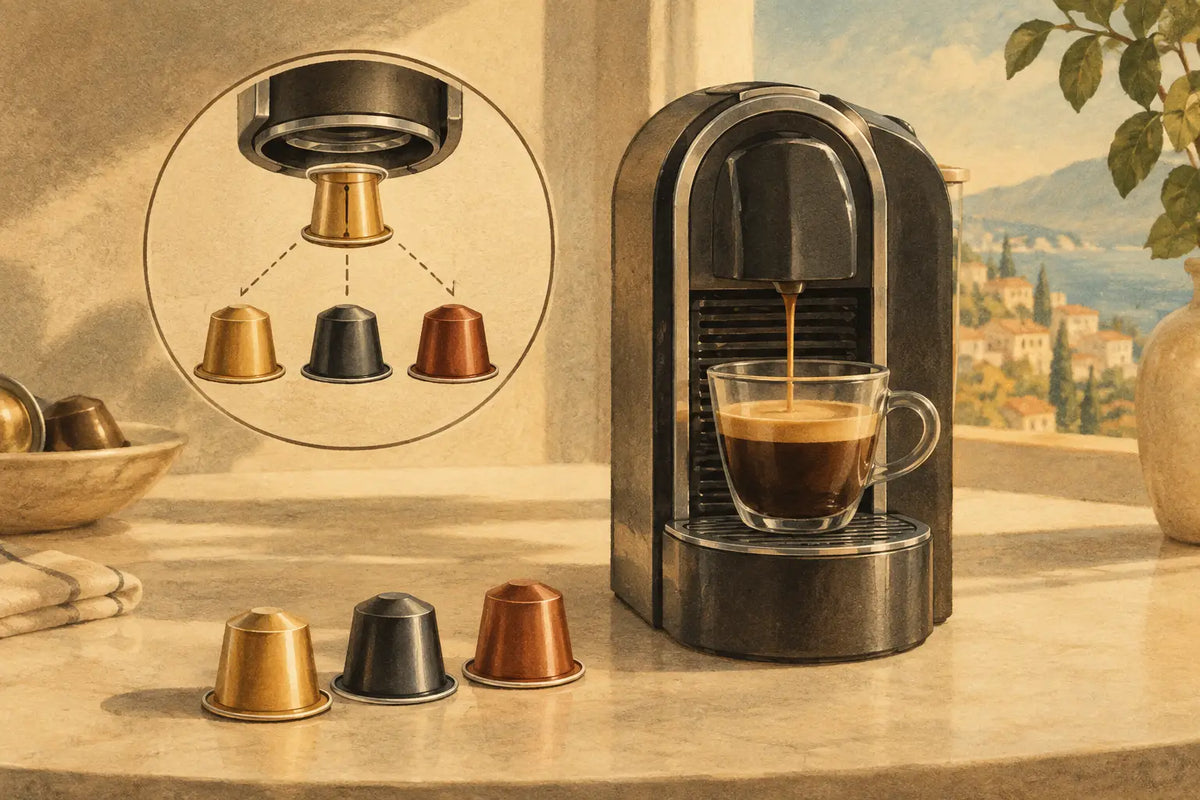
Your morning doesn't start with a technical manual. You drop in a capsule, press espresso and expect your machine to simply do its job. Yet machine compatibility is exactly where things often go wrong: a capsule can look like it fits, but only under pressure, heat and water does it become clear whether it was truly made for your system.
With capsule coffee, compatibility isn't a detail on the packaging. It determines whether the water flows properly through the capsule, whether the crema is right, whether the machine ejects the capsule cleanly and whether your appliance isn't put under unnecessary strain. Especially when you choose a capsule material other than aluminium or conventional plastic, you want to know what sits behind the word “compatible”.
What machine compatibility really means
A capsule and a machine form a single system together. The machine pierces the capsule, builds up pressure and sends hot water through the coffee. The capsule has to respond just right at each of those moments. Not too soft, or it may deform. Not too stiff, or the machine's piercing or sealing can struggle.
It starts with the shape. The diameter, height, rim and base have to match the capsule holder. A millimetre of difference can already affect the seal. Then comes the material's resistance. During extraction a capsule faces heat, pressure and moisture. The material has to stay stable, without blocking the water flow or tearing open in an uncontrolled way.
The coffee itself matters too. The grind, dose and compactness determine how much resistance the water meets. A capsule can fit mechanically yet still give a slow or watery extraction when its contents aren't tuned to the system. So machine compatibility isn't only about whether the capsule fits inside. It's about whether the whole extraction works as intended.
An example of machine compatibility: Nespresso Original
A clear example of machine compatibility is a capsule developed for Nespresso Original machines. That system has a recognisable capsule format and a specific way of perforating and extracting. Capsules for this system aren't automatically suitable for every capsule appliance, even when they look similar at first glance.
If you have a Nespresso Original machine, there are three practical signals to watch for. The capsule should drop into the holder without being pushed. The lever should close with normal, controlled resistance. And after brewing, the used capsule should land neatly in the collection bin. One deviation isn't necessarily a problem, but repeated forcing is.
Don't confuse Nespresso Original with other capsule platforms. Some machines work with larger capsules, others use a different perforation or brew via a different technical principle. A brand's name therefore tells you less than the exact system and model. Always look for the label that says compatible with Nespresso* Original, not just a general claim like suitable for capsule machines.
Why the material has to pass the technical test
Aluminium was the default choice for capsules for a long time because it behaves predictably in machines. But predictable isn't the same as unimprovable. The capsule category stood remarkably still for decades, while users now expect more from what they throw away every day.
Q Drinks chooses capsules made largely from coffee - coffee chaff with an organic binder. That calls for engineering, not a nice story. A new material has to handle the same practical discipline as a traditional one: seal well, stay stable during extraction and perform consistently in a Nespresso Original machine.
And there's the nuance. A capsule made from coffee doesn't behave the same as aluminium by definition. The wall thickness, the rim, the pressure resistance and the way the material reacts to heat all have to be deliberately designed and tested. So compatibility isn't a marketing sticker you add afterwards. It's a product choice from the very first shape.
For the user, it should mostly just feel calm. Capsule in. Coffee out. No fuss with adapters, no doubt about a jamming lever. The technology can stay in the background, as long as it does its job.
Compatible doesn't mean every result is identical
Anyone switching from an aluminium capsule to a capsule made of another material sometimes expects everything to be one-to-one the same. That isn't always realistic, and it isn't necessary either. The quality of an espresso is shaped by more than the outside of the capsule: roast, origin, grind, recipe, water temperature and the state of your machine all play a part.
A short espresso, for instance, calls for a different balance than a lungo. With an espresso you want concentrated body and a neat crema. With a lungo an even flow matters more, so the coffee doesn't turn thin or harsh. A capsule that's technically compatible should leave room for those differences without the machine responding unpredictably.
Machines also differ from one another. A new appliance can seal slightly differently than one used daily for years. Limescale, a full capsule bin or coffee residue around the capsule holder can affect performance. If a capsule unexpectedly closes with difficulty or the flow is off, look at maintenance and placement first before concluding the capsule doesn't fit.
How to check compatibility without guesswork
Start with your machine, not with the design of the capsule box. Check which system you have at home and, if needed, look up the model on the bottom or back of the appliance. If you have a Nespresso Original machine, choose capsules that are explicitly designed for Nespresso Original.
Then try the capsule without force. A little resistance when closing can be normal, but a lever you have to press hard is a signal to stop. Pull one espresso and watch the flow. A consistent stream, a normal brew time and a capsule that's ejected cleanly afterwards tell you more than a general product promise.
Getting a slow flow? Descale your machine following the manufacturer's instructions and clean the capsule holder. If the problem persists, stop using that capsule in that machine. Compatibility should give comfort, not improvisation.
The waste question belongs to the compatibility question
A capsule that works well but leaves a long-lasting material problem behind feels less and less like progress. At the same time, sustainability only has value when it's practical. A capsule shouldn't have to choose between brewing well and a better material. It should do both.
According to Wageningen University & Research in 2023, a compostable capsule, when it's actually composted, can reach around 100% circularity. Aluminium capsules reach 61% at best, with about 48% as the typical picture. Conventional plastic capsules sit around 23%. That difference isn't an abstract green story, but about what happens after your espresso is finished.
For Q Drinks capsules there is one practical rule: they're fully compostable in the Dutch GFT (organic waste) stream, but not every municipality accepts coffee capsules in the GFT bin. So check your local waste guide. A good material deserves a good route after use too.
Choose by system, not by assumption
Machine compatibility is the kind of detail you only miss when it's wrong. A capsule that doesn't seal properly, an espresso that only half flows through or a machine you have to force: no one is waiting for that, certainly not before seven in the morning.
So choose capsules that explicitly belong to your system, that are technically developed for the pressure and perforation of your machine, and that are honest about the material they're made from. Then capsule coffee stays what it should be: fast, good and considered. Don't just drink. Think.