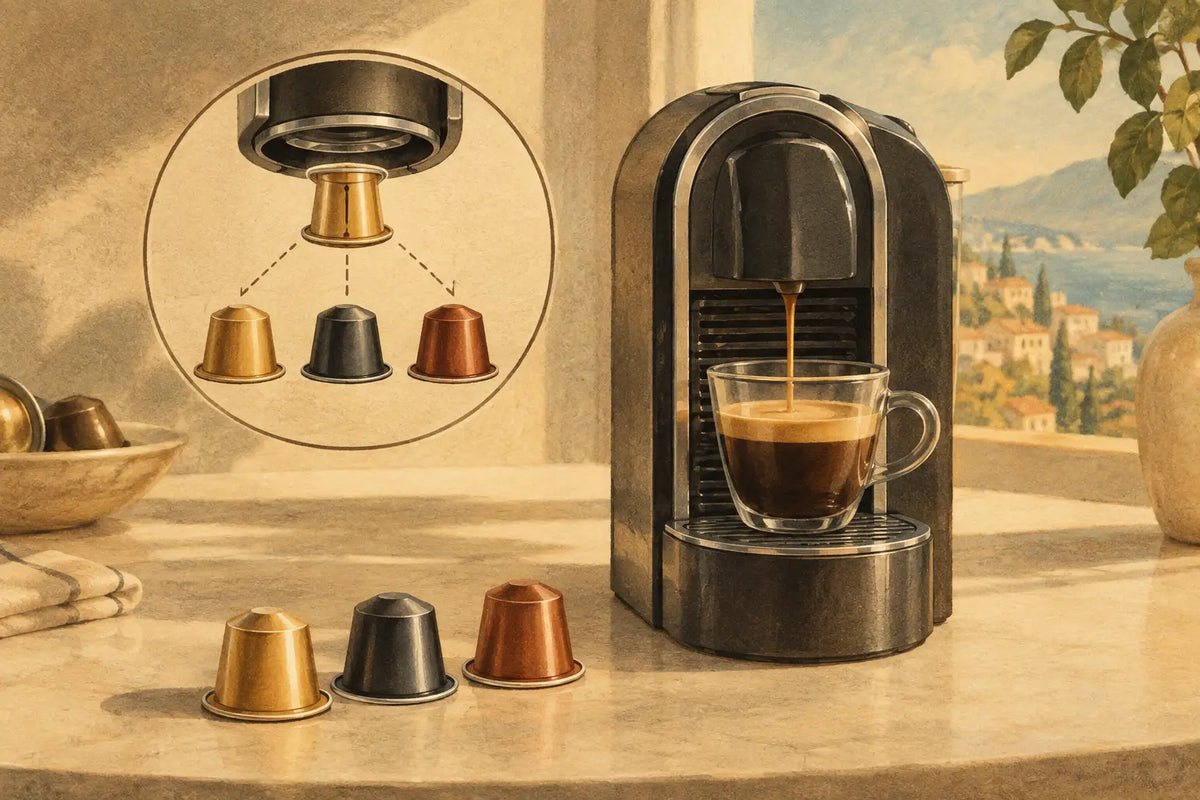

Searching for ‘made in netherlands coffee capsules’ is rarely just about a country of origin. The real question is sharper: where does this product come from, what is it made of and does it still fit the way we want to drink coffee at home? Capsules are fast, consistent and part of busy mornings. But the material around that coffee deserves at least as much attention as the coffee itself.
A capsule that's made in the Netherlands doesn't automatically say everything. It isn't a mark of quality on its own, nor an excuse for vague sustainability claims. What it can mean: shorter lines, more insight into material choices and a brand that organises responsibility closer to home. As long as the story goes further than a little flag on the packaging.
Made in Netherlands coffee capsules, but made concrete
The capsule market was built for a long time on one simple promise: drop it in, press the button, done. That convenience stays relevant. It's just that the materials too often stayed out of sight. Aluminium and conventional plastic call for separate collection and processing streams. When that stream doesn't run well, what's mostly left is a small shell that lingers long after your espresso.
With coffee capsules made in the Netherlands, the interesting question is therefore not only where the factory stands. Look at the whole chain. Which material forms the cup? Does it work in the machine already on your counter? What do you do with it after use? And is the explanation clear enough to actually act on at home?
Q Drinks chooses a capsule made largely from coffee, more specifically coffee chaff, combined with an organic binder. No aluminium cup that first has to be separated and reprocessed. No standard capsule of conventional plastic. Instead a material choice that returns the used capsule to something that feels more logical alongside coffee.
That isn't a detail in the design. It is the design.
Staying compatible is no side issue
A better material is worth little if the convenience disappears. Most people don't want yet another appliance, a new ritual or a manual next to the coffee machine. That's why these capsules are compatible with Nespresso* Original machines. Your existing routine stays in place: capsule in, choose espresso or lungo, get on with your day.
That compatibility also sets demands. The capsule has to withstand pressure and hot water while still ensuring a good flow. That's exactly why material innovation in capsules is more complicated than choosing a different box. The cup is a functional part of the brewing process, not merely packaging.
Taste shouldn't be treated as the last checkbox here. Origin and roast still determine how a coffee lands in the cup: full or light, rounded or outspoken, suited to a short espresso or a longer lungo. Anyone switching because the material fits their choices better shouldn't have to settle for flat coffee. That would be the wrong trade.
Compostable calls for an honest story
Compostable sounds simple, but practice calls for precision. The capsules are fully compostable in the Dutch GFT (organic waste) stream. Only: not every municipality accepts coffee capsules in the GFT bin yet. So check your local waste guide before you throw them away. That's less spectacular than a big green promise, but it's how it works.
Composting isn't an abstract end station either. The result depends on the right collection and processing. A capsule that ends up in residual waste takes a different route than a capsule that reaches the accepted GFT stream. Good material choices therefore benefit from clear instructions, not from a wink on the packaging.
The scale of the difference is visible in research by Wageningen University & Research from 2023. When compostable capsules are actually composted, they score around 100% on circularity. Aluminium capsules reach 61% in the best possible scenario, around 48% on average. Conventional plastic capsules around 23%. That comparison comes from the Wageningen study from 2023, DOI 10.18174/641509.
Read those figures as they're meant. They're not a licence to throw things away thoughtlessly. They show that both the material and the route after use matter. Circularity is only credible when the product, the collection and the user's behaviour line up.
Locally made, without making it bigger than it is
‘Made in the Netherlands’ often gets an almost magical charge. As if local production automatically solves every transport problem and makes every product better. It isn't that simple. Coffee doesn't grow in the Netherlands, and ingredients, machines and logistics are always part of an international chain.
Still, production in the Netherlands has a concrete advantage: the distance between development, production and customer is smaller. That lets you adjust more quickly on quality, packaging and availability. For a young material like a capsule made from coffee, that's valuable. You don't want a product that's progressive only on paper. You want it to work in a real kitchen, every morning again.
It also makes room for a different standard in the category. Not yet another flavour variant in the same old shell, but a rethink of the cup itself. A market that stood still for a hundred years. We didn't.
What you actually notice at home
The best innovation isn't necessarily the loudest. In practice you mostly notice that you can keep drinking capsule coffee without stockpiling aluminium cups or watching hard plastic capsules disappear into the bin. The machine stays. The speed stays. The choice of espresso, lungo or a functional blend stays too.
That last point deserves attention. A capsule machine doesn't have to revolve solely around coffee. Alongside classic coffee, capsule formats can also make room for blends for different moments of the day. Not as a miracle cure, but as a practical choice for anyone who likes a fixed ritual and chooses ingredients deliberately.
For some, a subscription makes sense: thinking about it less often while keeping control of the supply. For others, ordering separately works better, precisely because taste stays something personal. There's no forced route. Flexibility is part of convenience. Pausing or stopping should be easy too.
Don't choose on claims, choose on the questions behind them
Anyone comparing capsules doesn't have to become a materials scientist. But a few questions quickly make clear how serious a product is. Is the material clearly described? Does the capsule work with the machine you already have? Is the waste instruction specific to your municipality? And does the brand say something concrete about roast, origin and taste, instead of only about a green feeling?
Watch out, too, for words like ‘biodegradable’ when there's no explanation attached. That term can mean all sorts of things, depending on conditions and processing. Compostable in the GFT stream, with an honest local check, is a more usable starting point than a broad claim without context.
Dutch production is ultimately not an end point, but a starting point for better questions. Who made this capsule? Out of what? Does it fit my routine? And what happens afterwards? If a brand can answer those questions without detours, you're closer to a capsule that does more than deliver coffee.
Your morning ritual doesn't have to get heavy to be more considered. Choose the coffee you enjoy drinking, use the machine that already works and look at the capsule with the same attention as what's inside it. Don't just drink. Think.