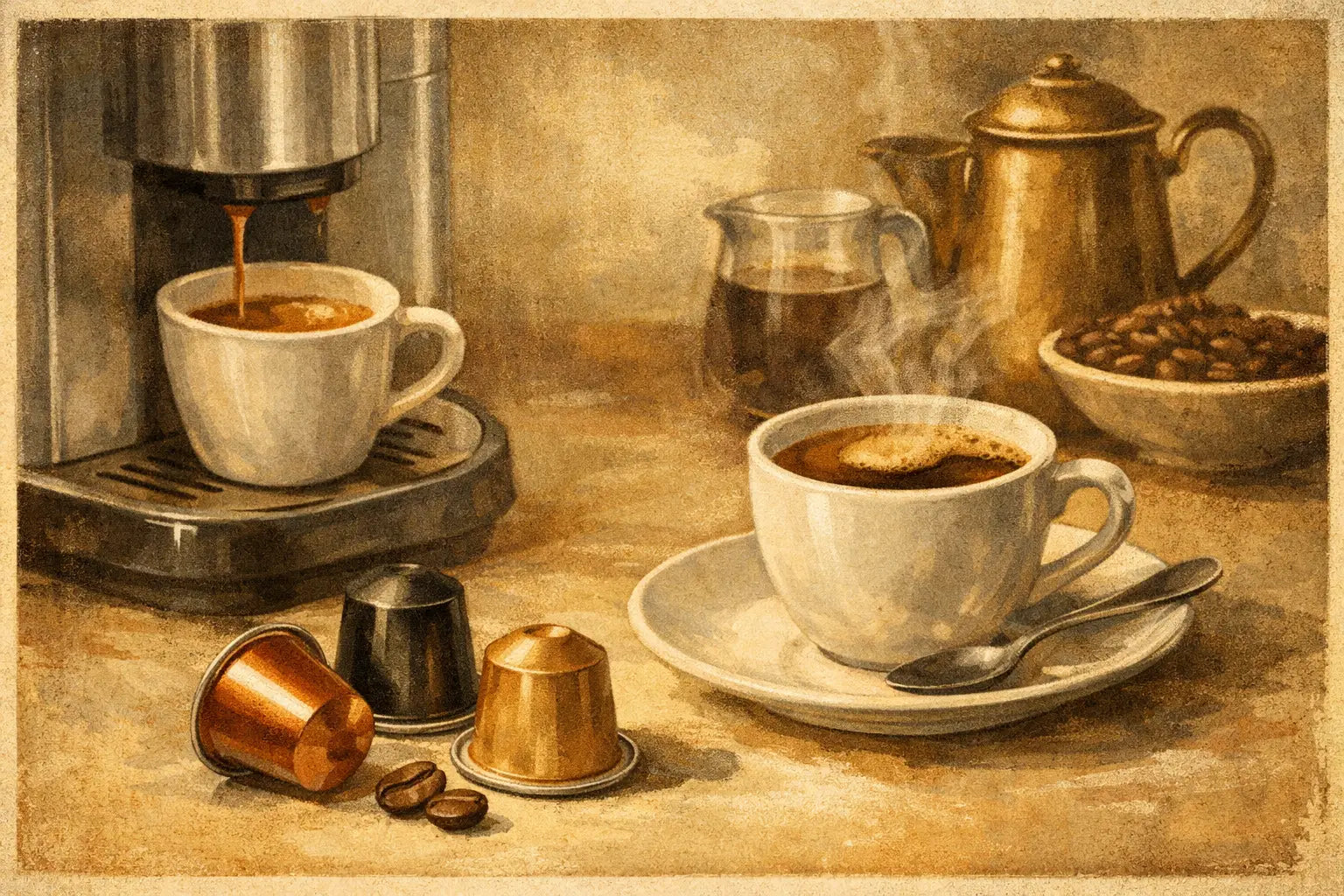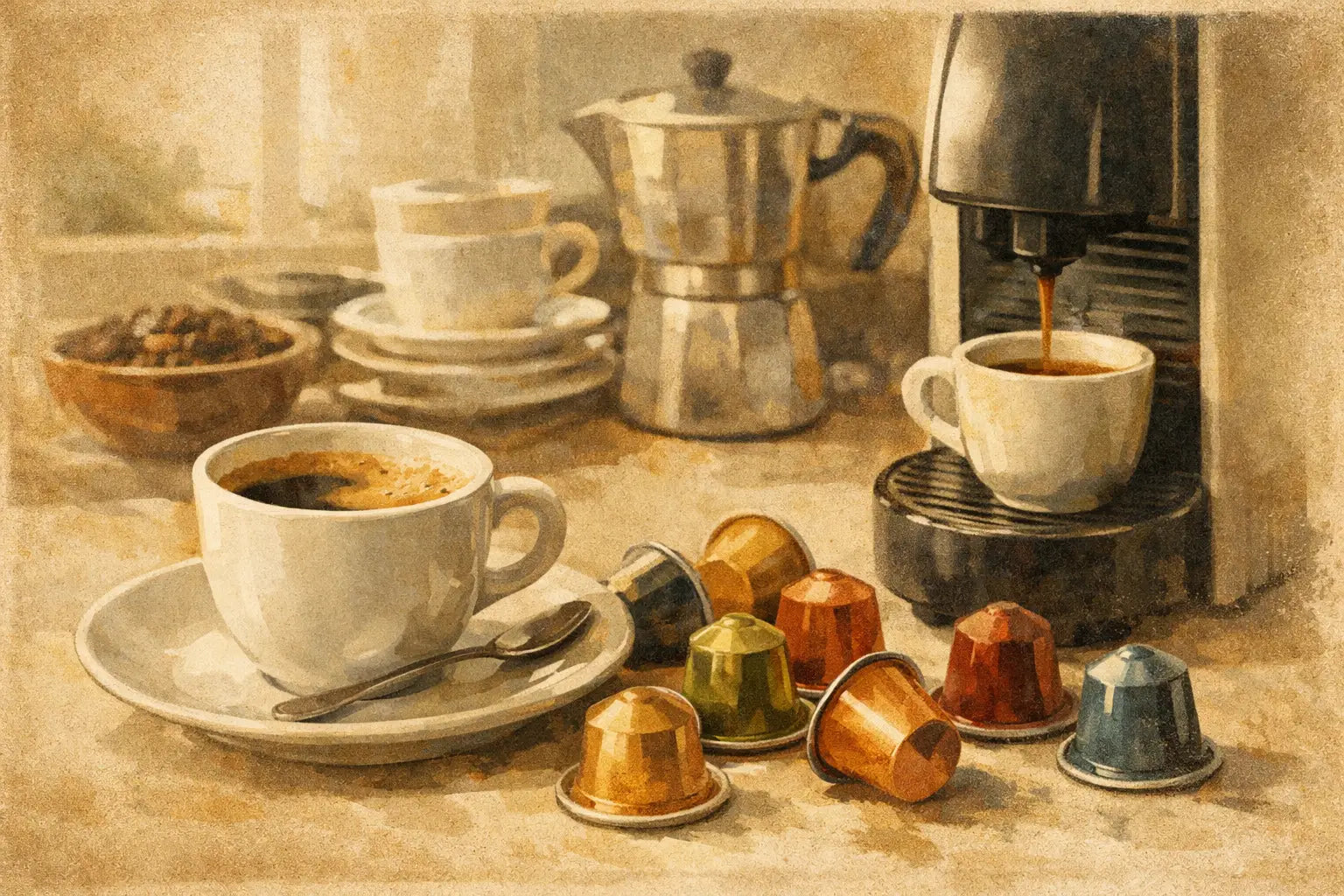

You're standing with a used capsule in your hand, above the organic waste bin. Because what does compostable actually mean in practice? This guide to organic-waste coffee capsules keeps it simple: a capsule made from coffee with a bio-based binder is fully compostable. Where your municipality accepts coffee capsules in the organic (GFT) bin, it can go there after use — exactly where aluminium and plastic don't belong.
Organic-waste coffee capsules: what is it really about?
The confusion usually starts with one word: compostable. Not every capsule called that actually is. Some are only "bio-based" or just partly degradable, and therefore do not belong in the organic waste bin. A capsule that is fully compostable and designed for it breaks down in the organic stream.
With coffee capsules you therefore mainly look at two things. One: what is the capsule made of? Two: is it fully compostable and designed for that? If both are true, the capsule is fully compostable after use. Do note: not every municipality accepts coffee capsules in the organic (GFT) bin yet, so check your municipality's waste guide.
What exactly are organic-waste coffee capsules?
By organic-waste coffee capsules people mean capsules that are fully compostable after use and — where the municipality accepts them — can go with vegetable, fruit and garden waste. So it is not about how a capsule looks, but about what it is made of and what happens to it after use.
A classic aluminium capsule does not belong there. It has to be collected separately or thrown away with residual waste. Capsules made of conventional plastic do not belong in the organic waste bin either. Fully compostable capsules are in a different category: made to return to the organic cycle after use.
That is also exactly where the difference between marketing and reality lies. A capsule that is only called "sustainable" says nothing yet. The question is simpler and harder: is it really fully compostable, yes or no?
The material makes the difference
With capsules it all comes down to material choice. Aluminium is strong, light and familiar, but it does not compost. Neither does plastic. So anyone who wants a capsule that is fully compostable needs one developed for composting.
Modern compostable capsules are often made from plant-based or bio-based materials. In the case of the newest generation of capsules, that can also be a mix of coffee and a bio-based binder. That is relevant, because it shows that a capsule no longer necessarily has to consist of metal or fossil plastic to be compatible with Nespresso Original machines.
That last point is where the market stood still for a long time. The system was convenient, but the material story lagged behind. A capsule made largely from coffee, with a bio-based binder, therefore does not feel like a gimmick but like a more logical next step. Less industry, more material that suits what the product already is: coffee.
What "fully compostable" really means
Fully compostable means that after use the capsule breaks down into compost, without any residue of aluminium or fossil plastic. That is a property of the material itself: coffee plus a bio-based binder break down where metal and plastic never do.
That is exactly why this category is becoming more interesting. After your coffee you no longer have to pry anything open, save anything separately or start a small logistics project on your counter. The capsule is fully compostable and therefore belongs in the organic cycle — where your municipality accepts coffee capsules, with the organic waste, just like your coffee grounds.
Organic-waste coffee capsules in practice
Say you use a capsule in a Nespresso Original machine. After brewing, moisture and coffee grounds are left behind. That is normal. With a fully compostable capsule you do not have to separate that content first: where your municipality accepts coffee capsules, capsule and coffee grounds go into the organic waste together. It is precisely that convenience that makes the difference in the daily ritual. No prying open, no saving aluminium separately.
That makes practice simple: if the capsule is fully compostable, it can go with the organic waste after use where your municipality accepts it. When in doubt, quickly check the waste guide; knowing once how it works in your municipality is enough.
For many people that is also the point where capsule coffee makes sense again. Not only quick in the morning, but also less cumbersome afterwards. Convenience should not stop the moment you have brewed your espresso.
Why this is more than a waste question
The discussion about organic waste is ultimately not only about the bin, but about design. What material do you choose for something you use once? And how seriously do you take the end-of-life of that product?
According to Wageningen University & Research in 2023, compostable capsules score almost fully circular if they are actually composted. Aluminium comes out much lower in their analysis, even in a favourable scenario, and conventional plastic lower still. That difference is not about feeling or branding, but about what happens to the material after you have pressed the button.
The biggest benefit arises when the capsule is actually composted. That is why clear communication is so important: if you know a capsule is fully compostable, and whether your municipality accepts it in the organic (GFT) bin, you also know straight away where it belongs.
What to look for when you buy capsules
When you search for organic-waste coffee capsules, you are really searching for clarity. Not for vague claims. So look first at machine compatibility. Not every capsule fits every system. For many households it comes down to compatible use in Nespresso Original machines, because that is the standard at home.
Then look at the material story. Is the capsule made for composting? Does it state concretely what is in it? A capsule made from coffee with a bio-based binder tells you more than a generic term like eco or green. Those kinds of words say little without context.
Finally: check whether the explanation is clear. Good brands state concretely whether a capsule is fully compostable, without theatre. No moral lesson, no fog. Just clear language. That is often a better signal than big sustainability promises.
The role of taste and routine
No one buys a capsule just for the waste bin. If the coffee is not right, it stops there. That is why it matters that new materials do not have to come at the expense of the experience in the machine. Crema, flow time, Intensity and consistency simply have to be good. Otherwise compostability is a theoretical benefit that does nothing for you in practice.
The better capsules show that you no longer have to choose between design, convenience and material choice. That is exactly why this category is becoming more interesting. A capsule can feel premium, perform well and be smarter designed at the same time.
Q Drinks fits into that movement with capsules made largely from coffee, fully compostable and — where your municipality accepts coffee capsules — suitable for the organic (GFT) bin, compatible with Nespresso Original. Not as a gadget, but as an answer to a category that leaned on the same materials for far too long. Still thinking about it…
Common misunderstandings
One of the most persistent misunderstandings is that everything bio-based is automatically fully compostable. Not true. Bio-based says something about the origin of the material, not automatically whether it fully breaks down. Compostable is a different, stricter claim.
A second misunderstanding is that organic-waste coffee capsules will disappear by themselves on the compost heap at home. Fully compostable capsules are made for organic waste processing, not necessarily for your cold garden compost. So put them, where your municipality accepts them, with the organic waste and not, on a hunch, in the garden compost.
The third misunderstanding is that compostable automatically means "less coffee". It does not have to. Material and taste are separate: a capsule can be fully compostable and perform in the cup.
What you can best do today
If you drink capsule coffee and want less hassle after use, start with the material. Aluminium and plastic capsules go into residual waste or separate collection; fully compostable capsules can go with the organic waste, where your municipality accepts them. That one difference determines how much work your daily coffee actually causes.
If you use a Nespresso* Original machine and want a smarter option, look for capsules that are fully compostable and designed for it. Material and compatibility have to line up. When they do, it immediately feels lighter - not dramatically, just more logical.
Good choices in this category are rarely loud. They simply work better in real life. And that is ultimately what this organic-waste coffee capsules guide is about: less confusion, more grip, and a morning ritual that does not lag behind the times.
Don't just drink. Think.