Throwing that capsule away after your espresso feels minor. Until you see how many go through in a week. Anyone wondering how to compost coffee capsules at home quickly discovers that the answer hinges on one detail: not every capsule that looks green is also suitable for your compost bin.
If you want to compost capsules at home, you first need to know what they're made of. Aluminium doesn't belong there. Most conventional plastic capsules don't either. Compostable capsules are a different category. They're designed to break down under the right conditions, but even then it holds: home compost isn't the same as industrial composting, and the outcome depends on moisture, warmth, oxygen and time.
How to compost coffee capsules at home without guesswork
Start with the material. A capsule made from coffee with a bio-based binder behaves differently than aluminium or fossil plastic. That sounds technical, but in practice it's simple: read the packaging, check whether home composting is explicitly mentioned and don't go by colour, matte finish or terms like eco or sustainable. Those say little.
For capsules suitable for home compost, it usually holds that you're best adding them to an active compost heap or well-managed compost bin. Don't leave them lying on top, but mix them with wet and dry material. So not only coffee grounds and vegetable peelings, but also some dry leaves, cardboard or small twigs. Compost thrives on balance. Too wet and it starts to rot. Too dry and too little happens.
A capsule also composts faster if you help the conditions along. You can add it whole if the manufacturer indicates that, but in a home compost smaller almost always works better. Opening or lightly breaking it speeds up the process, because moisture and micro-organisms then reach the material more easily. Not elegant, but effective.
What your home compost needs
Home compost isn't a black box. It's a system, and that system has to stay warm enough to genuinely break down organic material. In a large garden compost that succeeds faster than in a small kitchen compost bin on a balcony. That's why the question isn't only whether a capsule is compostable, but also whether your compost set-up is suited to it.
A healthy compost needs air, moisture and mass. You get air by turning it over now and then. Moisture should feel like a wrung-out sponge - not soaking, not dusty. Mass is crucial because a heap that's too small barely builds up temperature. If you only have a mini-bucket for peelings, the process takes longer and the chance is greater that capsules stay visibly lying around.
That doesn't mean composting at home is pointless. It does mean patience is part of the deal. Where industrial composting works under controlled heat, home compost stays dependent on season and scale. In winter everything goes slower. In summer, with enough volume, you see results much faster.
The mistake that's made most often
The most common mistake is wishful thinking. A capsule with a sustainable look ends up on the compost heap without anyone checking whether home composting is genuinely supported. Second mistake: throwing everything into one wet mass. Coffee grounds are nitrogen-rich and compact. If you just keep piling more wet kitchen waste on top, you shut out oxygen. Then you get odour sooner than compost.
Third mistake: judging too soon. Some compostable materials need months, certainly in a cool compost bin. A capsule still being visible after six weeks doesn't automatically mean the material isn't composting. Look instead at changes in structure. Is it getting more brittle, thinner or does it break more easily? Then the process is under way.
Can all coffee capsules go in the compost bin?
No. That's the short version. The longer version: only capsules explicitly designed and tested for it have a serious chance of breaking down well in compost. Aluminium capsules belong in residual waste or a separate collection stream if one is available. Conventional plastic capsules too. Bio-based, moreover, isn't automatically home-compostable. That difference is often skipped, but in practice it makes all the difference.
There are capsules made from coffee with a bio-based binder. That's relevant because the material aligns more with a circular logic than aluminium or conventional plastic. Wageningen showed in 2023 that compostable capsules, when they're actually composted, can turn out practically fully circular. Aluminium came out clearly lower in that research, and conventional plastic lower still. Important detail: that advantage only exists if the capsule ends up in the right waste or compost stream. A compostable capsule in residual waste misses the point.
Organic waste or home compost - that isn't always the same
Many people mix these two up. Understandable, but not helpful. A fully compostable capsule belongs in the organic waste (GFT) after use. In a small home compost the same material breaks down too, just more slowly, because the temperature is lower there.
For the fastest and most reliable result, fully compostable capsules belong in the organic waste (GFT). The processing is set up for it. Home compost is a fine addition, but works more slowly. Compostable doesn't mean everywhere equally fast, but it does mean: eventually back into the organic cycle.
How to compost coffee capsules at home step by step
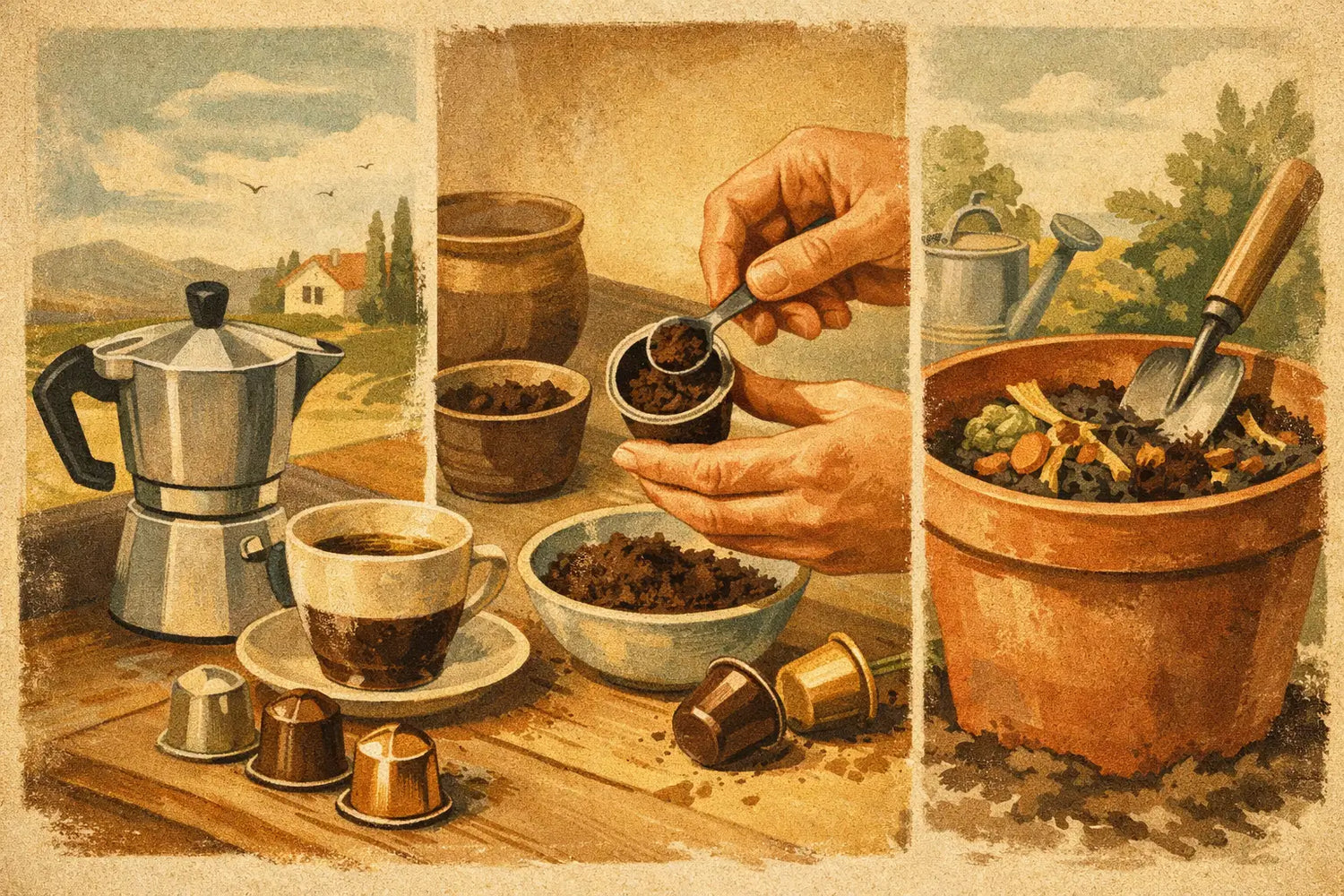
First you sort strictly. Only capsules that are clearly home or organically compostable qualify. Then you remove any packaging elements that don't compost along, such as loose foils or stickers if they're present.
Add the used capsules to an active compost heap, preferably not in one big load but spread out. Mix them through existing material. If you have a lot of wet kitchen waste, add something dry to restore the ratio. Think shredded cardboard or dry leaves. Turn the compost regularly, so oxygen can get in.
If you want to speed up the process, make the capsules smaller before they go into the bin. That doesn't have to be obsessive. A squeeze or a break is often enough. After that, watch temperature and moisture above all. If the compost is cold and compact, almost everything stays visible longer. That's not only down to the capsule.
Over time you check not for perfect disappearance, but for breakdown. Some parts go faster than others. That's normal. Sieve the compost at the end if needed and let larger bits go round once more.
When composting at home isn't a smart route
Sometimes the honest answer is: better not. If you live in an apartment without a garden, only have a small counter tub or don't want to put time into maintenance, then home composting is often more theory than solution. In that case the organic waste bin is the practical route: a fully compostable capsule belongs there anyway.
When in doubt about the material too, restraint beats good intentions. One aluminium or conventional plastic capsule among your compost seems like little, but it simply doesn't belong there. Compost works well when you sort clean. Sloppiness shows up later.
For anyone using capsules in a Nespresso Original machine, it pays to choose material that fits your waste routine already at purchase. That's the real shortcut. Not puzzling afterwards, but choosing smart upfront. Q Drinks has a clear approach for that: cups made from coffee with a bio-based binder, fully compostable in the organic waste bin and compatible with Nespresso* Original, designed with composting as the end point in mind.
What to watch for when you buy new capsules
Don't buy on marketing words alone. Look for clear information about material, composting route and machine compatibility. If home composting matters to you, it has to be explicitly stated. If only industrial composting is mentioned, you know enough.
Also pay attention to what isn't said. Words like sustainable, circular or plant-based sound good, but without an explanation about the waste stream they stay vague. Good capsules make that concrete. Where can they go after use? Organic waste, industrial composting, or only residual waste? That's the question that counts.
So anyone who wants to compost at home isn't just buying coffee. You're choosing a system. Machine, capsule material and waste route have to line up. Then that daily espresso suddenly makes a lot more sense.
Composting at home isn't a performance. It's a practical choice that works when your material and routine are right. Start small, look honestly at your set-up and don't make it more complicated for yourself than needed. Don't just drink. Think.