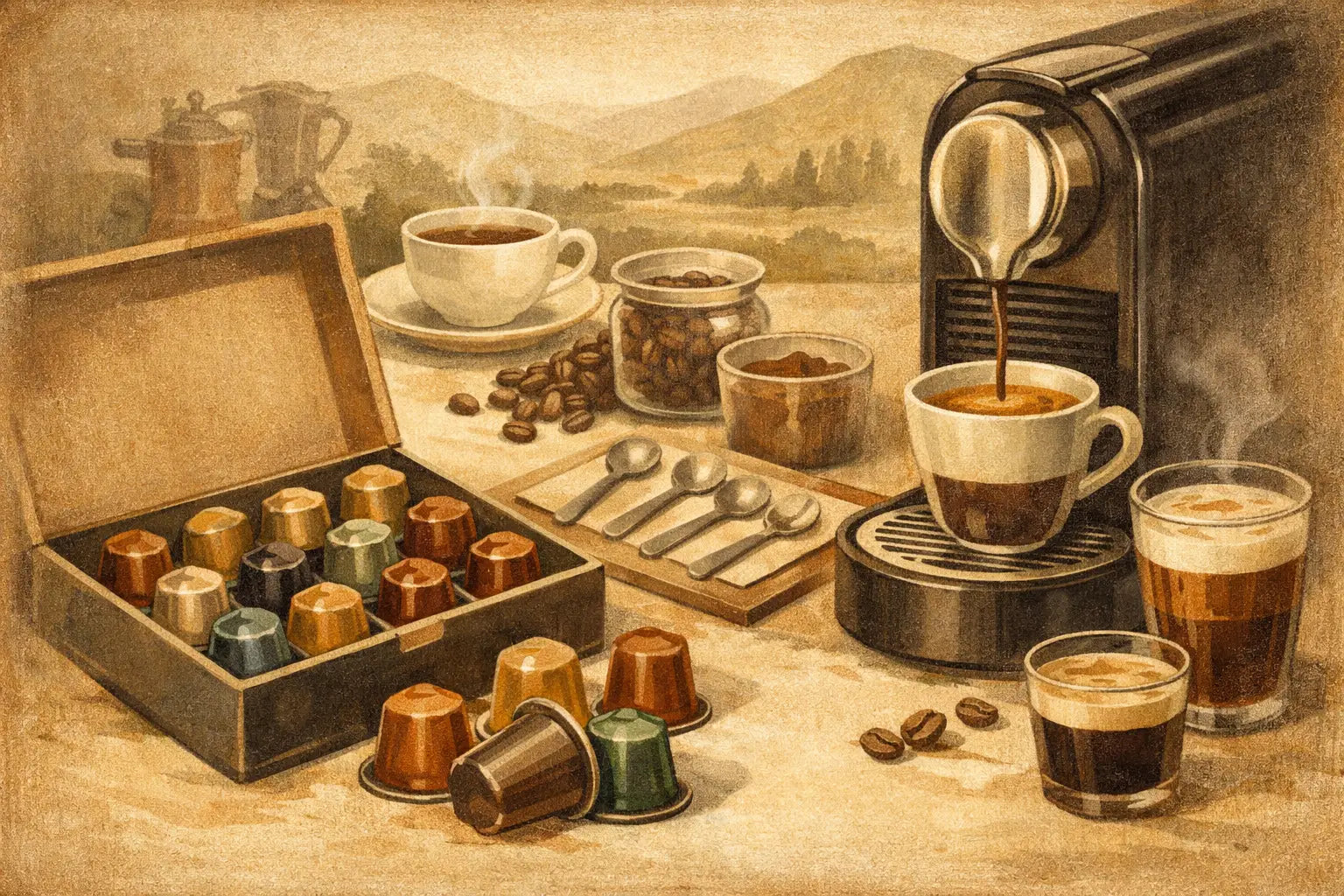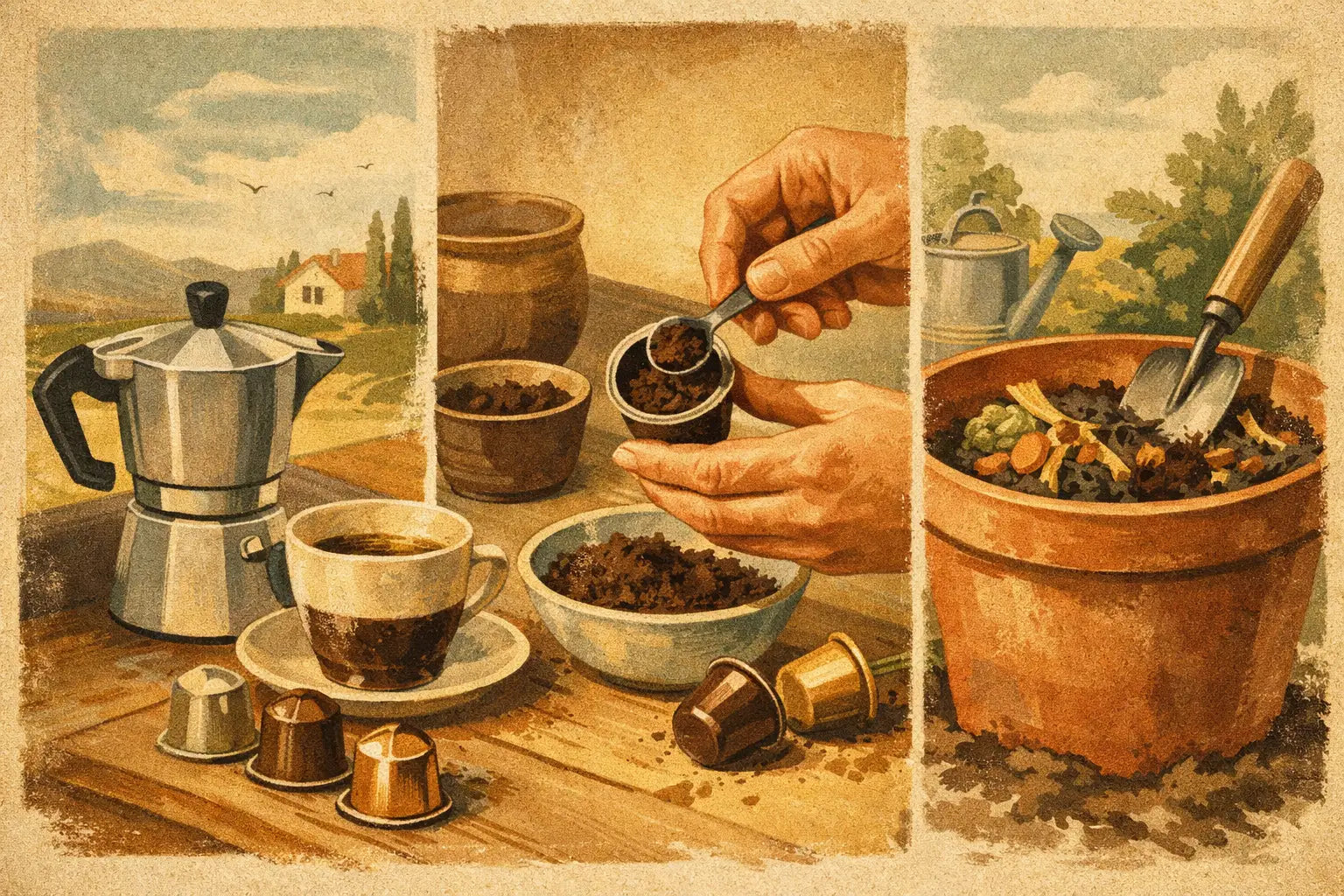
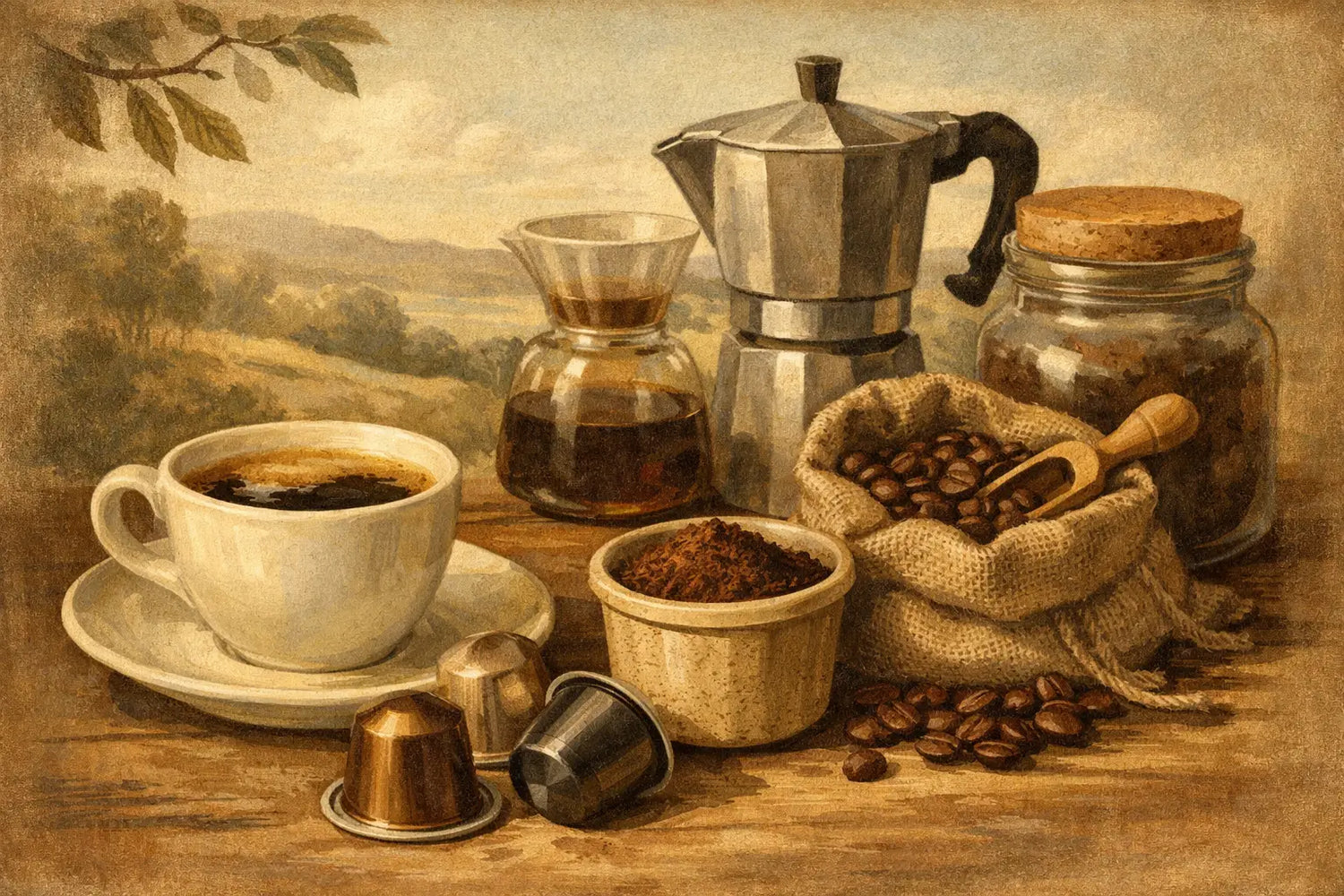
You know the moment. Morning, half awake, press the button, espresso ready. The convenience of capsules is hard to beat. But afterwards one question lingers: is there a sustainable alternative to coffee cups that doesn't feel like a step back in taste, speed or ease of use?
Yes, there is. But not every so-called green solution is automatically better. With capsules it's not only about material. Compatibility, waste stream, taste, machine behaviour and what you can realistically keep up at home all count too. Anyone who wants a smarter system has to look further than packaging in a green colour.
What is a sustainable alternative to coffee cups?
A sustainable alternative to coffee cups is, at its core, an option that depends less on new raw materials, fits better into existing waste streams and asks for no unnecessary compromises in daily use. That could be a refillable capsule, a compostable capsule or a completely different brewing method such as a bean-to-cup espresso machine.
Still, there's no single winner for everyone. Someone who already has a Nespresso Original machine and mainly wants less waste looks at sustainability differently than someone willing to buy a completely new device. That's exactly where this conversation often goes wrong: everything gets lumped together, while the best choice actually depends on your routine.
Not every alternative solves the same problem
The capsule market stood still for years. Aluminium and conventional plastic became the norm, while the user mainly had to choose between convenience and conscience. There are more routes now, but each route solves a different part of the problem.
Refillable capsules reduce packaging waste, but require time, precision and cleaning. For some people that works fine. For others the enthusiasm disappears into a drawer after two weeks. Bean-to-cup machines can score strongly on waste reduction, but do mean a bigger switch in space, maintenance and investment. Compostable capsules sit right in between: the capsule convenience stays, while the material is chosen far more smartly.
That last point makes them the most realistic sustainable alternative to coffee cups for many households. Not because it's the only good option, but because behaviour barely has to change. And behaviour is ultimately what determines impact.
What to really watch for in capsule sustainability
Material is the first filter. Aluminium looks premium, but takes a lot of energy in production and only stays interesting if it's also genuinely collected and processed well. Conventional plastic is light and cheap, but scores weaker as a raw material that often returns only partially into a high-quality loop.
Compostable capsules call for nuance. Not everything labelled "compostable" actually is. A capsule that is fully compostable belongs in the organic waste (GFT) stream, together with the coffee grounds. That's no detail - it determines whether a well-intended material also actually ends well.
That's why it's smart to look beyond the claims on the box. Ask yourself: what is the capsule made of, and is it genuinely fully compostable? If the answer is yes, you also know straight away where it belongs after use: in the organic waste.
The figures behind compostable, aluminium and plastic
If you want to make it concrete, you quickly end up at Wageningen University & Research. In a 2023 publication they looked at how circular different coffee capsule systems can be when they end up in the right stream. It shows that compostable capsules, when they are actually composted, reach around 100% circular. Aluminium sits around 48%. Conventional plastic capsules come out around 23%.
Those figures say something important. Not that compostable automatically always wins, but that the potential is large if the system is right. The condition is clear: composting has to actually happen. Sustainability isn't a marketing term, but logistics.
Made from coffee is something other than standard compostable
Within compostable capsules there's still a clear difference. Some capsules are bio-based or compostable, but still feel and look like a technical material. Others are made from coffee, with coffee as the main ingredient and a bio-based binder to make the capsule shape and machine performance possible.
That difference isn't only aesthetic. It shows you can think further than a less bad version of what was already there. A capsule made from coffee uses a material choice that feels more logical for the product itself. Coffee in a capsule that consists largely of coffee - that's simple, but strong.
Q Drinks builds on exactly that idea: cups made from coffee, fully compostable in the organic waste bin and compatible with Nespresso* Original machines, and designed for people who don't fancy aluminium or old-fashioned plastic as the default option. No theatre. Just a smarter object for a daily act.
Does a sustainable alternative to coffee cups work just as easily?
That's usually the breaking point. Many people are happy to become more sustainable, as long as the morning routine doesn't turn into a project. That's why solutions that work on existing machines often win over systems that are theoretically more sustainable but practically ask for more.
If you already use a Nespresso Original machine, compatibility is essential. A capsule can be sustainable on paper, but if extraction, flow or user experience disappoints, you'll drop it anyway. Then you shift either back to old capsules, or to a device you didn't really want.
So the best solution is often the one you keep using without thinking. That sounds less heroic than a complete switch to a new coffee set-up, but it's how sustainable behaviour really lands in real households.
Taste and convenience don't have to drift apart
There's still an assumption that more sustainable automatically tastes less good. That reflex comes from a time when green alternatives mainly wanted to be correct. The new generation of capsules no longer has to make that mistake.
For coffee drinkers who pay attention to roast, origins and intensity, that's crucial. Nobody wants to buy a better waste story at the expense of the espresso itself. A credible sustainable alternative to coffee cups therefore has to do both: be right in material and hold up in the cup. Without the machine acting up or the crema disappearing.
Which choice fits your routine?
If you mainly want as little waste as possible and don't mind extra manual work, refillable capsules can make sense. If you're sensitive to ritual, measuring and cleaning, you'll probably enjoy it. If you're honestly someone who presses the button and moves on, you won't.
If you're open to a new machine and drink a lot of coffee, brewing beans can be a strong route in the long run. Only, that's no small step. More space, more maintenance, often more noise. Fine for some kitchens. Not at all for others.
If you want to keep capsule convenience and at the same time a more serious material story, you end up at compostable capsules - ideally capsules made from coffee with a bio-based binder, fully compostable in the organic waste bin. For many users that's the most credible middle ground between comfort and consequence.
Sustainable without guilt works better
What helps is not to treat sustainability as an exam you have to pass perfectly. Not everyone will grind beans tomorrow, not everyone wants to refill. That doesn't make the choice pointless. It just makes it concrete.
A good sustainable alternative to coffee cups lowers the threshold. Less new aluminium. Less conventional plastic. Less friction. More chance that a better choice actually becomes the standard at home.
That's ultimately where the category has to go. Not towards more complicated, but towards more intelligent. Capsules that fit how people live, and that are finally better designed for the world around them.
Still thinking about it… Then don't start with ideals, but with your counter. Look at what your machine is, how you separate your waste and how much convenience you want to keep. The best choice usually isn't the loudest. It's the option you use again tomorrow.