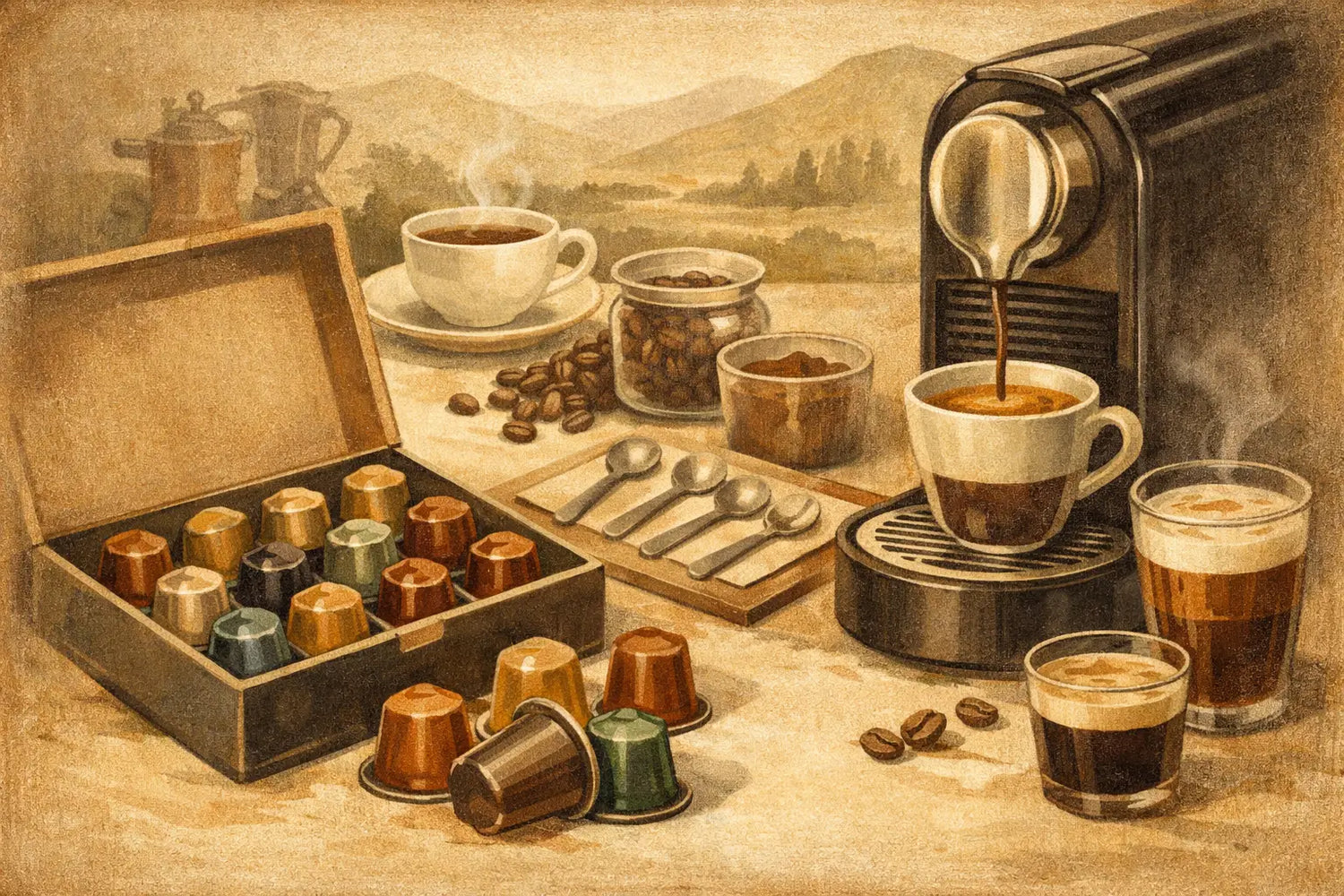
A drawer full of cups you only half enjoy is usually the result of choosing too quickly. Anyone who takes ordering a coffee cup sample pack seriously isn't just buying some variety in a box - they use that pack to get taste, intensity and machine fit clear in one go. That saves bad buys, subscription regret and far too many mornings with mediocre coffee.
Why ordering a coffee cup sample pack makes sense
A sample pack is especially useful when you want to drop two things: guessing and compromise. Online, almost every capsule looks good. Words like roast, lungo or espresso point you in a direction, but they don't tell the whole story. One medium roast drinks smooth in the morning; another turns out drier or darker than you expected.
There's more to it. Capsules are often bought out of habit. Your machine is already there, your ritual is running, so you quickly reorder what you know. That's exactly why a sample pack is interesting. It gives you room to compare without immediately locking yourself into one flavour profile or a big stockpile.
For people with a Nespresso* Original machine that's extra relevant. Compatibility simply has to be right. Not as a marketing line, but at the kitchen table, on a Monday morning, without any hassle. A good sample pack lets you not only taste, but also experience how the capsule behaves in your machine.
What to look for when ordering a coffee cup sample pack
The mistake many people make is to focus only on flavour descriptions. Understandable, but too narrow. If you really want to choose smart, you look at four things at once: style, moment of use, machine experience and material.
Style starts with how you drink. If you mainly drink espresso, a pack full of lungo variants says little about what you'll actually reorder later. If you make cappuccino or flat white, you want to know which capsule keeps enough body alongside milk. And if you switch things up during the day, a mix of lighter and darker roasts makes more sense than one narrow selection.
Moment of use is often underrated. Morning coffee isn't the same choice as that capsule after lunch or the quick cup between calls. Some flavours are direct and clean. Others have more depth and ask for attention. A sample pack works best when you don't take one sip and decide, but test over a few days at different moments.
Machine experience is more practical than it sounds. Does the extraction flow nicely? Is the crema consistent? Does the capsule fit smoothly? You only notice that kind of detail at home. A capsule can be compatible on paper and still feel a little less effortless in use. That's why trying matters.
Material belongs in that consideration too. Not as a moral checkbox, but as a product property. In a category that ran on aluminium and fossil plastics for decades, what a cup is made of - and what happens to it after use - is relevant.
Taste first, but not taste alone
Anyone ordering a sample pack usually wants the answer to one question: which cup do I like best? Fair enough. Only, taste is less fixed than many people think. The amount of water, the timing and even what you ate beforehand change how a capsule comes across.
That's why it helps not to hunt for the one "best" cup, but for the right cup per moment. Maybe you want a dark espresso with more punch early in the morning, and a softer lungo later in the day. That's not indecision. That's simply smarter buying.
Don't take intensity too literally either. A higher score doesn't automatically mean better. Sometimes you want more depth, sometimes more clarity. Especially if you're used to specialty, a slightly lower intensity can be more interesting than a capsule that mainly lands heavy.
Ordering a coffee cup sample pack when material matters too
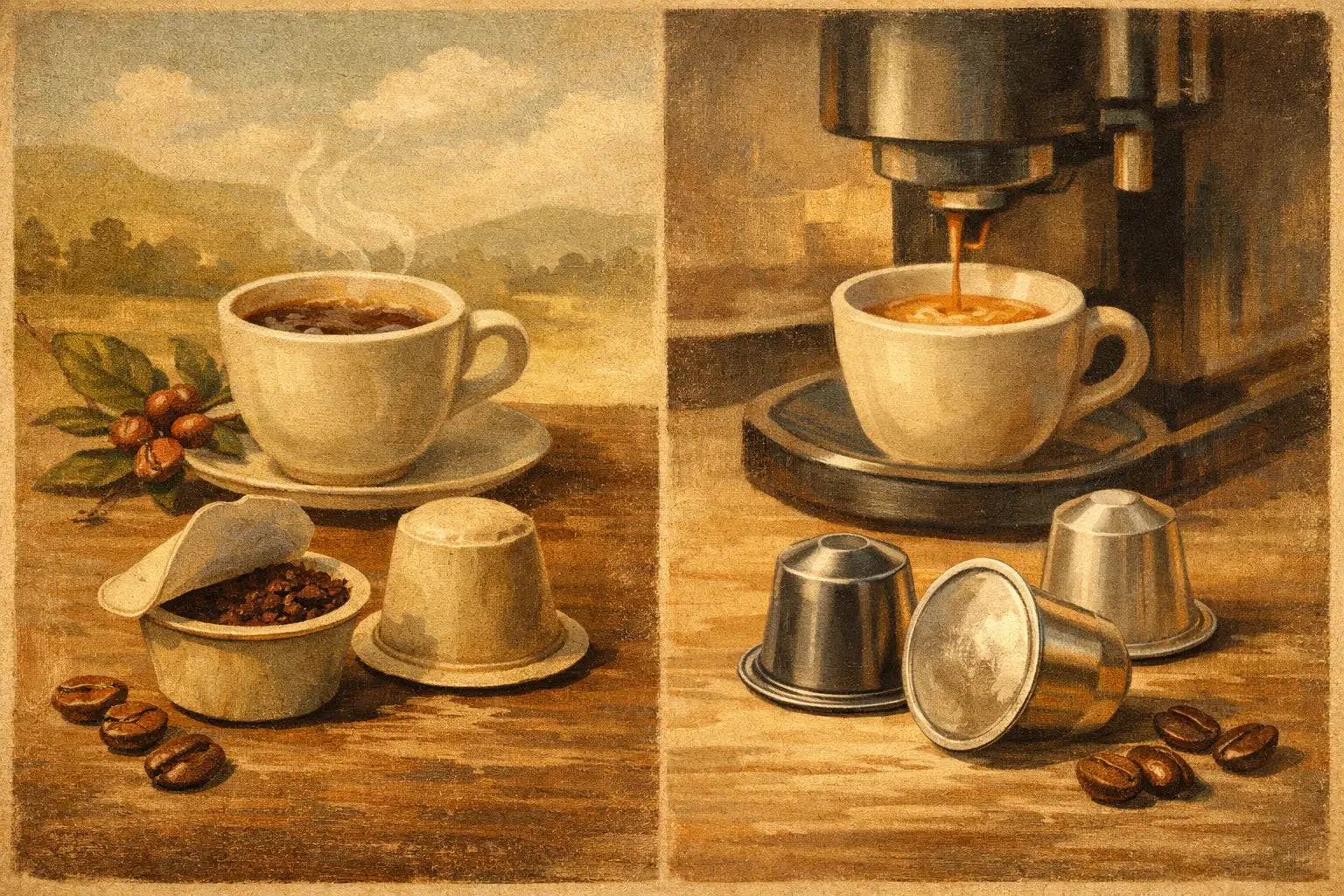
The capsule itself has been the least innovated part of the market for years. The machine got handier, the branding sleeker, but the material stayed remarkably old-fashioned. That's exactly where a sample pack from a modern brand makes a difference, because you're not just testing coffee, but a different product idea.
At Q Drinks the cups are made from coffee with a bio-based binder. That instantly feels more relevant than yet another capsule in aluminium or standard plastic. Not because it needs a big story around it, but because it's simply a better starting point for a daily product.
Nuance does matter, though. Compostable doesn't mean everything works the same everywhere. In the Netherlands these cups are allowed in the organic waste (GFT) bin, but not every municipality accepts coffee capsules in the same way yet. A quick local check stays sensible.
That doesn't make the choice any weaker. According to Wageningen University & Research in 2023, a compostable capsule that is actually composted scores almost fully circular, while aluminium reaches around 48 per cent and conventional plastic capsules stay around 23 per cent. Those aren't slogans, but sober figures that make one thing clear above all: material matters.
How do you test a sample pack without noise?
If you order a sample pack, don't test everything in one evening. Then you mainly taste differences in strength, not in character. Better to brew one or two variants per day, preferably on the same machine setting and with roughly the same cup size.
Start with how you normally drink. So espresso if you always drink espresso, lungo if that's your standard. Don't suddenly set every capsule to the longest setting "to taste more". Then you're mostly testing water.
Jot down three words per cup if you like. Something like round, direct, dry. Or soft, dark, clean. Not a whole notebook, just enough to still know after a few days why a particular variant stuck with you.
And test at least one capsule twice. The first cup says a lot, but not everything. Sometimes a flavour surprises you on the second or third brew, once you know what to expect.
When a sample pack is less useful
There are also situations where a sample pack isn't the smartest first step. If you already know exactly which roast and intensity you want, and you're only after a quick reorder, then a broad pack adds little. The same goes if you only make milk drinks and therefore mainly need one solid profile.
For people who buy purely on price per cup, a sample pack isn't always the shortest route either. Tasting is useful, but in a sense you pay for freedom of choice. That's logical. The gain then isn't in the lowest unit price, but in preventing a bigger bad buy afterwards.
Still, a sample pack does work for most households. Especially when several people use the same machine. Then you rarely have one universal favourite, and a small range is often more practical than a big bulk pack of a single kind.
From trying to routine
The best sample pack doesn't end as a fun one-off test, but as a sharper picture of what you really want to keep drinking. That can be one fixed favourite, or a combination of espresso during the week and lungo for the weekend. Both are fine.
What you're looking for is a routine without friction. No endless comparing, no using up cups you don't actually want, no material that feels outdated for something you use every day. Just clarity.
That's why ordering a coffee cup sample pack is mainly interesting for people who want convenience without giving up on taste or material choice. No more, no less. You're not buying a concept. You're testing whether a product fits your real life.
Still thinking about it… Then don't order the biggest pack, but the smartest. A few good comparisons say more than a full drawer. And if a capsule is right from the very first week in taste, use and material, you'll find you barely need to think about it afterwards.