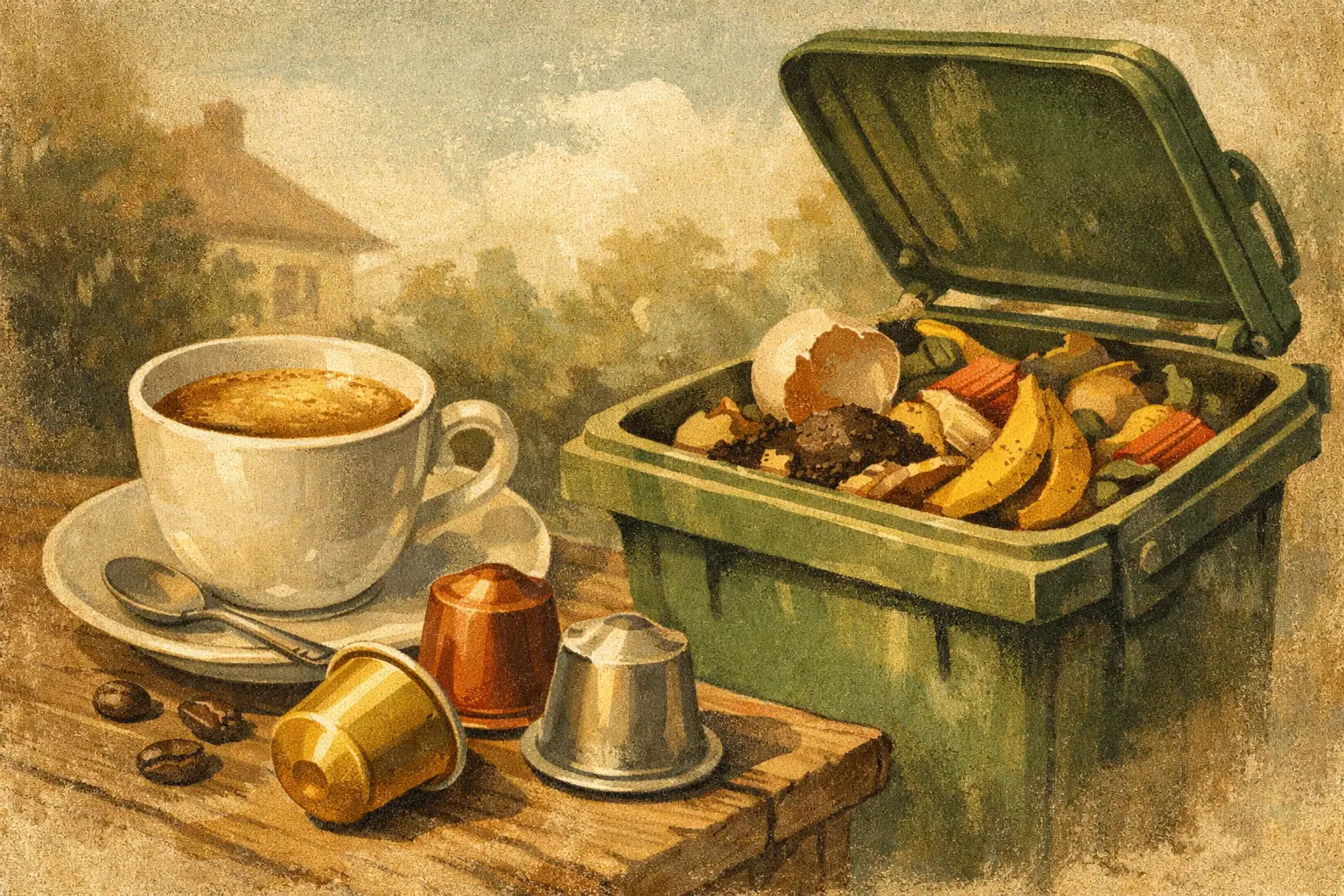
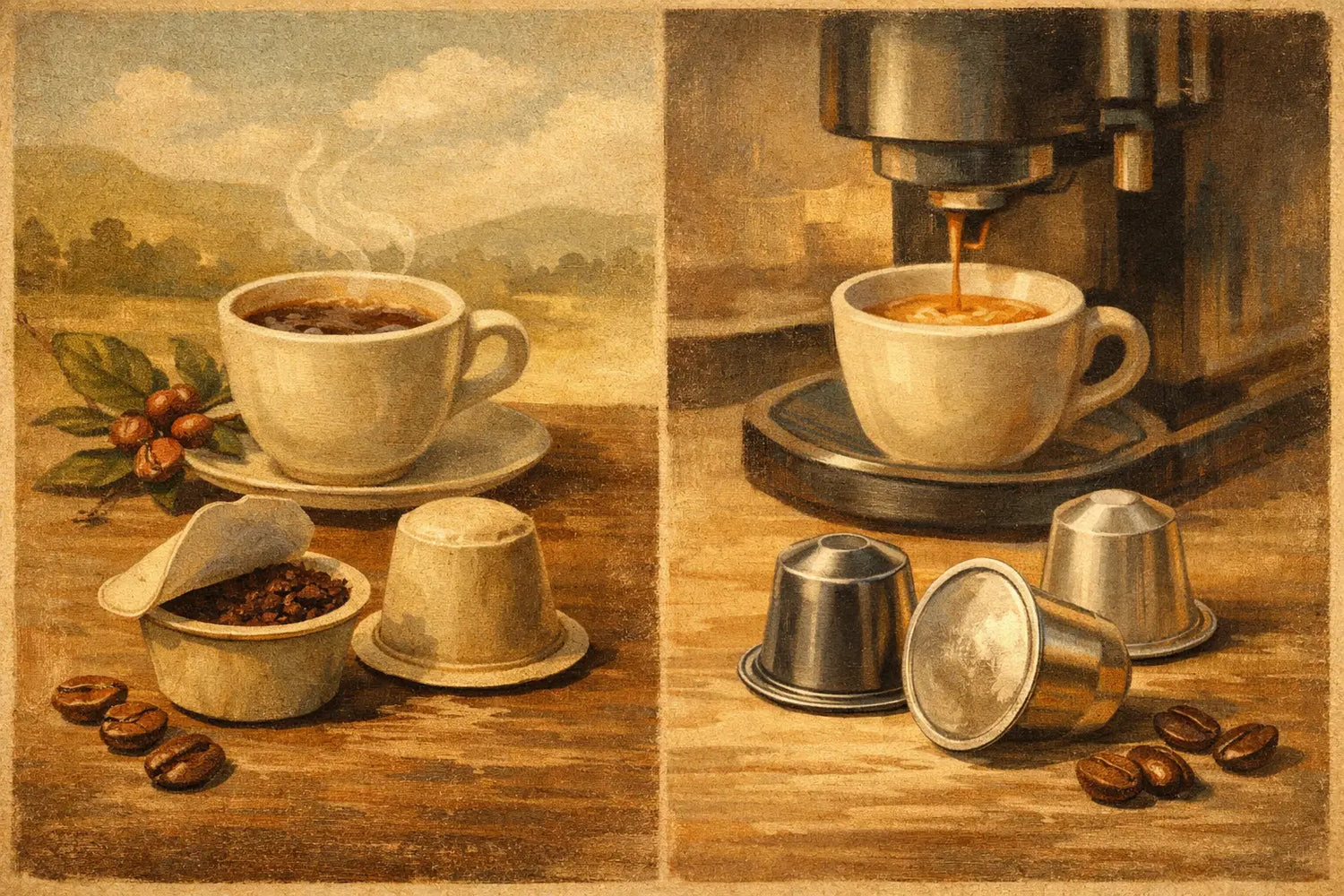
The capsule market looks sleek, fast and convenient. Until you look at the bin. That's where the real comparison between compostable cups versus aluminium cups begins - not with the marketing, but with what's left after your espresso.
Aluminium cups set the standard in single-serve coffee for years. They feel premium, protect the coffee well and work reliably in many machines. But they also bring a system that leans on collection, sorting and industrial processing. Compostable cups take a different route. Less about recovering, more about returning to an organic stream: the organic waste (GFT) bin.
If you use capsules at home, you don't have to be an activist to find that difference relevant. You want convenience, good taste and a material choice that doesn't lag behind the rest of your life.
Compostable cups versus aluminium cups: where's the real difference?
The short answer: in material, processing and what's needed after use. Aluminium is a valuable material, but only if it's actually collected and recycled. That sounds logical, but in practice a lot depends on it. The capsule has to end up in the right place, often handed in separately or pulled cleanly from the residual stream, and then processed in a system that takes energy.
Compostable cups are designed for a different ending. Not melting and reshaping, but breaking down into compost in the organic waste (GFT) stream. A fully compostable cup simply belongs there after use, together with the coffee grounds.
Aluminium isn't bad by definition. But fully compostable has one clear advantage: the material returns to the organic cycle after use, without any residue of metal or plastic.
Circularity isn't a feeling, but a route
If you compare sustainability seriously, you want something more concrete than nice packaging talk. A useful reference point comes from Wageningen University & Research. In a 2023 publication they looked at how circular different coffee capsules are - simply put, how much of the material keeps its value in a realistic system.
The outcome is clear. Compostable capsules score around 100 per cent when they're actually composted. Aluminium capsules come out at around 48 per cent. Conventional plastic capsules stay well below that, around 23 per cent. That difference isn't only in the material itself, but above all in what it takes in practice to close the loop.
With aluminium the theory is strong. The material is highly recyclable. With compostable, the strength lies in the simplicity of the ending: the capsule breaks down in the organic stream. That makes compostable cups versus aluminium cups not a debate about ideals, but about behaviour and infrastructure.
What this means at home
If you usually throw capsules in the residual waste, aluminium loses much of its supposed advantage. If you throw a fully compostable capsule in the organic waste - where it belongs - the compostable model works as intended.
The nice thing is that the waste choice then becomes simple: a fully compostable capsule belongs in the organic waste, aluminium and plastic don't. The material decides the bin.
Taste and freshness: aluminium doesn't automatically win here
One of the oldest arguments for aluminium cups is protection. Aluminium seals well against oxygen, moisture and light. That keeps the contents stable and predictable. That advantage is real, especially for capsules that sit in storage for a long time.
But the market has changed. Modern compostable cups are far beyond the early generations that were mostly well-intentioned. It's long stopped being only about environmental impact, and is now also about how a cup behaves under pressure, heat and flow time in the machine. With the right construction, sealing and recipe, you can deliver a seriously good result with compostable materials too.
That doesn't mean every compostable model is equally consistent. The quality differences between brands and production systems are large. Anyone comparing honestly compares not just material type, but engineering too.
Machine compatibility is no detail
For users of Nespresso Original machines, compatibility is almost as important as taste. A cup can be sustainable on paper, but if the extraction is irregular or the machine struggles to pierce it, that immediately feels like a compromise.
That's the real bar. Not a good story, but a cup that simply works. No hassle in the morning. No odd flow time. No thinking: nice product, but tomorrow I'll reach for something else anyway.
Ease of use: what do you still want to do after your coffee?
Single-serve is all about convenience. So it's fair to include the waste moment too. Aluminium cups often ask for a little more discipline. You have to know how and where to hand them in, or rely on a sorting system further down the chain. That needn't be a problem, but it is extra friction.
Compostable cups are attractive because they make the ending simpler. Use, throw away in the organic waste, done. No separate collection, no take-back programme.
For many households it's exactly that simplicity that's decisive. Not because they're busy with circularity every day, but because good choices only scale when they're effortless enough to become routine.
Material feel and brand experience
Aluminium feels premium to many people. Cold, sleek, precise. That material communicated status in the coffee world for years. Compostable cups feel different. Less industrial, less glossy, often a bit more matte or organic.
That difference isn't unimportant. We don't buy only on function, but also on feeling. Yet the definition of premium is shifting. Where the focus used to be mainly on gloss and weight, it now also counts whether a product feels logical for these times. A capsule that creates a complex waste problem after a single coffee simply no longer feels premium to a growing group of users.
There's a cultural shift underneath that. Luxury is still convenience, taste and design. But without old-fashioned material thinking.
When aluminium cups can make sense
There are situations where aluminium cups are still a defensible choice. If a user has access to a well-functioning collection system and faithfully follows that route, aluminium can perform strongly. For long shelf life and very stable product protection, the material stays relevant too.
For some consumers that gives confidence. A familiar system, predictable extraction, no questions. Especially when someone is less concerned with the waste stream at home and mainly wants maximum consistency, aluminium stays understandable.
But that's different from saying it's automatically the best route. That self-evidence has disappeared.
When compostable cups are the smarter choice
Compostable cups become interesting the moment you look at the whole picture: use, waste, routine and material impact. For households that already actively separate their organic waste, the fit is obvious. The same goes for users who don't want to give up capsule coffee, but are done with a system that depends too much on take-back programmes and good intentions.
There's more. A new generation of cups, made largely from coffee with a bio-based binder, shows the capsule itself can be rethought too. Not as a cosmetic update, but as real product innovation. Q Drinks works from that logic: fully compostable in the organic waste bin, compatible with Nespresso* Original, made from coffee and designed for people who want convenience without falling back on outdated materials.
That's not a moral story. Just a better idea of what a capsule can be today.
Compostable cups versus aluminium cups for Dutch users
For Dutch users the trade-off is surprisingly practical. You don't have to read reports to make a choice, but three questions help. Does the cup work well in your machine? How reliable is the taste and extraction? And what happens to the cup once you're done?
With aluminium the promise is strong as long as the recycling route is actually used. With a fully compostable cup the route is simpler: it belongs in the organic waste after use, together with the coffee grounds. That makes the waste choice simple for most households.
What is clear is that the old hierarchy - aluminium above all, alternatives as a niche - is no longer tenable. Compostable cups are no longer a fringe phenomenon. They've become a serious category, precisely because they fit better with how many people want to consume today.
So the best choice is rarely the loudest choice. It's the choice that's right in use, in waste processing and in material. Not only on the counter, but afterwards too.
And maybe that's the most interesting shift of all. The capsule itself was the end of the conversation for years. Now it's only the beginning.