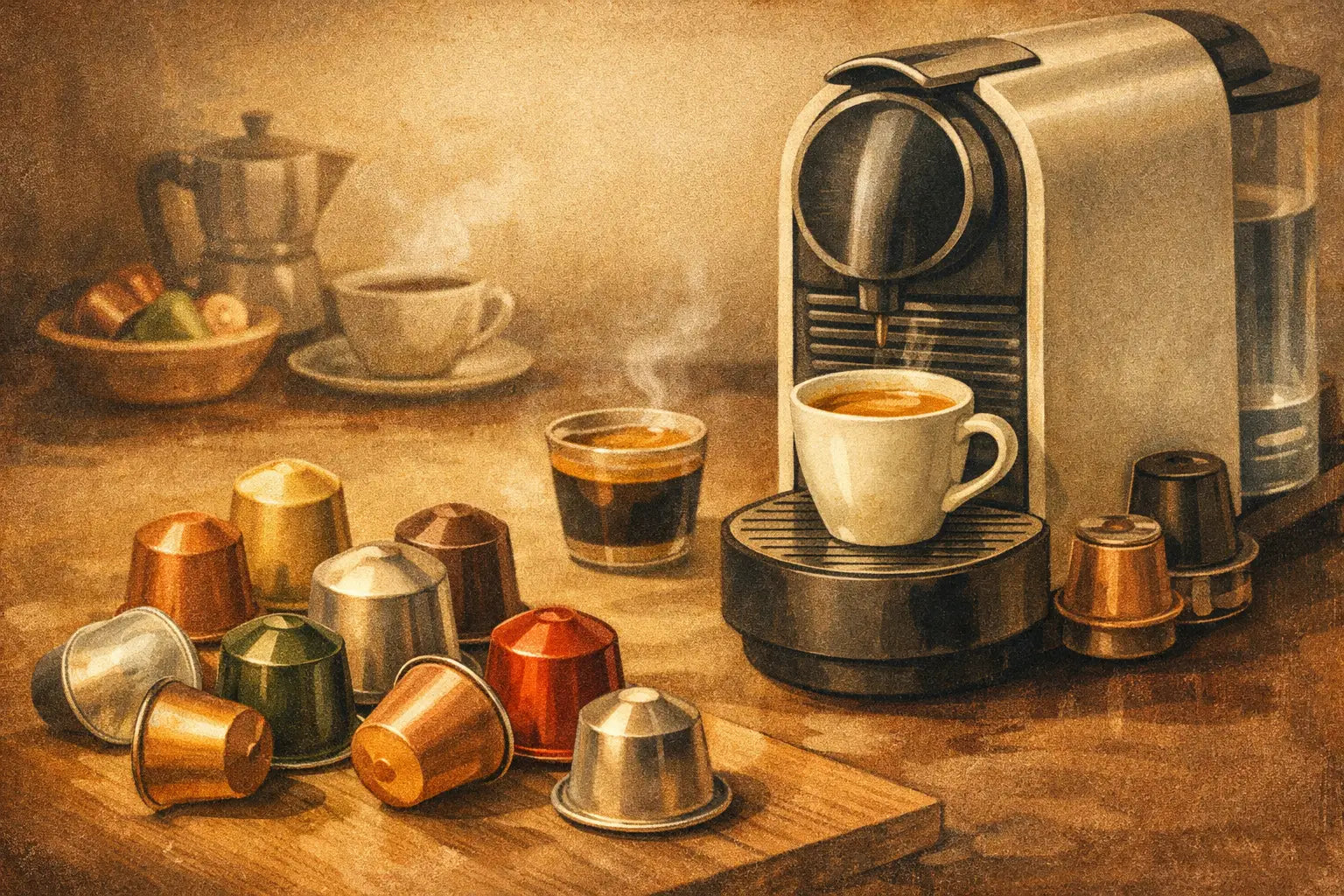
You're standing in the kitchen with a used capsule in your hand. Residual waste, plastic recycling or the organic bin after all? Anyone searching for coffee cups for the organic (GFT) bin rarely wants theory. You just want to know what's true - and what's marketing talk.
That's where the difference begins. Not every coffee cup is suitable for the organic waste bin, even if the packaging looks green. What counts is the material: only a capsule that is genuinely fully compostable can go in the organic waste. Aluminium and plastic can't.
Coffee cups in the organic (GFT) bin: when is it allowed?
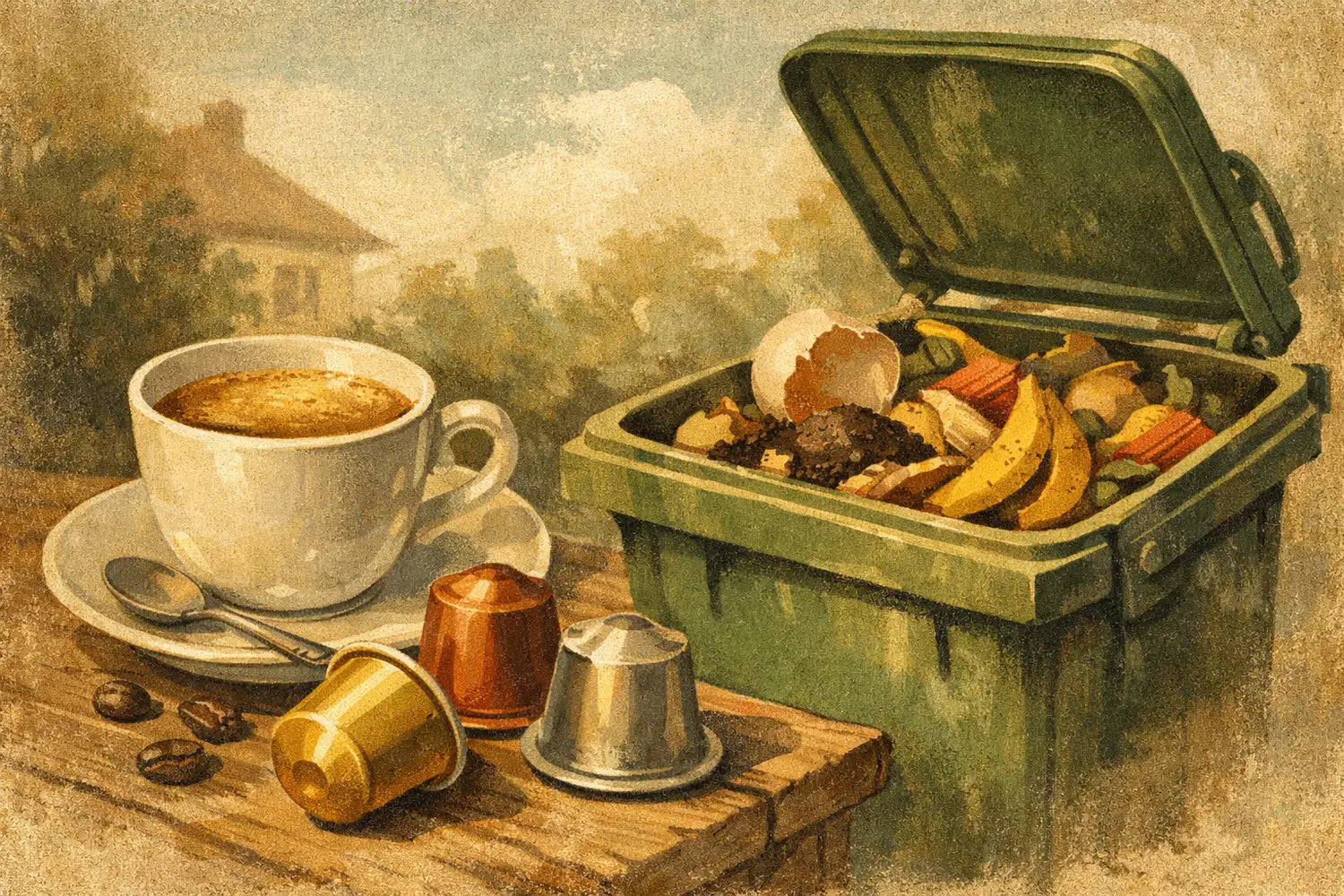
The short answer: a capsule that is fully compostable can go in the organic waste after use — provided your municipality accepts coffee capsules in the organic (GFT) bin. Aluminium capsules can't, and most conventional plastic capsules can't either. So it comes down to the material and to your municipality's rules.
That's more logical than it seems. Fully compostable means the material breaks down into compost after use, just like your coffee grounds. Aluminium and fossil plastic don't, so they belong in a different stream.
An important nuance: compostable doesn't mean every municipality already accepts coffee capsules in the organic (GFT) bin. Collection varies by municipality. So always check your municipality's waste guide before putting capsules in the organic waste.
Where much of the confusion comes from
The capsule market ran on comfort for years and treated waste as a footnote. As a result, consumers got used to a product that's handy in use but unclear the moment it's empty.
There's more to it. Words like biodegradable and compostable are often used interchangeably, while they don't mean the same thing. Biodegradable says little without context. Compostable is more concrete: the material breaks down into compost and returns to the organic cycle.
For the Dutch consumer it's exactly that difference that matters. A capsule made from coffee with a bio-based binder is fully compostable; a capsule made of aluminium or plastic is not. That determines which stream it belongs in after use.
Compostable means giving back to the cycle
A fully compostable capsule is designed to break down in organic processing, together with the coffee grounds still inside it. That's exactly why the material suits the organic (GFT) stream: it's organic, not metal or fossil plastic.
That's no detail. It's the difference between a capsule that still means something after use and a capsule you simply throw away.
What are coffee capsules made of?
Anyone who wants to know whether coffee cups are suitable for the organic waste bin has to look at the material first. With capsules you roughly see three directions.
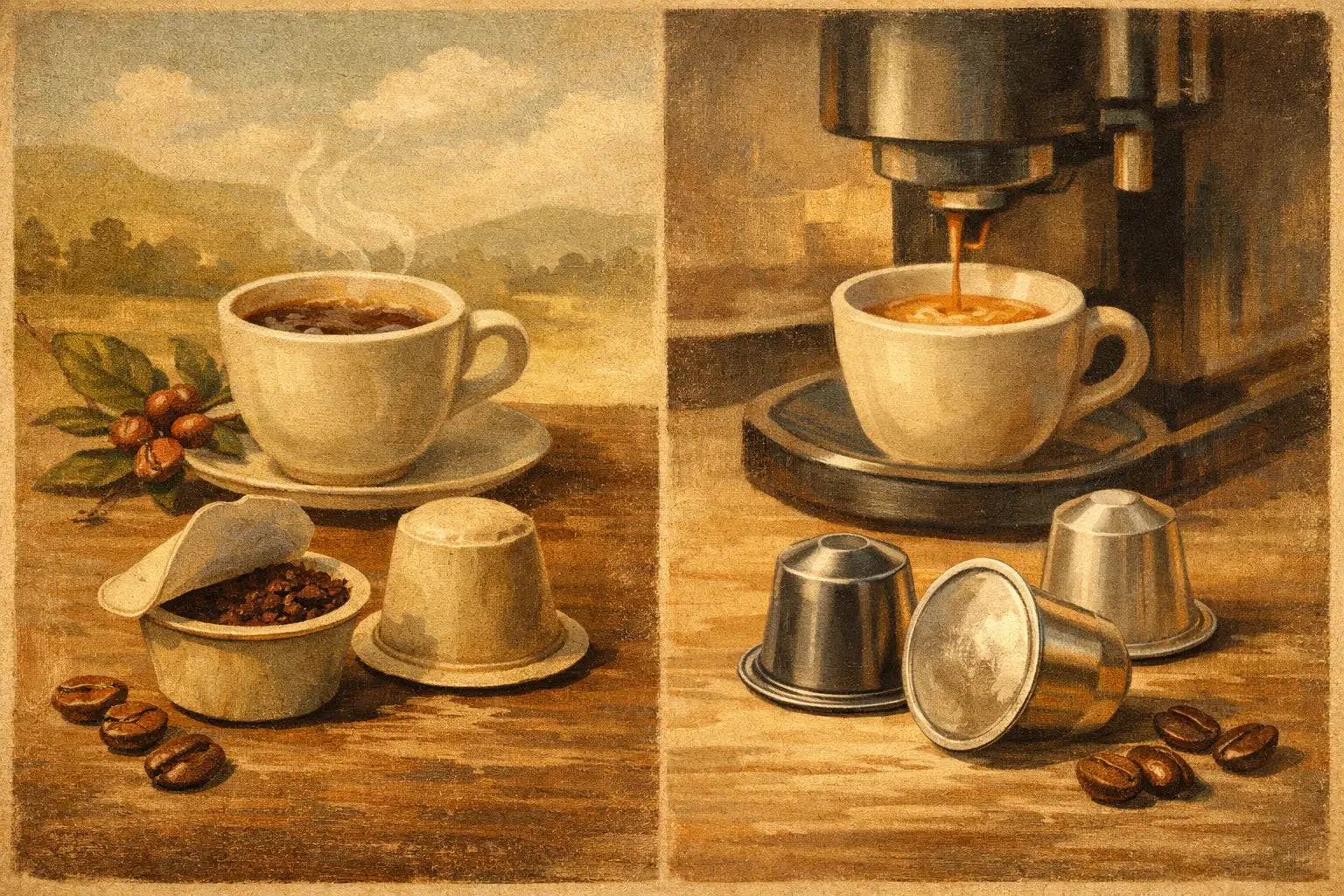
Aluminium is strong, heat-resistant and familiar territory in the category. It can be recycled, but only if it's collected and processed well. In practice that's far from always optimal.
Conventional plastic capsules are light and functional, but lag behind on circularity. They're mainly made for ease of use and machine performance, not for the organic waste stream.
Then there's a newer generation of compostable capsules, made from plant-based or bio-based materials. Within that group there's also a more interesting step: cups made largely from coffee, combined with a bio-based binder. That's a different approach than a capsule that only looks sustainable. The material already starts closer to the contents.
Why material matters after use
The capsule isn't packaging you forget the moment your espresso is ready. It's precisely after use that the design shows whether a product is really thought through. Wageningen showed in 2023 how big that difference can be. Compostable capsules score, when they're actually composted, around 100% on circularity. Aluminium comes out around 48%. Conventional plastic capsules around 23%.
Those aren't lifestyle claims, but a sober way to look at what happens to material after consumption. Not what's on the box, but what the chain can genuinely handle.
How do you tell whether a capsule is allowed in the organic waste?
Don't start with the colour or the look of the packaging. Start with the product information. Does it clearly state that the capsule is fully compostable? Then you know it belongs, by material, in the organic stream — and check whether your municipality accepts coffee capsules in the organic (GFT) bin.
After that, look at the material: coffee with a bio-based binder breaks down in the organic stream, aluminium and plastic do not. That makes the choice clear.
If a brand isn't concrete about the material, that's often more telling than any green claim.
Watch out for vague claims
Phrases like eco, green alternative or better for the planet say little about the bin at home. A claim like compostable without any explanation of the material is too thin as well.
Good information is concrete. What is the capsule made of? Is it compatible with Nespresso Original machines? Is it fully compostable? That's what's useful.
Practical: what do you do at home with used capsules?
For most households this doesn't have to get complicated. If you use capsules that are fully compostable, the used capsule may go in the organic waste, coffee residue and all, where your municipality accepts coffee capsules. That coffee residue in particular fits naturally into the organic stream.
If you use aluminium or conventional plastic capsules, they don't belong in organic waste. Sometimes separate return or collection systems exist, but that's something other than the green container next to your house.
The nice thing is: with a fully compostable capsule the material decides the route. When in doubt, quickly check your municipality's waste guide, and you'll know exactly where it can go.
Why this topic is bigger than waste sorting
The question of where a cup belongs after use says something about a category that barely moved for a long time. Capsules were handy, fast and consistent, but the material story lagged behind. That worked as long as consumers were willing to see waste as an unavoidable side issue.
That time is over. People still want convenience, machine compatibility and good taste, but without a system that needlessly grates after every cup. Not activist. Just logical.
That's why it's interesting when a capsule isn't only compatible with Nespresso Original machines, but is also built differently - for example made largely from coffee with a bio-based binder. That feels less like a cosmetic update and more like product design that has finally caught up with what consumers have sensed for years.
Choosing coffee cups for the organic waste bin without hassle
If you want to switch, you don't have to become a waste expert. A few questions are enough. Is the capsule really fully compostable? Is it clearly explained what it's made of? Does it fit your machine?
If one of those points goes missing, the story immediately gets weaker. Then you're mainly buying a promise. And promises don't make your morning better.
A brand that clearly explains its material choice and use scenario usually also shows that the product holds up further. Not only on sustainability, but also on compatibility, ease of use and flavour profile. That's how the category matures.
The honest answer to the question
So, can coffee cups go in the organic waste bin? Yes, if they're fully compostable — and where your municipality accepts coffee capsules in the organic (GFT) bin. A capsule made from coffee with a bio-based binder can then go in the organic waste after use. Aluminium and ordinary plastic cups don't belong there.
That's a clear answer that's genuinely useful at home. Especially if you use capsules daily, that last step counts. Not as a detail, but as part of the product itself.
Q Drinks shows it can be done differently: a capsule made largely from coffee, fully compostable and — where your municipality accepts coffee capsules — suitable for the organic (GFT) bin, compatible with Nespresso* Original, designed with the waste phase in mind instead of as an afterthought. Still thinking about it…
Take a look tonight at that used capsule on your counter. Often it's precisely that small object that tells you the most about which future of convenience you actually want to keep.