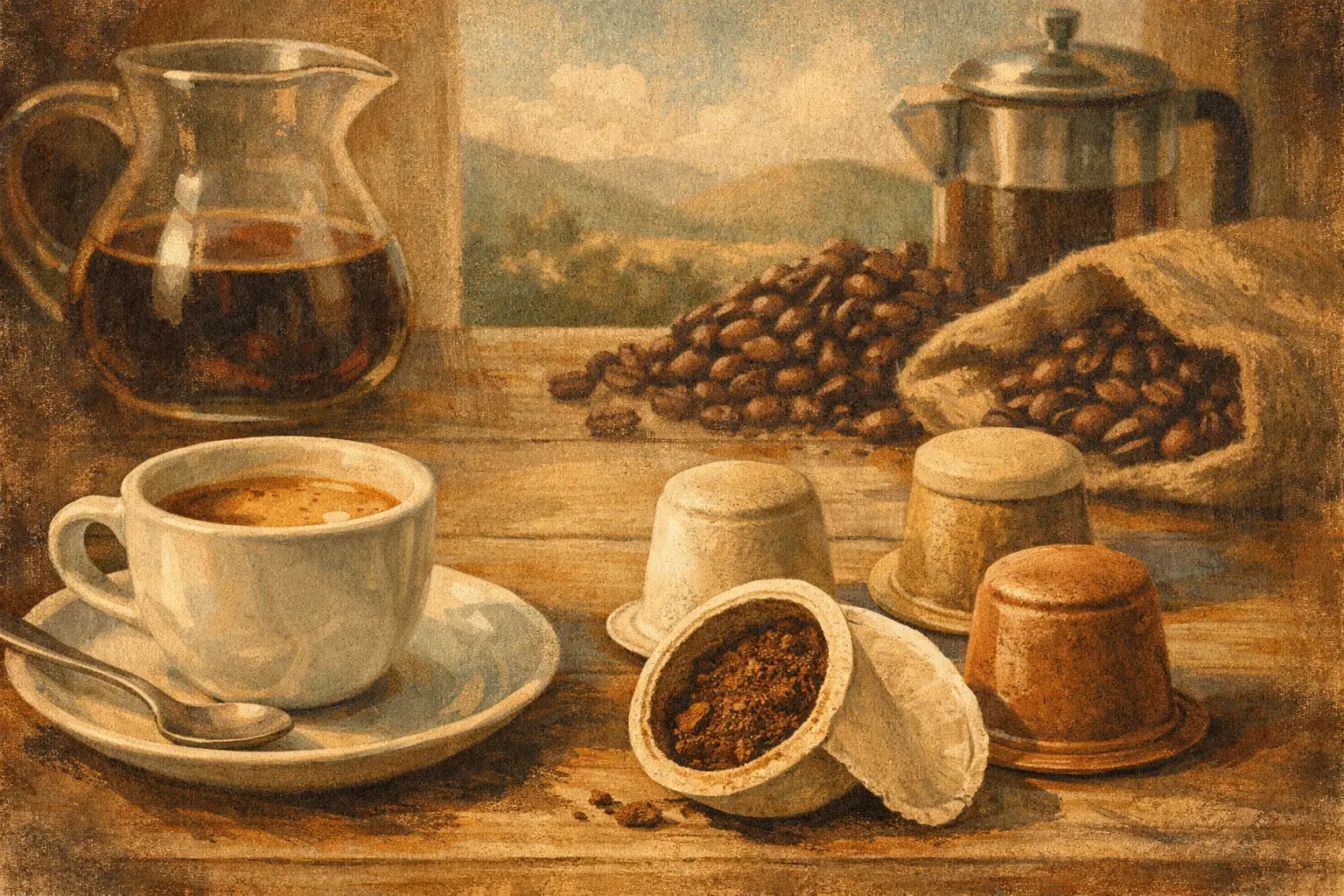

Aluminium in a coffee pod has felt like an odd compromise for years. Fast, clean, consistent - and afterwards you're left with a small shiny shell that outlives your espresso by decades. That's why interest in aluminium-free coffee pods is growing. Not as a niche, but as the logical next step for people who want convenience without being tied to a material that seems to belong to another era.
Why aluminium-free coffee pods suddenly matter
The capsule market is built on comfort. Press the button, done. But that comfort has long been tied to materials that were mainly convenient for the manufacturer: sturdy, cheap at scale, easy to transport. For the user, the trade-off was less elegant. You want a quick espresso in the morning, not a mini packaging file with every pod.
Aluminium-free coffee pods are part of a broader shift. Consumers no longer automatically accept that single-serve coffee has to come with an awkward waste trail. Certainly not when taste, machine convenience and design can stay intact. So the question is not just whether aluminium is recyclable. The real question is why it should still be the standard when smarter options now exist.
What exactly do we mean by aluminium-free coffee pods?
The term sounds simple, but there are big differences under the hood. Some pods replace aluminium with conventional plastic. Others choose compostable materials. And there are capsules made largely from coffee itself, combined with a bio-based binder. That last category is interesting because it's not just a material swap, but a different way of thinking about the capsule itself.
An aluminium-free pod is therefore not automatically the best choice. If a brand simply trades one hard material for another, you gain very little as a user. The comfort stays the same, but the system barely changes. The most relevant question is not just what's left out, but what the pod is actually made of and what happens to it after use.
Not every alternative is equally strong
Aluminium has properties the industry likes: it protects well against oxygen and light, and it looks premium. That makes replacing it technically harder than it seems. Anyone developing aluminium-free coffee pods has to solve several things at once: freshness, extraction, rigidity and compatibility with machines such as Nespresso Original*.
That's why results vary. One pod performs fine in the machine but still feels like traditional packaging. Another looks sustainable but gives up crema, flow or consistency. The difference often lies in the choice of material and in the engineering of the wall, filter layer and piercing resistance.
Do aluminium-free coffee pods work just as well?
Often yes, but not all in the same way. A good capsule doesn't need to copy aluminium; it simply has to perform reliably in the rhythm of every day. That means: piercing correctly, stable extraction and a flavour profile that holds up from the first sip to the last.
This is where nuance comes in. Some aluminium-free pods ask a little more of the machine or are more sensitive to storage. That doesn't have to be a dealbreaker, but it is relevant. Compatibility is not a marketing detail. For people with a Nespresso Original machine it's usually the first filter: does it fit, does it work, does it keep running smoothly?
The best new generation of capsules shows that aluminium is not sacred. Especially when the pod is designed around machine behaviour rather than just packaging, you can simply count on a good espresso or lungo. Not despite the different material, but thanks to better design.
Taste remains the litmus test
Nobody chooses a capsule purely for the material. If the coffee tastes flat or the extraction is erratic, it's over quickly. That's why aluminium-free coffee pods only become truly interesting when the taste doesn't feel like a compromise.
That requires a different approach than before. Not choosing a package first and then seeing which coffee fits, but developing capsule and blend together. Roast, grind, flow and pod construction influence each other. That's exactly where you see the difference between brands that add a sustainability story and brands that have rebuilt the product from scratch.
With premium capsule coffee, it's not just intensity that counts, but control. A pod has to do what it has to do under pressure. When that's right, aluminium doesn't need to be a precondition for a full espresso, bright single origins or a tight crema. The industry pretended otherwise for a long time. That was comfortable. Not necessarily true.
The waste story is less simple than many brands suggest
This is where it often goes wrong. Aluminium is happily presented as recyclable, and technically that's correct. But recyclable is not the same as automatically circular in practice. Small used pods have to be collected, separated and processed. That doesn't always happen, and certainly not always efficiently.
With compostable capsules the nuance sits elsewhere. Fully compostable capsules belong in the organic waste bin (GFT), together with the coffee grounds - where aluminium and plastic don't. That actually makes the waste choice simple: the material decides the bin.
Still, the direction is clear. Research from Wageningen in 2023 shows that compostable capsules, when actually composted, can turn out almost fully circular. Aluminium scores markedly lower in the same study, even in a favourable scenario. Conventional plastic capsules lag even further behind. That difference is not cosmetic. It says something about what remains long after the coffee moment has passed.
Aluminium-free coffee pods made from coffee
This is where it gets interesting. There are now capsules made largely from coffee, combined with a bio-based binder. That's a different starting point than simply replacing aluminium with standard plastic or a thin wall of biopolymer. The capsule itself becomes part of a more intelligent material story.
For consumers, that means something very concrete: the pod feels less like a separate packaging object and more like a product that matches what's inside. Not as a gimmick, but as a design decision. It's the difference between an alternative that just wants to be less bad and an alternative that wants to genuinely redraw the category.
Q Drinks works from exactly that idea. Not because it sounds nice, but because the capsule market clung to the same materials for too long while consumers had already moved on.
What to look for in this type of capsule
The first question is compatibility. If your machine is used daily, you don't want an experiment on the counter. So look for a clear statement of compatibility with Nespresso Original if that's your system.
The second question is material transparency. "Aluminium-free" says something, but not enough. Check whether a brand clearly explains what the capsule is made of, without empty claims like "pure coffee" or "no plastic whatsoever" when that's not accurate. Honest information may feel less loud, but it's ultimately more convincing.
The third question is end of life. Is the pod fully compostable, and does it therefore belong in the organic waste bin? A brand that's clear about that usually understands the rest of the product better too.
Who is this really a better choice for?
For busy households, certainly. For people who don't want to trade capsule convenience for hassle, too. But above all for consumers who have felt for a while that the classic capsule is an old answer to a modern routine.
That applies just as much to coffee drinkers who care about taste as to people who like their kitchen organised just a bit smarter. You don't have to be a zero-waste purist to be done with aluminium. Sometimes you just want a daily product to make more sense.
There is one caveat. If you look purely at the lowest price per cup, not every innovative capsule is automatically the cheapest route. New materials and better development simply cost money. On the other hand, many consumers don't compare on price alone, but on total experience: machine convenience, looks, taste and what you throw away afterwards.
The category is finally moving
For years, capsule coffee seemed like a closed system. The machine was a given, the material too, and the consumer mainly got to choose between blends. That era is ending. The interesting innovation is now not just in taste, but in the pod itself.
Aluminium-free coffee pods are therefore more than a material trend. They show that convenience doesn't have to be stuck to old packaging logic. That's good news for anyone who wants to keep single-serve coffee but make the rest of the system less outdated.
The smartest choice is usually not the loudest packaging or the greenest slogan. It's the capsule that's honest about material, works reliably in your machine and follows a more logical route after use. When that becomes the new standard, aluminium suddenly feels less premium and mostly just old.
Still thinking about it… Maybe that's exactly the moment a category starts to change.