Your machine still works fine. It is only those capsules that suddenly feel dated. Anyone searching for Nespresso Original compatible coffee cups is usually after more than just a different coffee, but a better system in the same format. Less hassle, the same routine, and ideally without compromising on taste or machine fit.
That makes this category more interesting than it looks at first glance. Compatible sounds simple, but in practice it is about pressure, flow, crema, material, waste and the question of whether a capsule really suits how you live. Especially if you drink espresso or lungo every day, you quickly notice the difference between a capsule that merely fits the machine and one that actually performs well in it.
What really matters with Nespresso Original compatible coffee cups
The first check is obvious: does the capsule work in a Nespresso Original machine? Not in Vertuo, not in a proprietary system, but in the classic Original format. Yet that compatibility only tells you about fit. It says nothing about extraction, about how stable the flow is, or about the quality in the cup.
Then comes taste. And taste does not start with marketing language, but with composition. Think of Roast, Origins and Intensities that are built up logically. A dark Roast can work well as espresso, but is not automatically better. For lungo you often want a little more balance and length. Anyone who drinks coffee at several moments during the day benefits more from a range with clear differences than from ten variants that all resemble each other.
The third point is material. For a long time this was the most stuck part of the category. Aluminium worked well technically, plastic was cheap and practical, and that was that. Now that is no longer enough. If you throw away capsules every week, you want to know what they are made of and what happens to them afterwards. Not as a moral statement, but simply because it is part of the product.
Compatible is more than fitting
A capsule can click mechanically into your machine and still disappoint. That happens when the wall is too stiff or too soft, when the perforation does not work properly, or when the capsule opens irregularly under pressure. You see the result straight away: an extraction that is too fast, a watery espresso, or a machine that seems to struggle more than usual.
Good compatible capsules are designed around the behaviour of the machine. That takes precision. Shape, thickness, sealing and material all have to be tuned to each other. With Nespresso Original in particular, everything comes down to repeatability. You want the same experience on Monday as on Friday, without guessing whether this batch will suddenly behave differently.
That is where the nuance lies. Some people think all compatible cups perform more or less the same. They do not. Differences in material and construction have a direct effect on use and taste experience. So it is smart to look not only at the blend, but also at the capsule design itself.
Material is no longer a detail
Anyone choosing new cups today looks at things differently than five years ago. Not only at Intensity, but also at what is left after use. Aluminium is sturdy and familiar, but takes a lot of energy to produce and depends on proper collection and recycling. Conventional plastic cups are light and cheap, but feel to many users like a solution from another era.
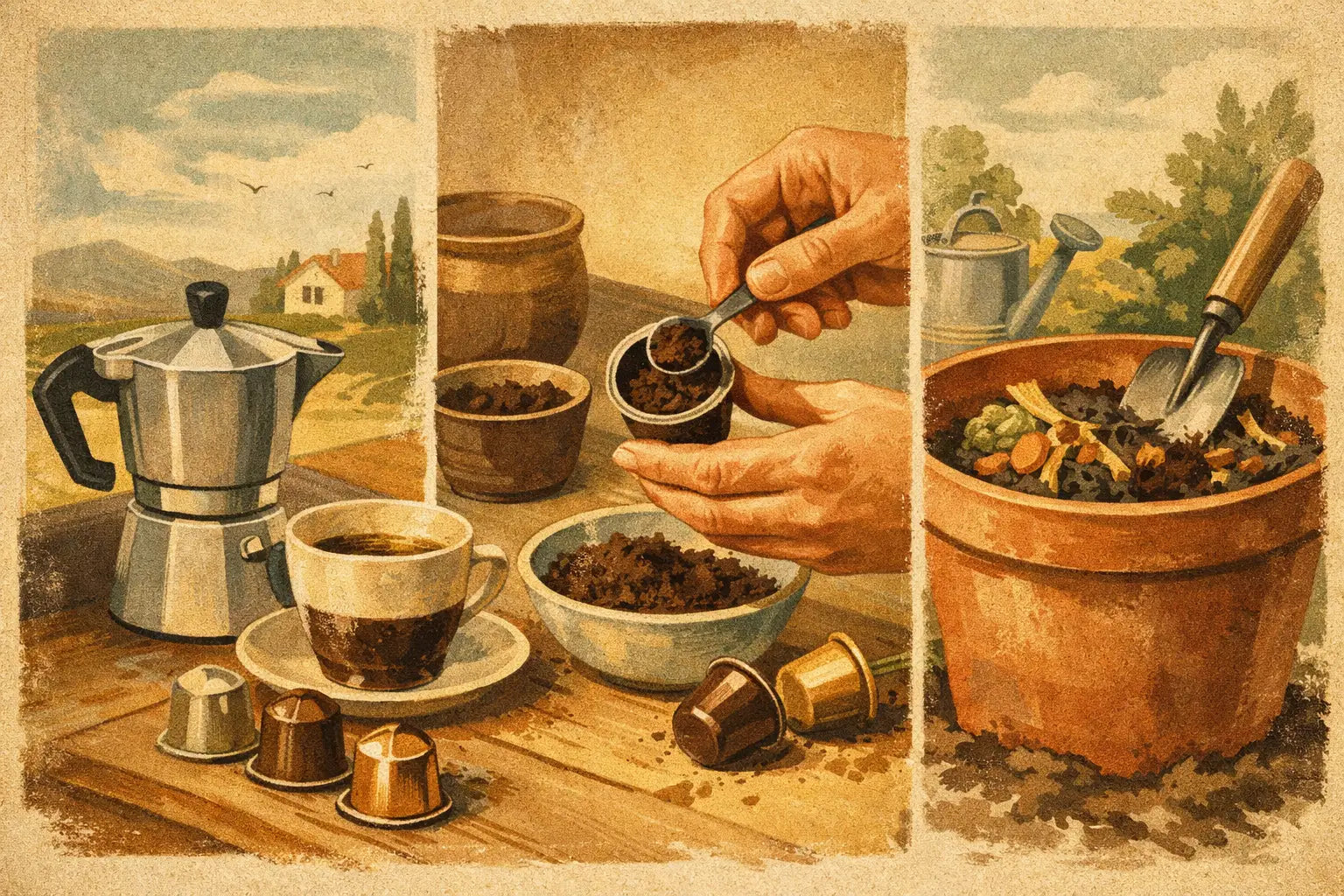
There is now a third route: capsules made from coffee, with a bio-based binder. That suddenly makes the material story a lot more interesting, because the capsule is not separate from its contents but comes from the same world. At Q Drinks the cups are made from coffee with an organic binder, designed for Nespresso* Original compatibility and meant to break the fixed script of aluminium or fossil plastic.
That does not mean every sustainability story automatically holds up. You want concrete information. In the Netherlands these capsules are fully compostable in the organic waste bin, together with the coffee grounds. That is not a side issue. It is exactly the kind of practical detail that determines whether something really works at home.
Compostability calls for honest language
Sustainability quickly becomes vague when brands promise too much. That is why it is more useful to look at clear figures. Research from Wageningen in 2023 shows that compostable capsules, when they are actually composted, reach around 100% circularity. Aluminium sits at around 48%. Conventional plastic capsules come out at around 23%.
That difference matters, but only if you explain it properly. A compostable capsule is not magic and does not simply disappear everywhere. The benefit lies in the system around it: material choice, processing and the possibility of becoming part of the organic cycle again after use.
That is exactly where the choice grows up. Do not make it bigger than it is, do not make it smaller than it is. You do not buy a conscience in capsule form. You choose a product that can fit better with how you want to drink and dispose of your coffee.
Taste remains the decider
However good the material story is, no one reorders if the coffee disappoints. So compatible coffee first has to be genuinely good in the cup. That starts with a range that has character. A clear espresso for the morning, a rounder lungo for later in the day, perhaps a decaf that does not feel like a compromise.
For many users, variety is also part of the routine. Not everyone always wants the same Roast. One person looks for classic and dark, another for cleaner and lighter. And more and more people want capsule drinks alongside coffee that suit a different moment, without immediately switching to a new device.
That is where the category gets interesting. A machine on your counter does not have to stay limited to one taste profile or one type of use. When compatibility is well arranged, you get freedom without friction. That sounds small, but in daily use it is exactly what counts.
When switching is smart - and when it is not
If you are happy with your current coffee, use few capsules and waste plays no role for you, then switching is not necessarily urgent. Not every difference has to be an immediate reason to change. Sometimes what you have simply works well enough.
But for intensive users it is different. If you make several capsules a day, every drawback adds up quickly. You notice material choice more, you literally see the waste pile up faster, and ease of use becomes more important. And if you are curious about specialty-oriented taste or about functional variants within the same capsule format, compatible innovation suddenly stops being a niche and becomes a logical next step.
There is also the machine side. Anyone with a Nespresso Original machine that can technically last for years does not need to invest in new hardware to choose a better capsule. That is precisely what makes this market so relevant. The best upgrade is sometimes not a new machine, but a smarter cup.
How to choose the right compatible cup
Start simple. First look at your machine and check that it really is Nespresso Original. Then do not choose straight away on design or claims, but on three things: taste profile, material and practical processing after use.
If you mainly drink espresso, choose a line built for that and not just a general all-round blend. If you mainly drink lungo, pay attention to balance and length rather than Intensity alone. And if compostability matters to you, choose a cup that is fully compostable in the organic waste bin. Then you know exactly where it belongs after use.
A tasting pack is often smarter than buying big straight away. Not because you should doubt the concept, but because taste stays personal. The best cup on paper can still just miss your pace or preference at home. Good compatible coffee does not win in theory, but in repetition.
The category is finally moving
Coffee cups were functional and predictable for a long time. Machine, aluminium, the same logic, done. Now the consumer expects more. Better taste, more honest materials, clearer information and a routine that suits now rather than twenty years ago.
That is exactly why the search for Nespresso Original compatible coffee cups means so much more than a technical question. It is a filter for a more modern standard. Does it work in my machine? Does it suit my taste? And does the material still make sense in 2026?
If the answer to all three is yes, you do not need to explain much. Then mostly one thought remains: your daily coffee is allowed to feel smarter than the category used to be.