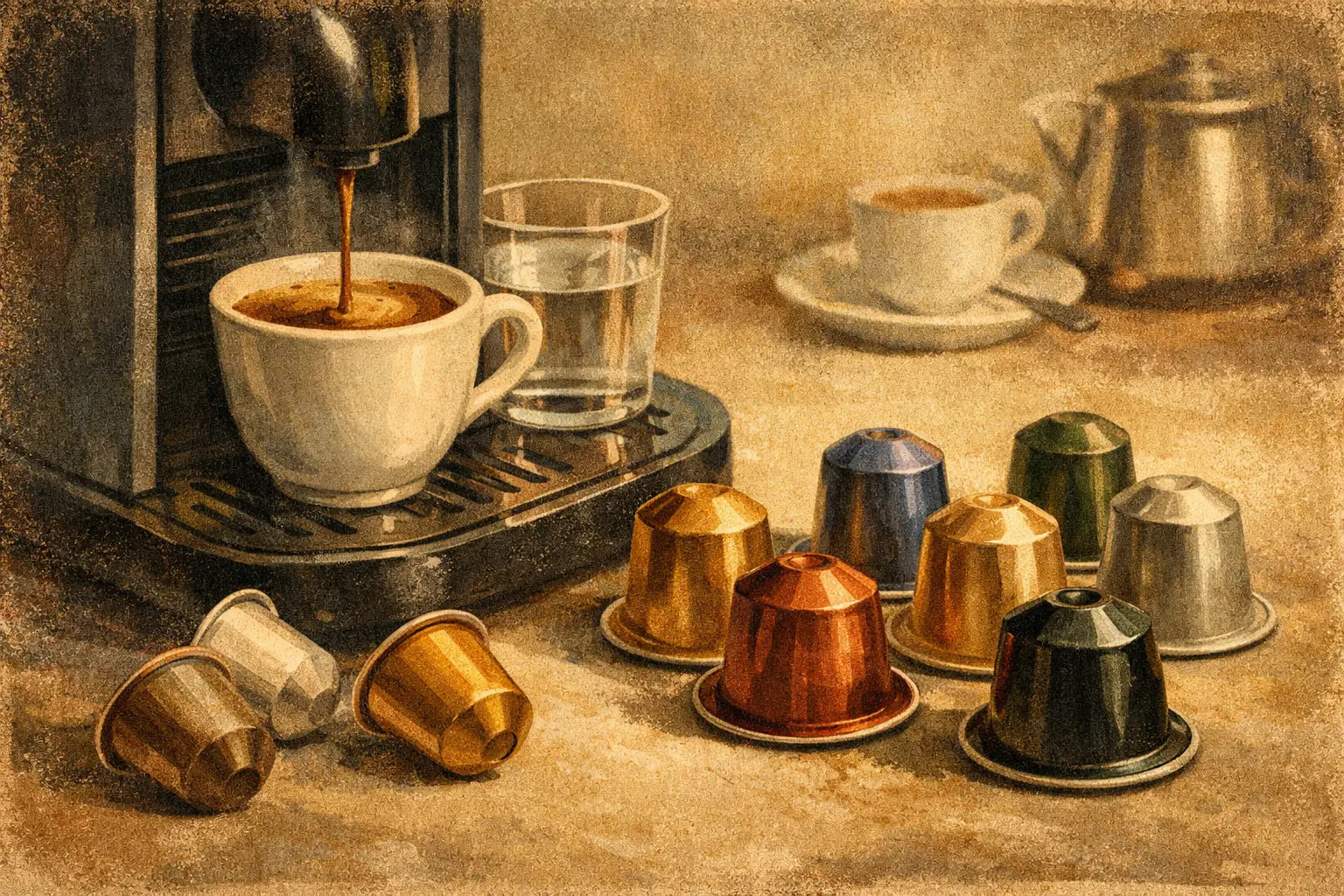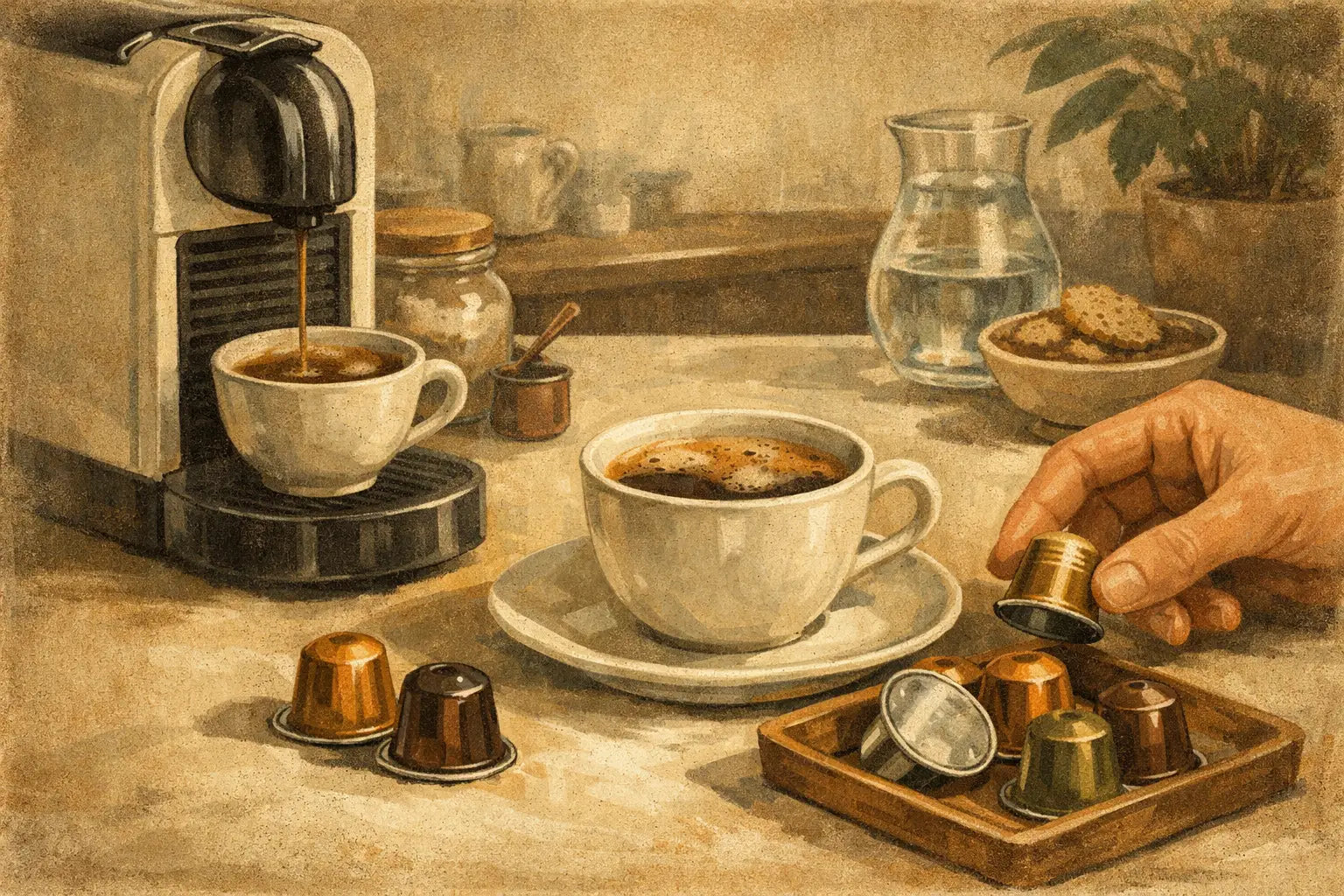
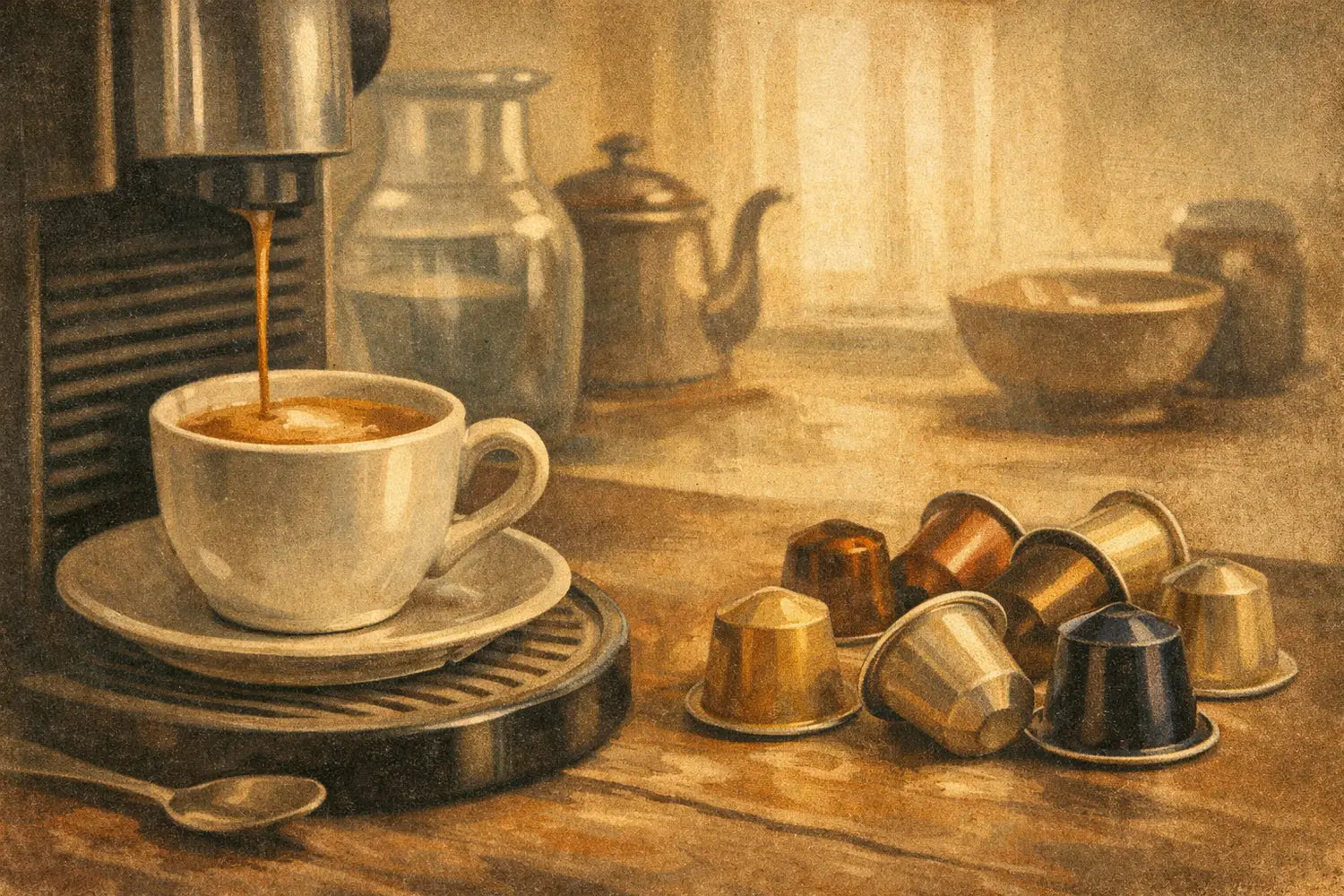
Your machine is already on the counter. The choice you make every morning is not in the device but in that small capsule. This guide to Nespresso Original capsules takes you further than the Intensity on a box: from taste and size to material, waste and what is genuinely compatible with your routine.
Capsule coffee does not have to be complicated. But anyone who wants to choose better looks beyond the branding or a high number. Roast, Origins, grind, capsule material and the setting of your machine together decide what ends up in your cup. Small object, surprisingly big difference.
First things first: Nespresso Original is not Vertuo
Nespresso Original capsules are the compact, cylindrical capsules for Original machines. Think of the familiar espresso and lungo buttons, with a capsule the machine pierces on both sides. A Nespresso Original capsule does not fit a Vertuo machine, and a Vertuo capsule does not fit an Original machine.
That distinction sounds basic, but it prevents the most needless bad buy in capsule land. So first check the name of your machine, not just the brand on the front. Does it say Original, or does your machine take the classic small capsules? Then look for Nespresso* Original compatible capsules.
Compatible does not mean every capsule behaves identically. Machines differ in age, maintenance and water pressure. The material and shape of the capsule also affect the flow. A good capsule is therefore not only a matter of fitting, but of brewing coffee consistently without hassle.
A guide to Nespresso Original capsules: choose on the moment, not on marketing
Many people start with Intensity. Understandable, because the number is printed large on the packaging. Yet Intensity is not a universal taste meter, nor a direct indication of caffeine content. It usually says something about how powerful a coffee comes across, through things like Roast, body and bitter notes.
For your first cup you often choose differently than after dinner. A light to medium Roast can taste brighter and livelier, while a dark Roast more often has a heavier, roasted profile. Neither is automatically better. It depends on your preference, your recipe and above all on the moment.
Espresso, lungo or with milk
An espresso is short and concentrated. Here details in the coffee stand out faster: the roast, the texture and any fruity or nutty notes. If you mainly drink espresso, a capsule with enough body is often a logical starting point.
A lungo runs through longer and calls for a coffee that does not turn thin or sharp once more water is added. Not every espresso capsule is made for a long extraction. So use the recommended amount of water on the packaging as a starting point, not as an optional suggestion.
Do you drink cappuccino, flat white or coffee with plant-based milk? Then the coffee may have more presence. Milk softens bitters and mutes subtle notes. A medium-dark Roast usually holds up better in such a recipe than a very light espresso. For black coffee you can more often choose nuance and a lighter profile.
Origins and blends: what do you really taste?
With single Origins the coffee comes from one country or area. That can give a clearer character, but is no quality stamp in itself. A blend combines beans to create a certain balance - for example more body, a more stable crema or a familiar profile that stays recognisable with every delivery.
Look less at exotic origin stories and more at concrete taste language. Cocoa, roasted nuts and caramel often point to a rounder profile. Citrus, berries or flowers can turn out fresher and more pronounced. Anyone looking mainly for a classic espresso is usually well served by a coffee in which body and roasted notes lead. If you want variety, you are better off with a flexible subscription than with a large stock of a single type straight away.
Material is part of the choice
A capsule is packaging, but also part of the brewing process. Traditionally you mainly come across aluminium and plastic. Q Drinks chooses a capsule largely made from coffee - coffee chaff - with a bio-based binder. That is a different starting point than a capsule that ends up as metal or plastic after a single cup.
The relevant question is not which material has the nicest story. The question is what happens to it after use. Compostable capsules can fully compost in the Dutch organic (GFT) stream, provided they are actually composted. Not every municipality accepts coffee capsules with organic waste yet. So always check the local waste guide before you put them in the green bin.
That difference counts. Research by Wageningen University & Research from 2023 shows that compostable capsules, when they are actually composted, can reach around 100% circularity. Aluminium comes in at around 48% on average. Conventional plastic capsules come in around 23%. This is not about an abstract label, but about the extent to which materials find a usable place again after use. Source: Wageningen University & Research, 2023, doi: 10.18174/641509.
A compostable capsule is therefore no licence to ignore waste rules. But it does make your daily choice less dependent on perfect sorting, collection and recycling of a miniature package.
Crema, flow and a machine that cooperates
Crema is attractive, but not a final verdict. That layer forms through pressure, carbon dioxide in the coffee and the way water flows through the capsule. Plenty of crema can look spectacular and still say little about balance or taste. So judge your coffee after the first sip, not only in the first five seconds.
If a capsule runs through too quickly, the coffee often tastes watery. If it runs extremely slowly or water spatters along the side, limescale or a dirty capsule holder may play a part. Descale in time, clean the drip tray and the capsule chamber regularly and use fresh water. That takes minutes and stops you writing off a good capsule because of a machine that needs attention.
Cup size matters too. An espresso in an enormous mug quickly feels meagre, even when the extraction is good. Better to pull an espresso as intended, or choose a capsule developed for lungo. If you want more volume with milk, first make a short coffee and then add milk. That keeps the flavour standing.
Look beyond standard coffee, but always read the label
A capsule machine is a handy fixture in busy homes. That also makes it suitable for more than your usual coffee. There are capsules with different coffee profiles and functional blends for moments when you want something other than a standard espresso.
But don't let big promises steer your choice. Look at the ingredients, the recommended preparation and the caffeine content. A blend can suit a morning, a workday or a quieter moment, but everyone's preference and sensitivity to caffeine differs. Transparency on the label is more interesting than exaggerated claims on the packaging.
For those ordering online, a recurring delivery is mainly practical if you know what you use. Count how many capsules you get through in a normal week. Start with room to switch flavours or pause a delivery. Convenience only really works when it adapts to your life, not the other way around.
The best capsule for your machine is ultimately the one that is right at three moments: when you choose it, when you brew it and when you dispose of it. Take one week to taste deliberately, check your local organic waste rules and stick to your usual cup size. After that, that morning choice suddenly becomes a lot simpler. Don't just drink. Think.