
An empty capsule bin next to the machine often says it all. In many offices coffee is arranged, but nobody really owns the stock, the taste or the pile of packaging that builds up every week. An office coffee subscription brings calm to that routine - as long as you don't only look at the price per capsule.
For teams already working with a capsule machine, good office service doesn't have to mean a big contract, a bulky appliance or a weekly supplier with boxes under the desk. It starts with a choice that fits how people actually work: flexible, fast and without a supply cupboard full of surprises.
When does an office coffee subscription make sense?
A subscription works especially well when coffee at the office is a fixed habit, but buying it always happens on the fly. Someone orders too late. A favourite roast runs out. Or suddenly there are six different packs in the kitchen, and nobody knows who bought them.
With a fixed delivery you turn coffee into a predictable part of the working week. That isn't the same as being locked into a rigid contract. A good subscription leaves room to adjust the quantity, pause a delivery or stop when the team's rhythm changes. Think of quiet summer weeks, hybrid working days or an office that grows temporarily.
The limit lies in consumption. A team of eight working together two days a week needs something different from forty people with a daily espresso after lunch. So don't start with the question of how many capsules you want to buy, but with how many cups are actually brewed.
Work it out from the coffee machine, not from a hunch
Watch the capsule bin for two weeks and count what goes through it. Then multiply the average by four and keep a small margin for visitors, deadlines and Mondays. That way you avoid two classics: a subscription that runs out too fast and boxes that sit around for months.
After that, pick a delivery frequency that suits your storage space. Monthly is clear and manageable for many small and medium-sized teams. For a larger office a shorter rhythm can make more sense, as long as it doesn't turn into a warehouse next to the meeting room.
Choose flavour for different moments
Office coffee doesn't have to set everyone to the same setting. The first espresso of the morning often calls for something different from a lungo during a long meeting. Still, a range of ten flavours usually isn't a sign of hospitality, but an invitation to decision fatigue and leftover stock.
Keep it tight: choose an accessible daily roast and add one more outspoken option for lovers of higher intensity. A third variant can make sense if you drink a lot of lungo. That gives colleagues choice without the drawer becoming a tasting room.
At Q Drinks, teams can also add capsule blends to their order alongside coffee, if that suits the moment and the team's preference. Don't see such options as a replacement for ordinary coffee, but as an extra choice for people who like to vary their routine.
A tasting pack is a smart start when you don't yet know where the office will land. Don't let one person decide based on their own espresso. Set up a short trial week, ask for honest reactions and then choose the two or three variants that go the fastest. The office usually gives the clearest answer itself.
Machine compatibility prevents frustration
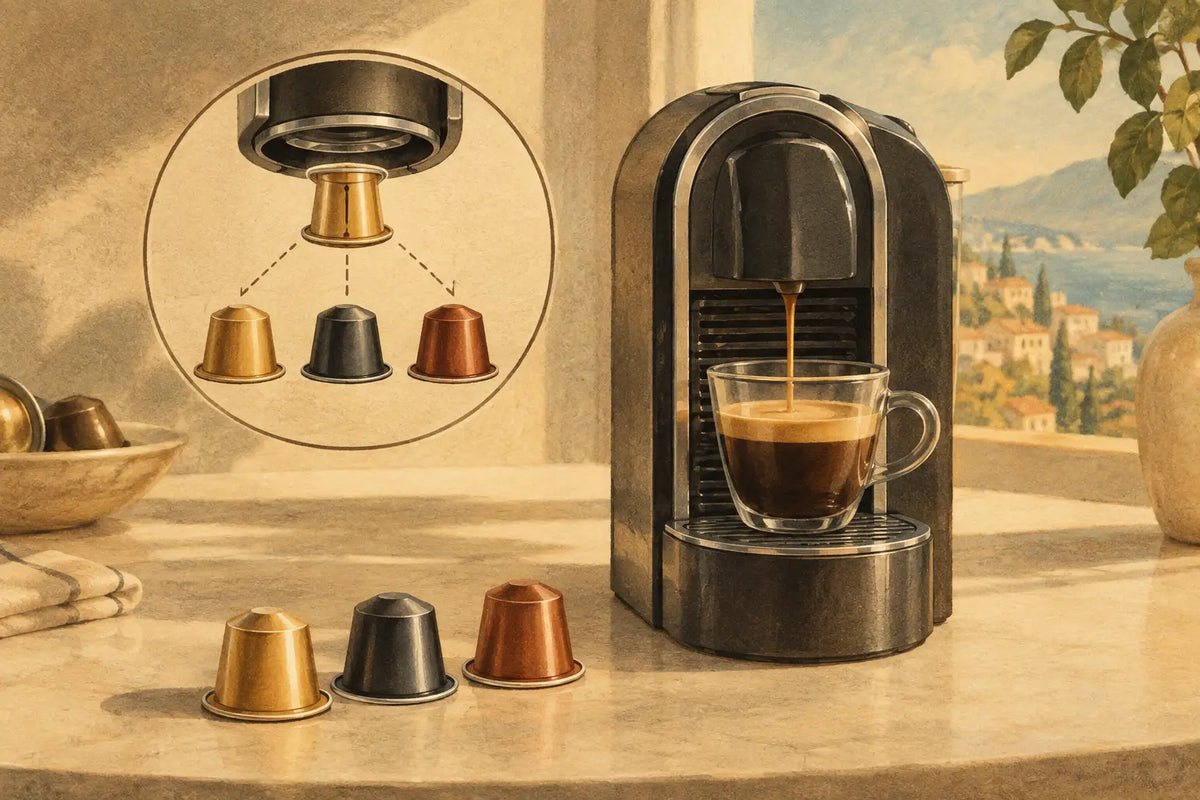
The best capsule is worthless if it doesn't fit the existing machine. So before you start, check which system is in the kitchen. Many offices use a Nespresso Original machine. Capsules that are compatible with Nespresso* Original fit those, but always check the exact machine type if there's any doubt.
Test it practically too. Does the capsule run through well? Is the crema how you like it? Does the machine work smoothly across several cups in a row? On paper, capsule formats sometimes look interchangeable. In the kitchen that's a lot less abstract.
For an office with multiple machines there's one more thing: standardise where you can. Different systems on different floors make ordering more complicated, increase the chance of the wrong stock and mean capsules end up in the wrong place. One clear system makes the subscription easier to manage.
Less waste starts with what you throw away
Capsule coffee is fast. The question is what's left after that speed. Aluminium and conventional plastic capsules call for a separate collection and processing routine that, in a busy office, isn't always followed consistently. The capsule bin gets emptied, but where the contents end up is often unclear.
A capsule made largely from coffee - coffee chaff with an organic binder - takes a different route. Q Drinks capsules are fully compostable in the Dutch GFT (organic waste) bin. There's a practical caveat, though: not every municipality accepts coffee capsules in the organic waste. So check your local waste guide before you introduce an internal waste routine.
The comparison isn't only a matter of feeling. Research from Wageningen University & Research in 2023 shows that compostable coffee capsules, when they're actually composted, score around 100% in circular use. Aluminium reached 61% in the best scenario studied, typically around 48%; conventional plastic capsules came in at 23%. Those figures make one thing clear: the material counts, but the route after use counts just as much.
So place a small, clearly labelled organic waste bin next to the machine if your municipality accepts capsules. Not as a green gesture for the photo, but because a good choice only works when the routine around it holds up.
How to keep the subscription manageable
An office coffee subscription shouldn't become yet another task for office management. Appoint one owner, but keep the details visible to everyone: which capsules arrive when, where the reserve stock is kept and who adjusts the subscription when staffing changes.
A simple monthly check is usually enough. Look at three things: has anything run out, is anything sitting unused and is the delivery still matched to the number of office days? Then adjust one variable at a time. Ordering more capsules and adding three new roasts at once makes it impossible to see what actually changes.
Budget control also gets easier when you work from the cost per cup brewed rather than the price of one large order. That includes not just capsules, but also rush purchases, unused stock and time lost to ad-hoc ordering. A lower capsule price can work out more expensive if something is constantly missing.
Give the team one simple rule
The best office rituals are almost invisible. Agree that the last two boxes aren't opened without someone flagging it. Let one spot in the kitchen serve as the reserve stock. And don't leave loose capsules in various drawers, where they only resurface months later.
That sounds small, but this is exactly where a subscription proves its worth: not in an impressive dashboard, but in a coffee corner that simply does what it should every working day.
A subscription is no excuse to choose less critically
Convenience is appealing, but automatic ordering mustn't become automatic mediocrity. Each quarter, assess whether the taste still fits, whether the quantity is right and whether the waste stream works as intended. A team changes. The subscription has to be able to move with it.
So don't choose the biggest promise, but a system that's clear about compatible machines, ingredients, delivery and what can happen to the capsule after use. Coffee at the office is a small moment between big agendas. That's precisely why the choice behind it can be sharp. Don't just drink. Think.