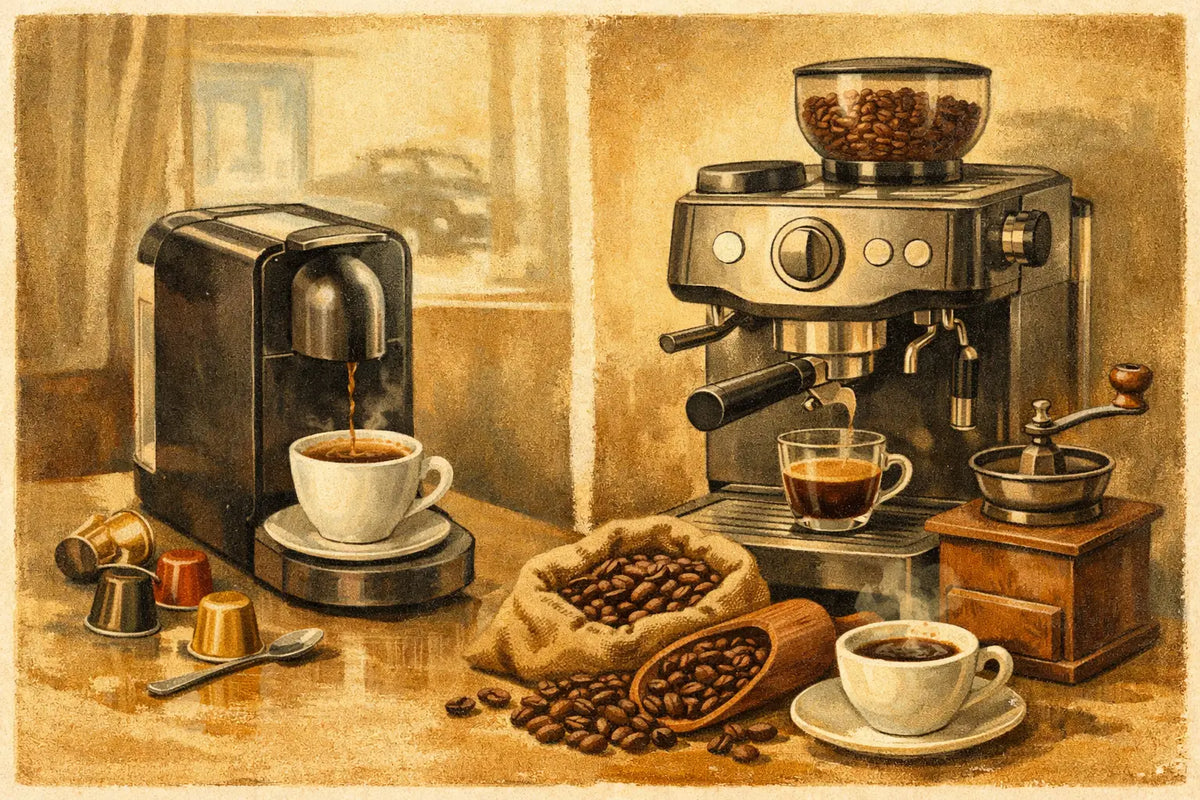
At 08:12 you don't want to read a manual, weigh beans or rinse a drip tray. You want coffee. But the moment you consider a new machine, the choice becomes bigger than a button or a bean hopper. Capsules versus a bean-to-cup machine is about taste and speed, but just as much about counter space, maintenance, waste and the way your day runs.
A bean-to-cup machine has the image of the serious choice. Capsules stand for convenience. That picture is only half right. The better question is: how many actions do you want to take for one espresso, and where do you want to avoid compromises?
Capsules versus a bean-to-cup machine: the real difference
A bean-to-cup machine grinds coffee beans just before you brew. That's the big advantage: you often set the grind size, strength and quantity yourself. With fresh beans, a well-adjusted grinder and regular maintenance, that can deliver a pronounced espresso. Anyone who likes to fiddle with settings and try different Origins gets a lot of freedom in return.
A capsule machine works differently. The coffee is pre-dosed and ground, so every capsule has the same extraction as a starting point. Insert, press, done. The control lies less in the machine and more in your choice of Roast, Intensity and blend. That doesn't make capsules necessarily less interesting for taste lovers. It's simply a different kind of precision: consistency over adjusting.
For a household where one person drinks a short espresso at seven and another a lungo at ten, that predictability can be exactly what you want. No discussion about the setting that was still fine yesterday. No beans sitting open in the hopper while you're away for a weekend.
Taste: fresh grinding isn't the whole story
Freshly ground coffee smells impressive. That moment has something to it. But aroma alone doesn't decide the quality in your cup. Temperature, pressure, water, grind, dose and the time between grinding and brewing all play a part. A bean-to-cup machine offers plenty of potential, but also asks for attention to realise that potential.
With capsules the dose is protected until the moment of brewing. That makes them strong in repeatability. Choose a capsule that suits you and you know what you'll get on a Monday morning and a Friday afternoon. For many people that's not a compromise but a luxury: good coffee without an extra project.
There is a caveat. Anyone who loves the whole ritual - smelling beans, refining settings, approaching an espresso differently per bean - will feel more at home with a bean-to-cup machine. Anyone who mainly wants a clear, reliable espresso or lungo without barista ambitions is better off with capsules.
Milk drinks make the difference smaller
If you mainly drink cappuccino or latte, small flavour differences in the espresso become less dominant. The quality of your milk frother, the milk itself and your routine then weigh heavily. In that case it's often smarter to choose on ease of use and cleaning work than on the maximum adjustability of the brew.
Time and maintenance: what do you pay daily?
A bean-to-cup machine asks for work you don't always see on the machine's packaging. Refilling the bean hopper, emptying the drip tray, removing coffee grounds, cleaning milk systems, descaling and sometimes cleaning the brew group. That needn't be a problem. For someone who deliberately maintains one machine, it's part of the ritual.
But maintenance is no detail. Old coffee grounds and milk residue affect taste and hygiene. If you have little time or simply no appetite for extra household tasks, a bean-to-cup machine quickly becomes a device that demands more than it gives.
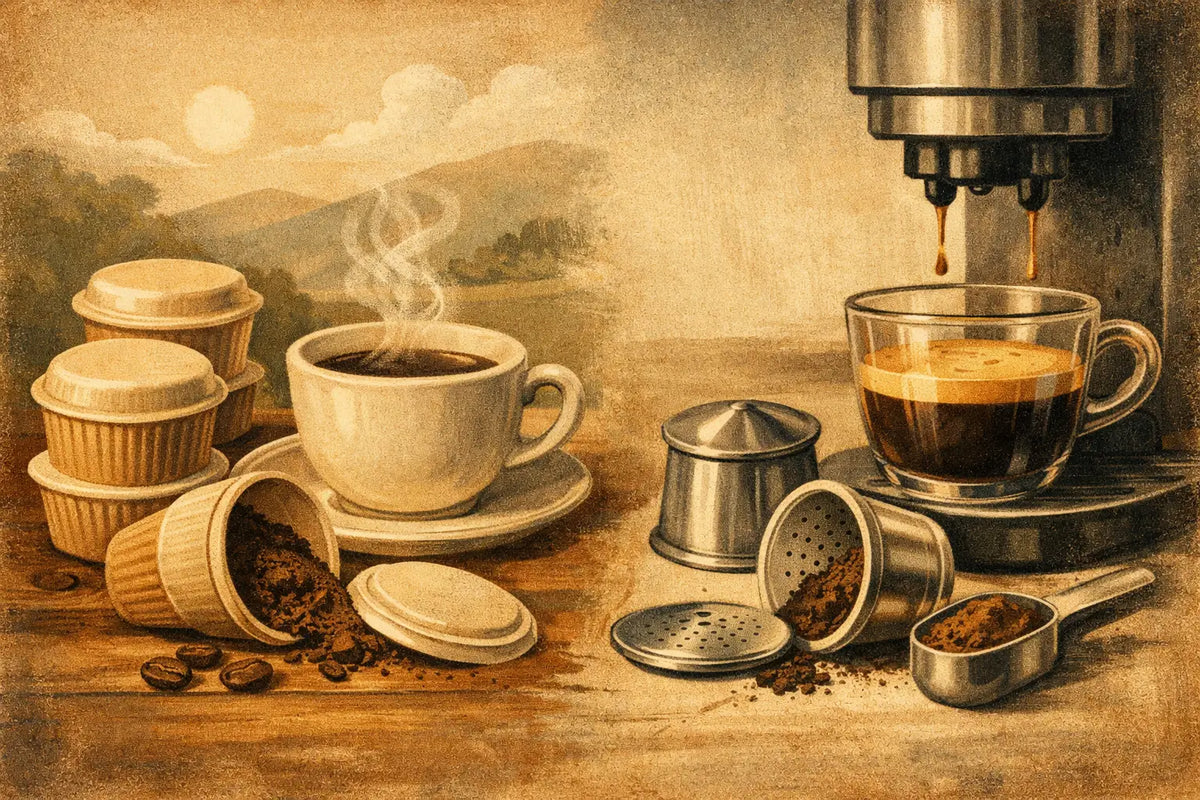
Capsule machines are generally simpler in daily use. The used capsule comes out, the drip tray and water tank need attention now and then and descaling remains necessary. If you have a separate milk frother, that of course needs cleaning too. The difference lies mainly in the amount of coffee grounds, loose beans and internal parts you manage.
Don't think only of your best morning. Think of a busy Wednesday, guests who want coffee and a kitchen that's already full. That's the moment when a machine shows whether it suits your life.
Waste: look beyond the used coffee
Here lies the most visible contrast. A bean-to-cup machine produces coffee grounds. Those can go, depending on the rules in your municipality, in the GFT. The bean packaging is left over, often a bag with several materials. Per cup there's no loose capsule.
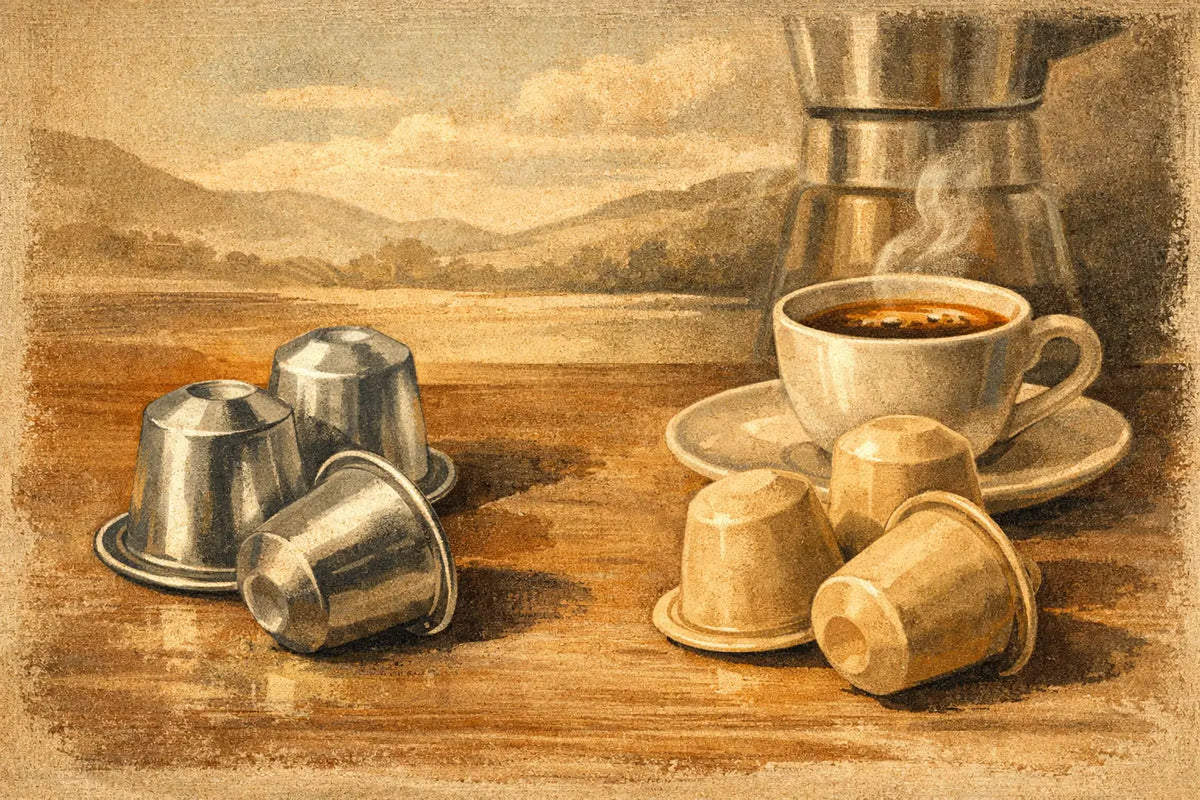
Traditional capsules do add packaging per cup. Aluminium and conventional plastic capsules therefore call for a good collection and recycling system. In practice that isn't equally clear or equally consistent everywhere. A capsule that's technically recyclable isn't automatically actually recycled.
That's why the material matters, but also what happens to it after use. Wageningen University & Research calculated in 2023 that a compostable capsule, when it's actually composted, comes out at around 100% circularity. Aluminium capsules came out at around 48% in that study. Conventional plastic capsules stayed around 23%.
Those figures are no licence to throw everything away thoughtlessly. They do make clear that the route after your espresso is part of the design. Compostable capsules belong, in the Netherlands, in the GFT bin, but not every municipality accepts coffee capsules yet. So always check the local waste guide.
Q Drinks opts for capsules that are largely made from coffee, with coffee chaff and a bio-based binder. They're compatible with Nespresso* Original machines and fully compostable via GFT where the municipality accepts capsules. That changes nothing about the fact that you have to follow your waste streams. It does make the choice at the machine less old-fashioned.
Cost: compare your behaviour, not just the price per cup
A bean-to-cup machine usually asks for a higher investment up front. Against that stand beans that can often be cheaper per cup than capsules. Only: that sum is only fair if you look at what you actually drink. Do you regularly throw away beans that are past their best? Do you buy expensive beans for milk drinks in which you barely taste the nuance? Then the picture shifts.
Capsules are easier to budget. You choose your stock, know how many servings you bring in and prevent an open bag slowly going flat. For a household with varying preferences it can also limit waste: a decaf capsule for the evening, a strong espresso for the morning and a different blend for guests, without several opened bags of beans.
A bean-to-cup machine can make financial sense if you drink a lot of black coffee, maintain it consistently and like to brew larger quantities. Capsules can be more logical if you drink less predictably, want to alternate different flavours or mainly value speed and control over your stock.
When does a bean-to-cup machine suit better?
Lean towards beans if you take pleasure in the brewing itself. You have room for a larger device, drink several cups a day and want to play with grind, dose and Origins. Also if you regularly make coffee for several people at once, a bean-to-cup machine is practical: one press of the button per cup, without refilling capsules.
Just don't forget that a bean-to-cup machine is no maintenance-free shortcut to better coffee. A good device with neglected cleaning rarely delivers the result you bought it for.
When do capsules win?
Capsules suit people who organise their morning tightly and don't want to compromise on a consistent cup of coffee. They're strong in small kitchens, hybrid workdays and households with diverse preferences. Anyone who already has a Nespresso Original machine also doesn't necessarily have to buy a new device to make a different material choice.
In addition, the capsule format opens up room beyond classic coffee. A fixed machine can become part of a broader drinking moment, with different blends and functional variants, without your shelf being full of loose jars and bags. No health promise, but more choice in a routine that already exists.
The right machine is ultimately not the machine with the longest list of features. It's the machine you happily use on an ordinary day, keep clean and choose again. Don't just drink. Think.