A capsule machine exists precisely so the morning doesn't have to revolve around weighing, grinding and cleaning. With compostable cups versus refillable capsules, the choice therefore isn't only about waste. It's about what you actually want to do every day: throw a capsule away, compost it, rinse it, refill it or reach for a disposable capsule after all.
Refillable capsules sound logical: one capsule, lots of coffee. Compostable capsules keep the ritual as quick as you're used to, but give the used material a different route. Neither is automatically the best choice. The best choice is the one that suits your machine, your taste and above all your behaviour on a Monday morning.
Compostable cups versus refillable capsules: the difference
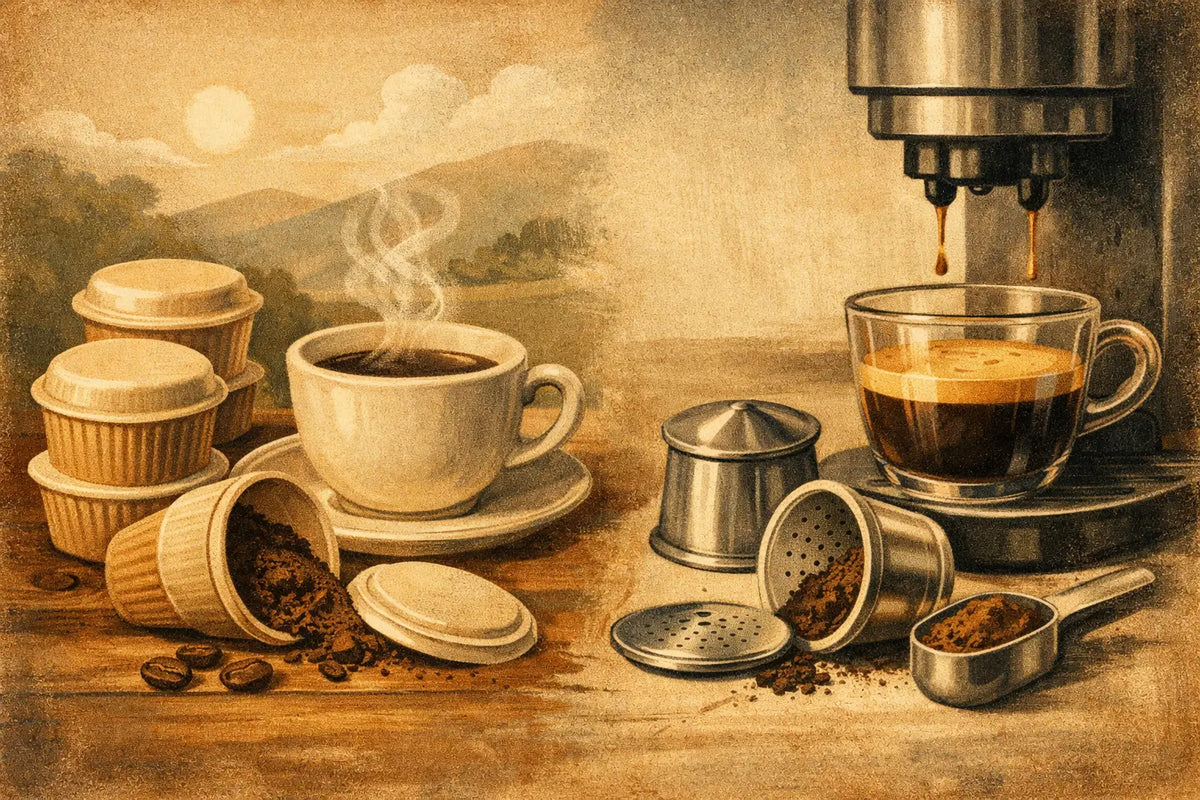
A refillable capsule is usually made of metal or hard plastic. You fill it yourself with ground coffee, close it and use it again. After the espresso you empty the capsule, clean it and start again later. The principle is simple, but the execution asks for attention: the right grind, the right amount of coffee and not tamping too hard.
A compostable capsule is meant for single use, but not for an endless life in the waste stream. At Q Drinks the capsule is largely made from coffee - coffee chaff - with a bio-based binder. It's compatible with Nespresso* Original machines and keeps the handling short: insert, brew, dispose of it according to the local waste rules.
Refillable is only sustainable if you use it often
The strength of a refillable capsule lies in reuse. But reuse only works when the capsule actually lasts a long time and is consistently refilled. If it ends up at the back of a kitchen cupboard after three attempts because the coffee turns out too weak, too bitter or too messy, that advantage quickly disappears.
There's also the coffee around it. Ground coffee has to be bought, stored and dosed. That coffee often comes in packaging that also has to be processed. That doesn't make refillable less interesting, but it does make it less black-and-white than it seems at first glance.
Compostable calls for the right waste route
Compostable is no licence to blindly toss everything in the green bin. Compostable capsules are fully compostable in the Dutch GFT (organic waste) stream, but not every municipality accepts coffee capsules in the GFT bin. So always check the rules of your municipality. If a capsule doesn't end up in the right stream, it can't fulfil its compostable potential.
That detail matters. Circularity lies not only in the material, but also in the route it travels after use. A capsule designed to compost also has to actually be composted.
Comparing waste without marketing haze
Anyone who only looks at the waste bin sees almost nothing with refillable capsules. That's their appeal. The comparison becomes fairer when you look at the whole use phase: how long does the capsule last, how much coffee waste arises, how often is it washed and how much packaging comes with the loose coffee?
Compostable capsules do produce a used capsule per cup. Against that stands the fact that the material can have a concrete destination via GFT, provided your municipality accepts that route. That's different from a capsule that remains as residual material after use, or has to be recovered through a separate collection route.
Wageningen University & Research compared the circularity of capsule materials in 2023. When compostable capsules are actually composted, they come out at around 100% circularity in that comparison. Aluminium came out at around 48% and conventional plastic capsules at around 23%. Those figures are no excuse to separate waste less carefully. They make clear precisely that the processing after use is decisive.
For refillable capsules, such a material comparison gives no universal final figure. Their result depends heavily on the number of times you use them. A sturdy capsule that is part of your routine for years can be a strong choice. A capsule that is barely used is not.
Taste and ease of use aren't a side issue
A capsule is small, but espresso is sensitive. The flow time, water distribution and pressure in the capsule partly determine what ends up in your cup. With a refillable capsule you have influence over that yourself. That's attractive if you like to experiment with Origins, grind and dose. It can also frustrate if you mainly want coffee at 08:12 that's simply consistent.
The grind is often the breaking point. Too coarse can give a fast, thin espresso. Too fine or tamped too firmly can slow the flow. Different refillable capsules also have different lids, filters and fill heights. What works in one capsule needn't work in another.
Compostable capsules are pre-filled and sealed. That gives more control over the dose and a more predictable result per brew. It also removes a practical doubt: is there loose coffee left on the counter, do you have enough in stock and do you have time to clean the capsule afterwards? For many households that's not a detail, but exactly why they bought a capsule machine in the first place.
Freshness plays a part. Coffee gradually loses aroma after grinding. With a refillable capsule you can grind small amounts fresh, which is attractive for anyone who already has a grinder and values the ritual. If you use pre-ground coffee from a large bag that stays open for weeks, that advantage is less obvious. A well-sealed capsule opts for convenience and consistent storage, not for endless fine-tuning.
When does which choice suit you?
Choose refillable if you enjoy adjusting your coffee yourself, already buy loose coffee and don't find cleaning an obstacle. It's a system for people who want control and are prepared to use that control daily too. Especially if you already grind at home, it can fit well into your routine.
Choose compostable if you want the same speed as a regular capsule, without aluminium as the standard material. Then the machine stays the tool it's supposed to be: fast, tidy and predictable. Do check the GFT rules in your area in advance. A compostable capsule only belongs, at the end of its story, in the right bin.
There's also an in-between form that is often the most realistic. Use refillable on quiet moments when you feel like experimenting, and compostable capsules on busy workdays, in a shared household or at the office. Sustainable behaviour needn't be ceremonial. Above all it has to be sustainable to keep up.
Look beyond the capsule itself
The better question isn't: which capsule looks greenest on paper? Ask: which system will I still be using in six months? A refillable capsule that stays consistently in rotation is a serious alternative. A compostable capsule that's disposed of according to the local GFT rules offers a clear route for anyone who doesn't want to trade in convenience.
So don't choose the capsule that shouts loudest. Choose the routine you'll keep repeating without effort. Don't just drink. Think.