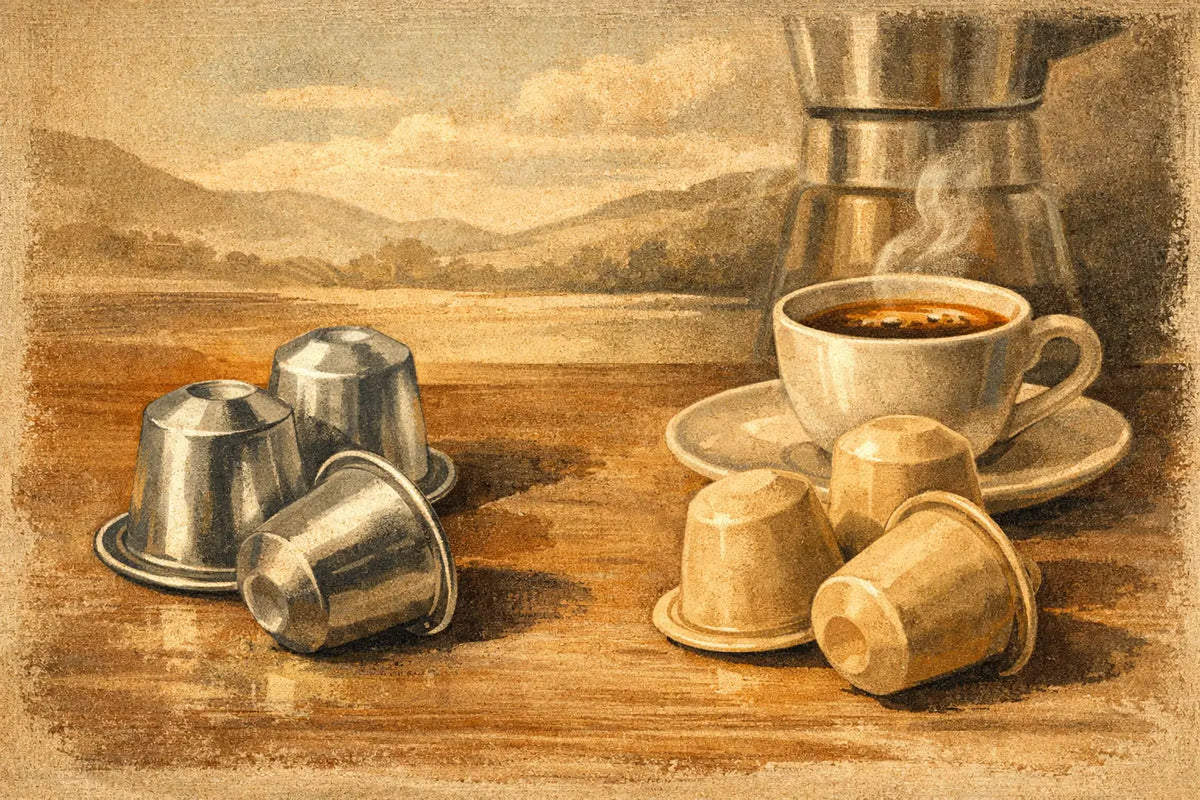

A single capsule is small enough to ignore. Until you consider how many of them pass through European kitchens every morning. That is why the future of capsule materials will not be decided by a new shade of aluminium or a smarter lid, but by a simple question: what is left once the espresso has been brewed?
For years, capsule innovation was mostly about convenience. The machine had to be fast, the coffee consistent, the capsule strong enough for pressure and heat. That produced a system that works well, but one in which the material itself stayed a side note for a long time. And yet that is exactly where the next category shift is happening.
Not because people want a lesson in waste separation. But because they expect a daily ritual to fit better with how they want to live: fast, full of flavour and less dependent on materials that lose their value after a single use.
Why capsule materials are being reinvented now
A coffee capsule has a tricky job. It has to protect freshness, handle hot water and high pressure, allow good extraction and fit existing machines. Preferably without asking the user to do anything extra. That makes switching to other materials far more complex than simply replacing aluminium.
Aluminium is light, strong and easy to seal. But it relies on collection, sorting and recycling that do not always happen in practice. Plastic capsules are often lighter and cheaper to produce, yet they raise the same question: is the material genuinely reused after use, or does it end up as residual waste?
Over the coming years, the standard shifts from technically possible to demonstrably sensible. Material choices are judged not only on how the capsule comes out of the machine, but also on what can happen to it afterwards. That is a higher bar. And rightly so.
The material has to do more than promise less harm
Compostable sounds appealing, but it is not a free pass. A capsule has to compost under the right conditions and connect to the local waste stream. In the Netherlands, a fully compostable capsule can go into the organic waste bin, but not every municipality accepts coffee capsules there yet. So always check the rules of your own municipality.
That detail matters. Good material innovation is not only about composition, but also about the system around it: clear instructions, recognisable processing and a route that is realistic for people at home. If a solution only works with perfect knowledge and perfect discipline, it stays a niche product.
The future of capsule materials is material with a second life
The most interesting development is not a capsule that looks sustainable. It is a capsule whose material story genuinely holds up. Think of capsules made largely from coffee, with coffee chaff and a bio-based binder. That gives coffee a role beyond the contents of the capsule.
That calls for precision. A capsule made from coffee is not the same as a capsule made of coffee alone. The bio-based binder is needed to keep the material stable in shape and suitable for use in a coffee machine. It is exactly that honesty that separates a smart material choice from a loose marketing claim.
Q Drinks works from that starting point, with capsules made largely from coffee, compatible with Nespresso* Original machines. For the user, the experience stays familiar: capsule in, choose espresso or lungo, get on with your day. The innovation is not in extra hassle, but in what the product already does before and after that moment.
Circularity is a practical question, not a slogan
How big the difference can be depends on what actually happens after use. A 2023 study by Wageningen University & Research compares the circularity of different capsule materials. When a compostable capsule is genuinely composted, it reaches roughly 100 percent circularity in that analysis. Aluminium sits at around 48 percent. Conventional plastic capsules come out at around 23 percent.
Those figures are no reason to ignore every other factor. Production, transport, coffee type, machine use and local collection all count too. But they make one thing clear: material is not neutral. It largely determines whether a capsule reaches a dead end after one cup of coffee, or can be part of a usable cycle.
The condition stays clear: compostability only has value when the capsule ends up in the right stream. For brands, that means fewer vague promises and more responsibility for explanation. For users, it means a quick look at the municipal guideline sometimes becomes part of a better routine.
Taste stays the test nobody skips
A good material without good coffee will not last. Capsule coffee is bought on repeat: on Monday morning, between meetings, just before heading out. If the crema disappoints or the taste is flat, every material story fades into the background.
That is why the next generation of capsules will not win on sustainability alone. The capsule has to protect the coffee against oxygen and moisture, stay stable during extraction and leave room for a consistent roast and origin. That is mainly a design question. Wall thickness, porosity, sealing and the interaction with the filter together decide what ends up in the cup.
There is a real trade-off here too. Some new materials are easier to process after use, but harder to shape or less strong under pressure. Others offer excellent barrier properties, but depend on a specific waste route. There is no universally best capsule material. There is a better choice for a clear use case.
For people at home with a Nespresso Original machine, compatibility is not a detail, for example. A capsule that sounds sustainable but jams, leaks or needs a different machine only moves the problem elsewhere. The relevant innovation is the one where material, machine and taste are tuned to each other.
From coffee product to everyday choice
Capsules have long stopped being only a format for black coffee. The category is moving towards decaf, different intensity profiles and blends for moments when people want something other than their standard espresso. Functional capsule drinks are gaining space too, as long as ingredients and taste are taken seriously.
That changes the material question. Once capsules come into the home more often and are used for several moments, the volume becomes more visible. Then an unnecessarily complicated waste stream no longer feels like a small inconvenience, but like a design flaw in a product that was meant for ease.
The brands that move forward will therefore talk less about an abstract sustainable future. They make concrete choices: material with a credible route after use, capsules that fit existing habits, clear information and coffee you want to brew again. No guilt. No technical fog.
What you can check for yourself before buying capsules
Anyone who looks beyond the packaging does not have to become a material expert. Start with three questions: what is the capsule made of, does it work with your machine and what do you do with it after use? If a brand answers one of those questions evasively, that is usually information in itself.
Also watch the difference between recyclable and actually recycled, or compostable and locally accepted. Those words only mean something once the route behind them is clear. An honest product page does not make that more complicated than it needs to be.
The future of capsule materials is not futuristic. It sits on your counter, fits your existing routine and asks at most for a better choice before you press the button. Don't just drink. Think.