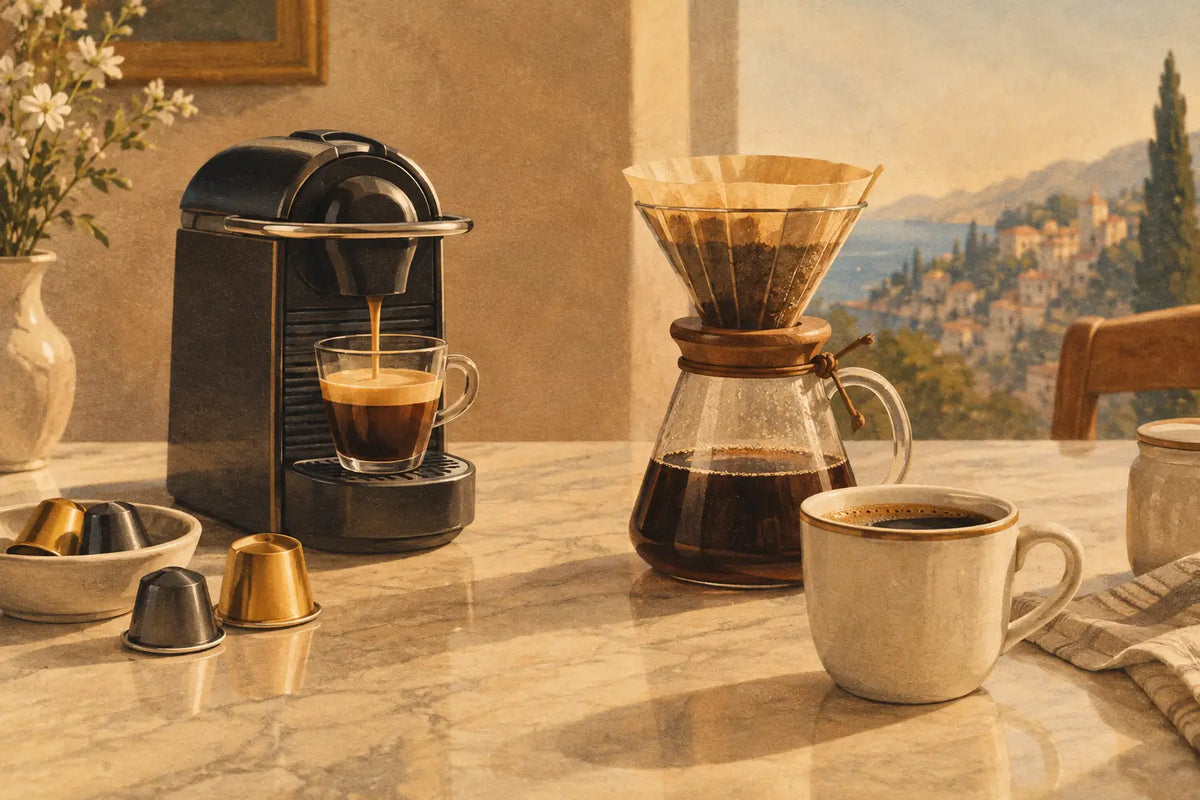
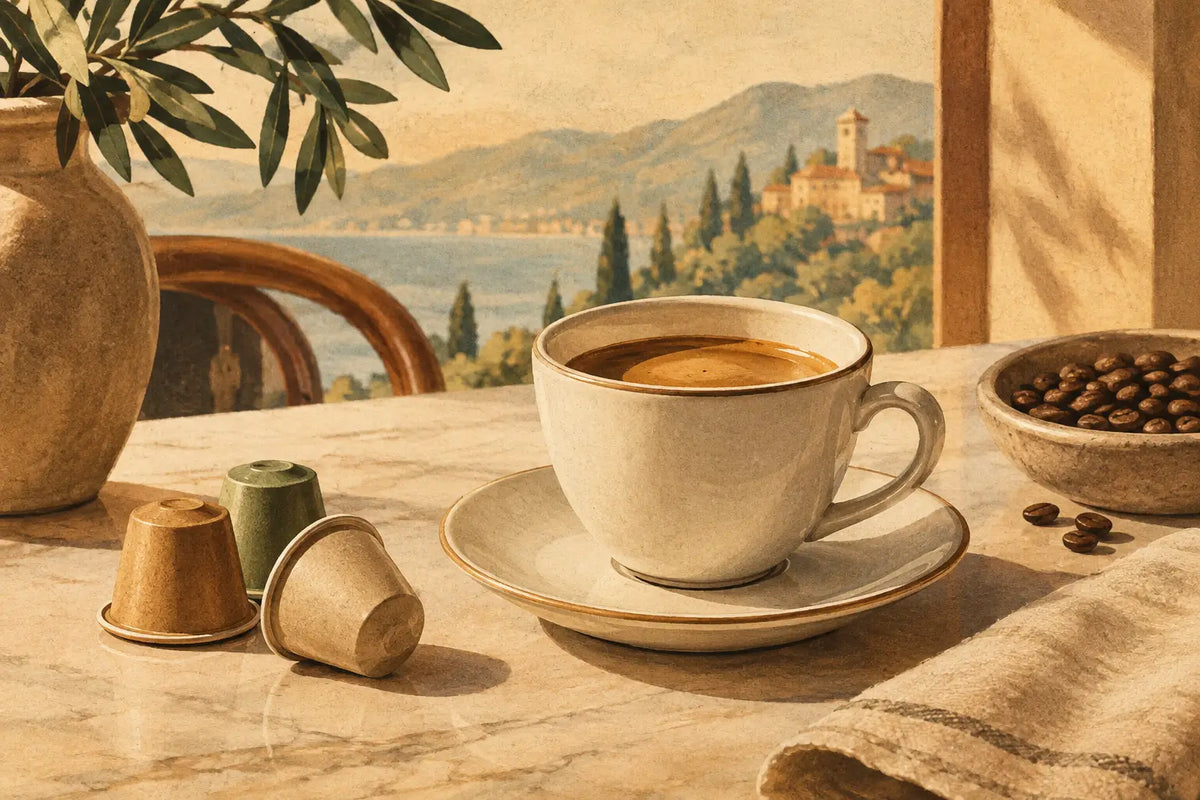
A capsule is small. The decision behind it isn't. Anyone searching for compostable coffee capsules review Netherlands usually wants to know three things: does it taste serious, does it fit the machine, and what really happens to the capsule after use? That is exactly where the difference is made - not by a beige pack or a leaf on the label.
Compostable capsules are no excuse for a mediocre espresso. They have to keep the same routine that makes capsule use so attractive: switch on, insert, press, carry on. But with a material choice that better suits a kitchen that wants to produce less waste. The best choice depends on your machine, your taste and on what you can actually do locally with the used capsule.
Compostable coffee capsules review: what to look for
An honest review doesn't start with the word 'compostable', but with what a capsule has to withstand under pressure. Hot water is forced through it. The capsule has to stay firm, pierce well and give an even flow. If the coffee runs through too fast, the body turns thin. If it runs too slowly, the taste can become harsh or bitter. Material, Roast and grind are therefore not separate choices.
Then comes the machine fit. Many households in the Netherlands use a Nespresso Original machine. Capsules for that system have to be shaped precisely enough to close, pierce and eject without fuss. 'Compatible' only becomes valuable when it also holds on a Monday morning, not just in a demo with one machine.
Third: taste. Compostable material is not a flavour profile. So look at Origins, Roast and Intensity, and at the brewing style you use yourself. A dark Roast can work well as a short espresso, while a lighter or rounder blend gets more room as a lungo. Someone who mostly drinks milk-based coffee wants something different from someone who drinks it black. That sounds obvious, but it stops you judging a capsule on a brewing style it was never meant for.
The material: made from coffee, with an organic binder
Not every compostable capsule is the same. Some capsules are mainly made from plant-based biopolymers. Others choose a distinctive material story. The Q Drinks capsule is made from coffee - coffee chaff - combined with an organic binder. That makes a capsule possible that is suitable for Nespresso* Original machines, without aluminium as the standard starting point.
That nuance matters. The binder is needed for shape and function, while the capsule stays fully compostable. A good product page explains what a capsule is made of, what each material does and how you dispose of it. No woolly promise, but information you can act on.
The coffee itself deserves attention too. A capsule can have a clever material and still fail to convince in the cup. Look for concrete information about the blend, the intended volume and the recommended brewing style. A brand that only talks about packaging leaves half the experience on the table.
Compostable is about the material, not automatically about processing
This is the practical side that many reviews miss. A compostable coffee capsule is fully compostable - that's about the material. Whether it actually ends up in the composting stream is a separate question: Dutch waste processing isn't yet equipped for compostable capsules. That sits with municipalities and their waste processors, not with the material. So always check your municipality's waste guide and follow what it says.
That is no footnote. Composting only works if the capsule ends up in the right stream and is processed in a facility set up for it. If the capsule doesn't reach the composting stream, the material advantage doesn't vanish entirely, but the compostable route obviously isn't used.
The figures do show why that route matters. Research by Wageningen University & Research from 2023 compares the circularity of different capsule materials. When a compostable capsule is actually composted, it reaches roughly 100% circularity in that assessment. Aluminium sits at around 48%. Conventional plastic capsules come out at roughly 23%. Wageningen makes one point clear with that: collection and processing are just as decisive as the material itself.
So a good review doesn't promise that 'the capsule simply gets composted everywhere'. The better question is: what can I actually do with it locally, and will I do that consistently?
Taste and crema: judge a capsule on your own routine
Judging a capsule on one espresso is too quick. Test it over a few days instead, at the moment you'd normally drink it. If you usually pull a lungo in a large mug, do that in your test too. If you have a short espresso after lunch, taste it then. That is the only way to notice whether the coffee works in your rhythm.
Watch the crema, but don't make it the only yardstick. A nice layer says something about extraction and freshness, not everything about balance. What sits underneath matters more: is the coffee clear or flat, round or sharp, does the finish stay pleasant? Taste it without sugar or milk before you decide, too. Milk can bring out a blend very differently, but it shouldn't have to hide a weak base.
Machine behaviour is part of it. Does the lever close without extra force? Does the capsule stay calmly in place while brewing? Does it come out normally afterwards? A few drops after brewing aren't unusual, but leaking, jamming or a lot of grounds in your cup are reasons to be critical. Compatibility is a user experience, not a line on a box.
When are compostable capsules the right choice?
For someone with a capsule machine who brews coffee daily, the switch makes sense as long as convenience stays important and the material choice is allowed to change with it. You keep the speed of a capsule, without being locked into aluminium or conventional plastic as the only option. In a busy household especially, that is more concrete than grand sustainability rhetoric: you change one small, repeatable moment.
There are also situations where you're better off waiting or choosing more carefully. If waste processing in your municipality isn't yet set up for compostable capsules, you have to accept that the compostable route isn't available to you for now. If you have a capsule system other than Nespresso Original, first check that the format fits. And if you only drink very specific, extremely dark flavours, compare the available Roasts first instead of choosing blindly on material.
Anyone who likes variety can also look beyond espresso and lungo. Capsule machines have long stopped being a device for one kind of coffee moment. Alongside coffee there are capsule drinks with other flavour directions and ingredients. Choose those not on promises about performance or health, but on taste, ingredient list and the moment you want to drink them.
The verdict: choose facts over a green story
The best compostable coffee capsule isn't by definition the one with the loudest sustainability claim. It's the one that brews well in your machine, is clear about material and honestly tells you what you can locally do with the used capsule. That is a higher bar than a fine word on the packaging. Rightly so.
Start small: check your municipality's waste guide, choose a Roast that suits your regular cup of coffee and give a new capsule a week instead of one sip. If those three things line up, your daily coffee moment doesn't get more complicated. Just smarter. Don't just drink. Think.