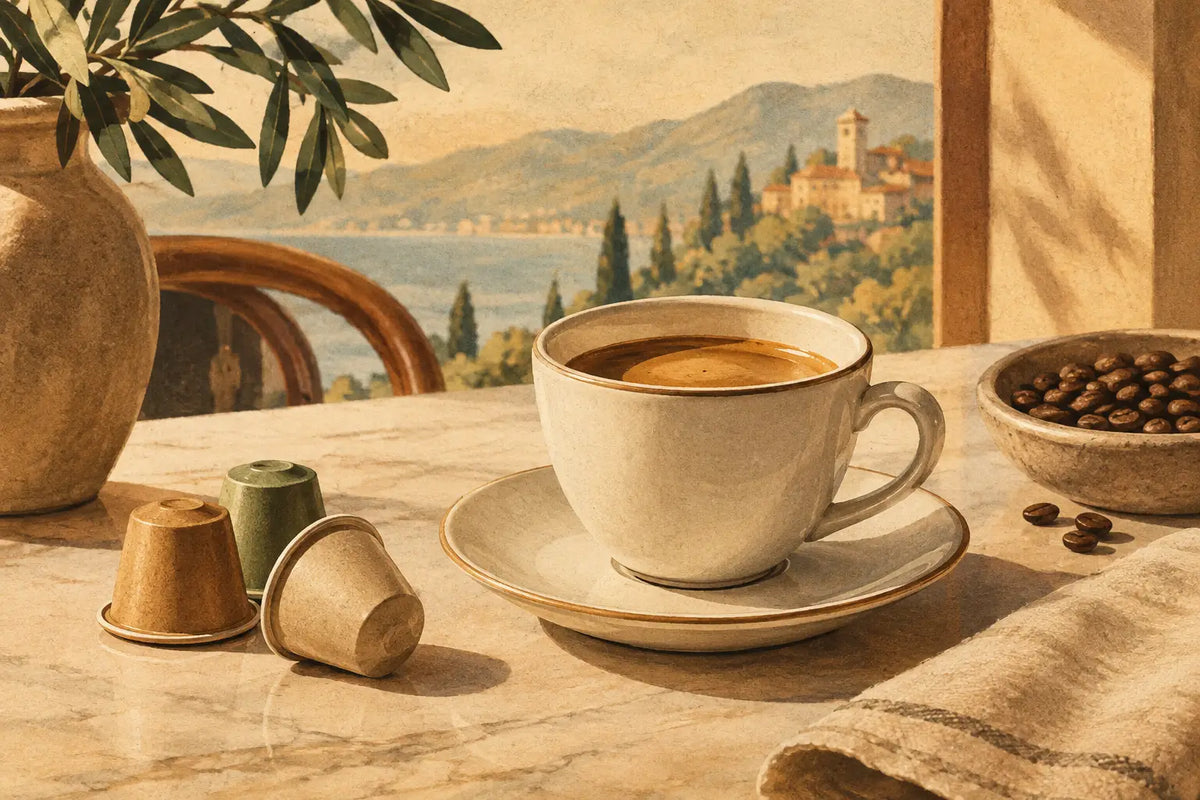

A capsule is small enough to ignore — until you open the waste bin. The future of sustainable coffee capsules is therefore not about a greener label. It is about a better system for a habit that happens millions of times a day: pulling a quick espresso without that convenience automatically leaving a stream of aluminium or plastic behind.
The capsule market has long leaned on a single promise: consistency. Same machine, same motion, same coffee. That was smart. But for years the choice of material stayed almost out of view. Now the question is shifting. Not only: does it taste good? Also: what is this capsule made of, what happens to it after use, and does the solution fit my daily rhythm?
These are exactly the questions that decide which capsules stick around — and which start to feel like yesterday's product.
The future of sustainable coffee capsules is material-driven
Coffee capsules are not neutral packaging. They have to handle pressure, withstand heat, protect flavour and work reliably in a machine. Anyone who claims a more sustainable material is automatically better is making it too easy. A capsule that sounds good but leaks, delivers a flat espresso or doesn't fit the user's waste route changes nothing.
The interesting innovation therefore sits in material that does several jobs at once. Aluminium protects coffee well and can be recycled, but only if collection and processing actually happen. Plastic can be light and functional, but has the same problem: the material is only as circular as the system around it.
Compostable capsules add a third route. Not as an abstract ideal, but as a practical choice for households that separate their organic waste. The nuance is essential: in terms of material a compostable capsule is fully compostable, but Dutch waste processing isn't yet equipped for it. The local waste guide remains decisive. Sustainability without clear disposal instructions is mostly confusion with a green edge.
Made from coffee, not just packaged as coffee
The next step is material that sits closer to the product itself. Q Drinks works with capsules that are largely made from coffee — coffee chaff — and a bio-based binder. That is a different design choice than putting coffee into a standard shell of aluminium or conventional plastic.
That distinction deserves precision. The combination of coffee chaff and a bio-based binder makes the capsule fully compostable and shows where product development is heading: less dependence on fossil raw materials, without losing sight of what a capsule has to do.
It is also a more meaningful story than packaging that merely looks sustainable. Material has to do something. In this case: protect the coffee, stay compatible with existing routines and offer a credible route after use.
Circularity only begins after the espresso
The most common mistake in the debate about sustainable coffee capsules is that it stops at the purchase. But a capsule doesn't become circular because the box says compostable or recyclable. The decisive phase comes after the last sip.
Research by Wageningen University & Research from 2023 makes that difference concrete. When a compostable capsule is actually composted, it reaches roughly 100 percent on the circularity measure studied. Aluminium capsules sit around 48 percent. Conventional plastic capsules come out at roughly 23 percent. Those figures are no licence to rank every material in a single order. They do show how large the effect of the right waste route can be.
For aluminium that holds especially true: the material has value, but that value has to be recovered. That requires separate collection, processing and behaviour that isn't always a given. Compostable capsules shift part of that responsibility to an existing household routine, once waste processing is set up for it.
So the best capsule on paper is not automatically the best choice in a specific kitchen. Someone with a well-functioning aluminium collection system can follow a different route than someone who carefully separates organic waste. Honest product information names both scenarios. No guilt. Just a clear choice.
Convenience stays the hard baseline
Sustainable innovation only wins when it doesn't become an extra project. Nobody wants to read a coffee manual at half past seven in the morning. That is why machine compatibility stays decisive.
For many households, progress doesn't mean replacing their appliance. It means a capsule simply works in a Nespresso Original machine: in, brew, out. No adapters, no fiddly cleaning steps and no compromise on the speed that made capsule coffee attractive in the first place.
That sounds hardly revolutionary. That is precisely where the strength lies. A better material achieves more when it fits millions of existing machines than when it first demands a completely new ritual. The future is shaped not only by laboratories, but also by the kitchen table.
Taste stays non-negotiable throughout. Sustainable capsules aren't interesting as an excuse for mediocre coffee. The capsule has to deliver consistent extraction, with a crema that matches the chosen Roast, Origins and Intensity. An espresso drinker weighs a different balance than someone who pulls a lungo every morning. Material innovation has to handle those differences, not smooth them away.
From coffee capsule to drinking moment
The category is also moving beyond standard coffee. That makes sense. People use capsules for a quick, predictable moment between meetings, after sport or at the start of a busy day. Within that rhythm there is room for other blends and functional drink options, as long as ingredients and taste stay clear.
Health+ and Performance+ variants fit that development as a choice within the same system, not as a medical promise. The appeal is in simplicity: one machine, a familiar motion and more variety in what you drink. For brands there is a challenge here. The product line may broaden, but the base has to stay sharp: clear ingredients, reliable preparation and no grand claims a capsule can never deliver.
So-called subscription models also play a role in this. They can reduce waste when consumers can adjust, pause or stop delivery without hassle. A subscription that piles up unwanted stock is no progress. Flexibility isn't an extra, but part of a system that fits real use.
What to look out for as a coffee drinker
Anyone who wants to choose without dissecting marketing words can ask three questions. Does the capsule fit my machine? Which waste route is allowed in my municipality? And is the material story specific enough to check?
Watch for concrete wording. “Made from coffee with a bio-based binder” says more than a vague natural feel. “Fully compostable; whether it gets processed depends on your municipal waste processor” is more useful than a universal claim about every compost bin. And “Compatible with Nespresso* Original” prevents disappointment at the first brew.
Ask about taste too, not just material. Look at Roast and Intensity, try a few flavours side by side if you're still searching, and judge a capsule on what actually happens in your cup. Choosing more sustainably doesn't have to be a choice against quality. It should be a choice for a product that holds up at every relevant moment.
Tomorrow's capsule doesn't have to sound bigger
The future of sustainable coffee capsules will probably not be decided by one spectacular material or one perfect waste stream. It is built from better combinations: design that asks less of raw materials, systems that match how people separate waste, coffee that is taken seriously and compatibility that keeps things convenient.
That makes the direction clear. Tomorrow's capsule doesn't have to shout that it saves the world. It just has to show that a daily habit can be designed more intelligently. Brew your next capsule with the same attention you give to choosing your coffee. Don't just drink. Think.