If you search for the difference between coffee capsules and coffee pods, you usually don't want a theoretical explanation. You want to know what comes out of your machine tomorrow morning, how many steps it takes and what you throw away afterwards. Capsules and pods both promise convenience, but they deliver a completely different coffee experience.
The short version: a pod is made for a mild, larger cup of coffee with a softer character. A capsule is built for pressure, concentration and a choice between espresso and lungo. Neither system is automatically better. But one often clearly suits your taste, machine and rhythm better.
Coffee capsules versus coffee pods: the difference at a glance
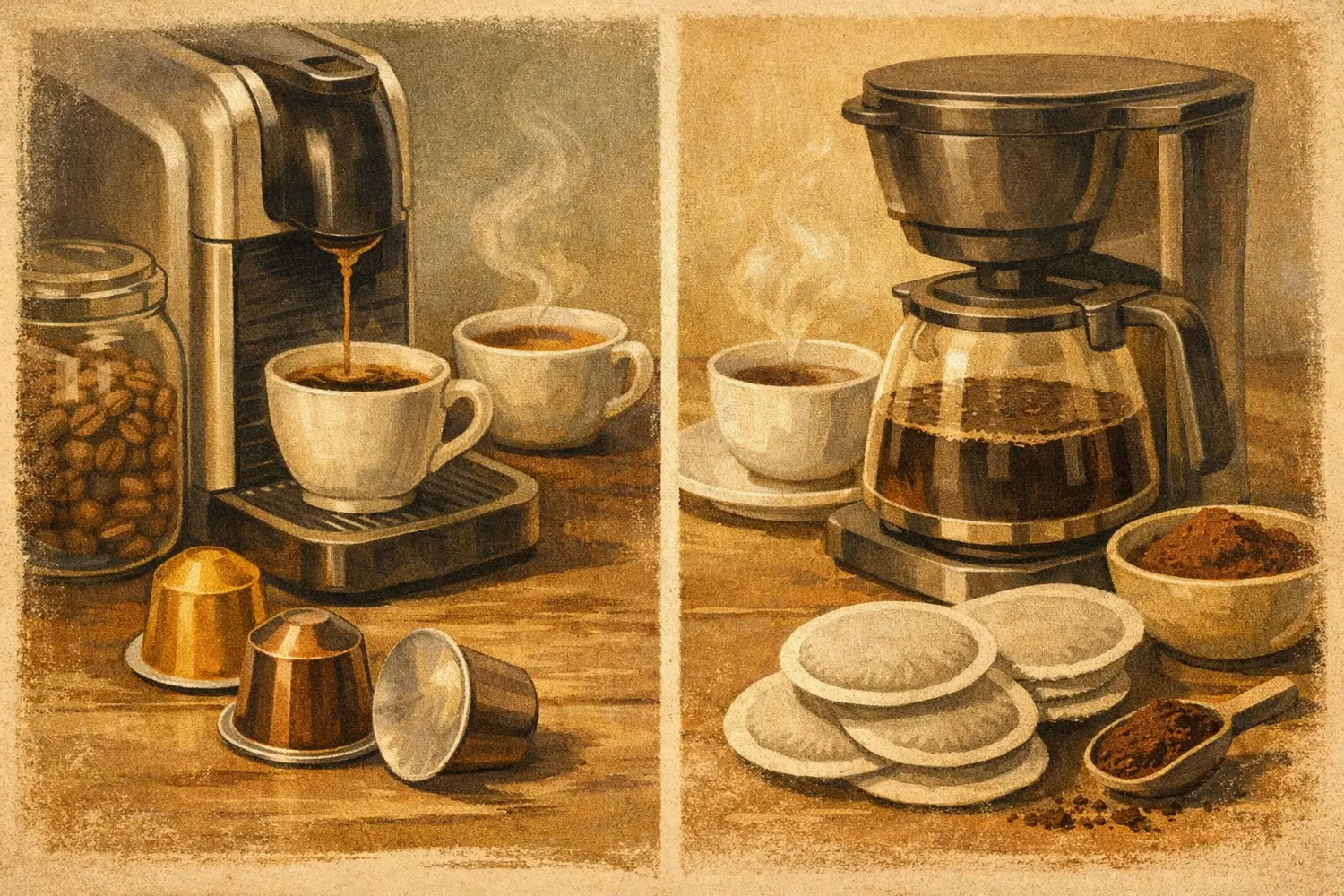
A coffee pod is a round pouch of filter paper with ground coffee. The machine lets hot water run through the pod relatively gently. The result is close to filter coffee: accessible, light and meant for a full cup.
A coffee capsule is a sealed portion of ground coffee. The machine pierces the capsule and forces water through the coffee under pressure. This gives you a shorter, more concentrated drink with more body and, depending on the Roast, a clear crema. Capsules are generally suited to espresso and lungo, not to a large mug of coffee without further adjustment.
The machines differ fundamentally too. Pods only fit a pod machine. Capsules only fit the capsule platform they were designed for. A capsule for Nespresso Original therefore does not work in a pod machine, and a coffee pod does not work in a capsule machine. It seems obvious, but with a new machine or a move to a different system this prevents a bad buy.
Taste: soft and roomy versus compact and pronounced
The biggest reason to choose pods is familiarity. A pod usually delivers a generous cup of coffee that needs little explanation. The extraction is less intense, so the taste is often softer and less pronounced. That can be pleasant if you drink several cups a day or drink coffee with milk without it becoming too heavy.
Capsules give more control over style. A short espresso can taste dark and spicy, or bright and fruity. A lungo draws that same coffee through further, with more volume but a different mouthfeel. The capsule also keeps coffee sealed until the moment of brewing, which helps keep flavour and aroma stable in a busy kitchen cupboard.
That does not mean a capsule tastes better by definition. Quality depends on the coffee, the grind, the Roast and how well a capsule fits the machine. Anyone looking for a soft, large cup can be perfectly happy with pods. Anyone who wants to taste the difference between Origins, Intensity and brew lengths usually gets more room to play with capsules.
Crema is not a detail
Capsule machines work with pressure. That pressure creates a layer of crema on top of an espresso or lungo. That is not just for looks: crema adds to texture and to how the coffee smells when you lift the cup.
A pod machine works differently and sometimes makes a light foam, but that is not the same as the crema of an espresso. If you expect the compact, café-style structure of an espresso, you logically end up with capsules. If you mainly want an easy, longer coffee without much intensity, a pod is a calmer choice.
Convenience is not only in the button
Both systems are fast. You top up the water, load coffee and press start. Yet the daily routine differs. Pods are large, soft and instantly recognisable. You rarely have to think about the state of your machine, but you have less variation in cup size and style.
Capsules take up little space, are clean to load and give consistent dosing. For households where one person drinks espresso and the other lungo, that is practical. And if you like to switch between regular coffee and capsule drinks with a functional angle, a capsule system is easier to build around different moments of the day.
The flip side: capsules require attention to compatibility. Always check which system you have before you order. With Nespresso Original machines, for example, the shape and size are different from other capsule platforms. A good capsule should fit without forcing and come out of the machine neatly after brewing.
Waste: this is where the difference becomes concrete
A paper pod feels at first glance like the simple waste choice. The coffee sits in filter paper and the portion is light. Yet the real impact depends on material, processing and what your municipality accepts. Coffee pods, too, do not automatically belong with organic waste everywhere.
With capsules the difference between materials is larger. Aluminium and conventional plastic capsules are made for protection and ease of use, but after use they need a separate route if you want to reuse the material. More importantly: that route only works if capsules are collected, separated and processed.
Research from Wageningen in 2023 shows how large that difference can be when you look at circularity. A compostable capsule can, when it is actually composted, reach roughly 100% circularity. Aluminium capsules reach around 48% on average. Conventional plastic capsules sit around 23%.
Those figures are no excuse to throw something away thoughtlessly. Above all they make clear that material choice and waste route matter. Compostable also does not mean a capsule may automatically go in the GFT bin in every Dutch municipality. Municipal rules differ. So check locally what is accepted before you put capsules in with organic waste.
Q Drinks chooses capsules that are largely made from coffee, with coffee chaff and an organic binder. They are compatible with Nespresso* Original machines and fully compostable in the Dutch organic (GFT) stream where capsules are accepted. Not nostalgia for an old system, but a logical update to a daily ritual.
What takes less effort in the long run?
Pods sometimes seem simpler because they are familiar. But look beyond the first week. How often do you want to clean your machine? How much space do you have? Do you always drink the same thing, or do you want to be able to switch? And do you want to separate, collect or dispose of packaging via organic waste when that is possible locally?
A pod machine often has a larger, wetter coffee residue per brew. Capsule machines collect used capsules in a container, so you can brew several cups without clearing up straight away. The trade-off is that you don't want to leave that container standing too long. Coffee grounds stay coffee grounds, even when they come out of a sleekly designed machine.
For a household that mainly drinks large, mild cups, a pod machine remains a logical and uncomplicated system. For someone who wants a quick espresso on workdays, a lungo later and a change of Roast at the weekend, a capsule machine feels more versatile. The difference is not in how many seconds one button takes, but in how many choices the system allows without friction.
Which choice suits your coffee?
Choose coffee pods if you like a soft, larger coffee and one fixed routine. They are pleasant for people who are not looking for espresso, different Intensities or a pronounced crema.
Choose coffee capsules if you value a compact machine, consistent portions and more flavour directions. Especially when espresso and lungo are both part of your week, the system offers more range. In that case, pay close attention to the coffee itself, the compatibility and the material of the capsule.
The best choice is rarely the machine with the most promises. It is the choice that suits what you actually drink, how you live and what you want to leave behind after that last sip. Don't just drink. Think.