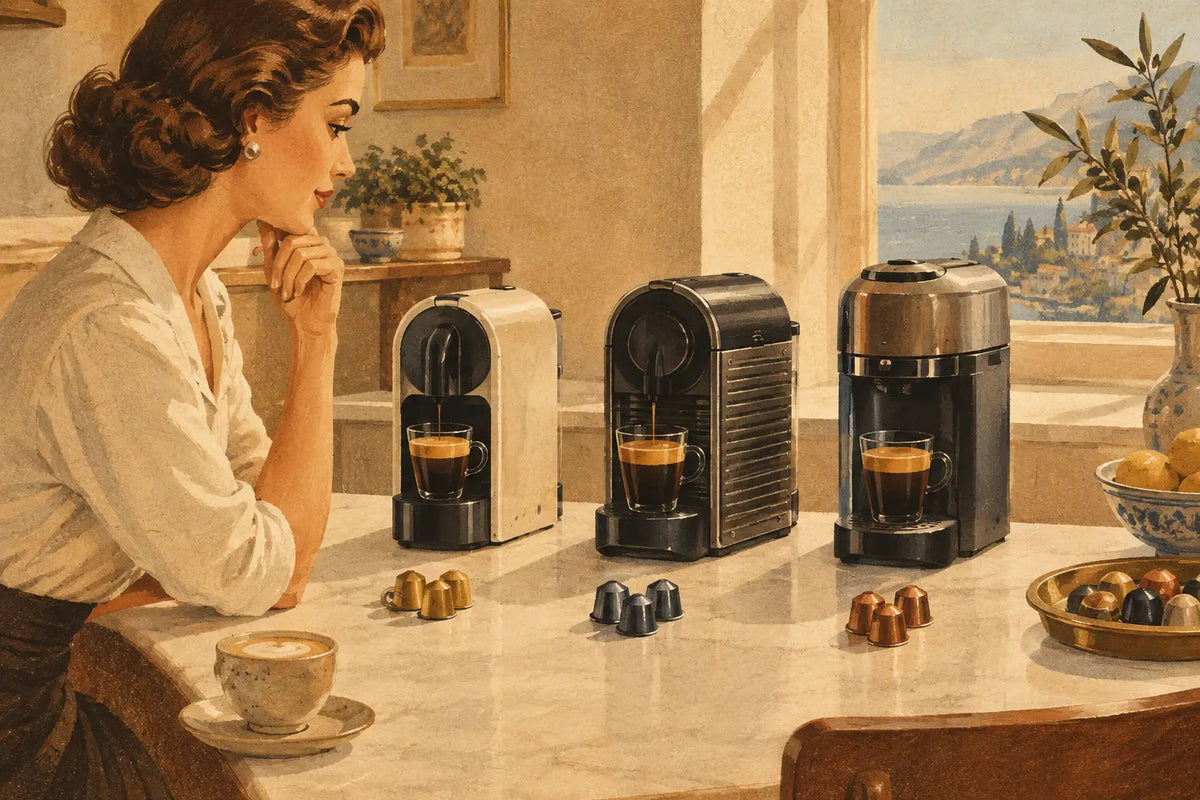
A capsule looks small. But the material determines more than you'd think: how it feels, how it behaves in your machine and where it belongs after use. Anyone who wants to identify coffee capsules by their material doesn't need to be a packaging expert. A few sharp observations quickly reveal the difference between aluminium, conventional plastic and capsules made largely from coffee.
That difference matters, precisely because capsule coffee is so effortless. You pull an espresso before your calendar has even opened. Only, the capsule then often drops out of sight. Material brings that moment back to reality - without turning it into a preachy ritual.
Identifying coffee capsules by material starts with looking and feeling
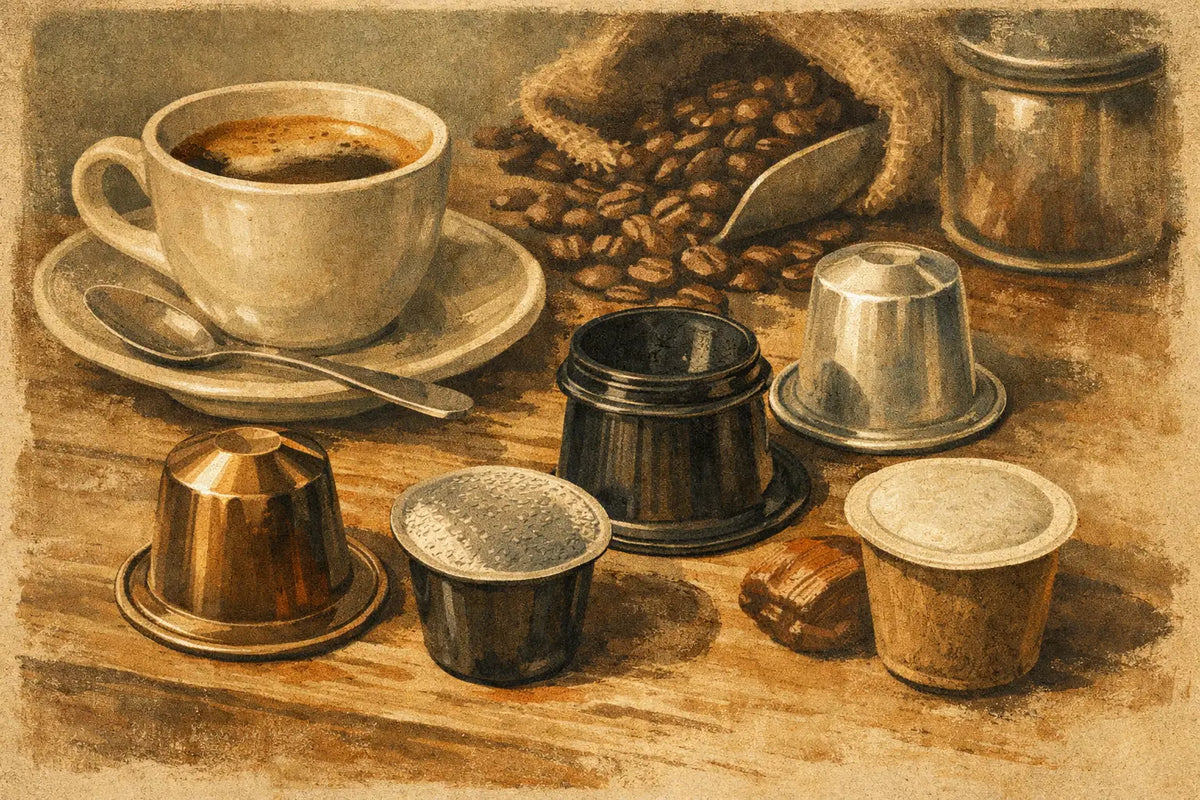
Hold an unused capsule in your hand. Aluminium usually feels cool, is light and has a sleek, metallic surface. The wall is often thin and can give a little or dent under light pressure. The top is usually sealed with a thin foil, also made of metal.
A conventional plastic capsule feels less cool and often has an even, smooth finish. The wall is usually stiffer than aluminium and springs back sooner when you press on it. Plastic capsules come in many colours, from black to striking red or gold. That colour tells you nothing in itself about the composition. So look beyond the design.
A capsule made from coffee has a different presence. The surface is usually more matte and natural, with subtle variation in colour and texture. That's not a production flaw, but the character of a material that isn't trying to look like metal or hard plastic. At Q Drinks, the capsule consists largely of coffee - coffee chaff - with a bio-based binder. The result is a capsule with a pronounced, organic look that is compatible with Nespresso* Original machines.
Still, feeling is a clue, not a lab test. Manufacturers can colour, coat or give materials a glossy finish. So the packaging and product specifications remain the most reliable source.
Watch the capsule wall and the rim
The rim is a useful detail. It has to be sturdy enough to seal into the capsule holder and handle water pressure. With aluminium you often see a sharp, precisely formed rim. Plastic usually has a thicker, more rounded rim. Capsules made from coffee can have a visible, slightly fibrous structure, depending on the finish.
Look at the underside too. Aluminium often has a recognisable metallic sheen, even when the outside is coloured. With plastic the base is usually uniform in material and colour. With coffee-based capsules it's precisely the matte, composite character that stands out.
Don't use the capsule as a test object by squeezing it hard or breaking it open. A capsule is designed for a controlled extraction in the machine, not for a trial of strength on the worktop.
Why material goes beyond appearance
The capsule isn't just packaging. It's part of the brew. Its shape, thickness and stiffness help steer how water runs through the coffee. That's why compatibility is more than the notice that a capsule fits. A capsule also has to function consistently under pressure, so your espresso or lungo behaves as intended.
Aluminium has long been the standard because of that dimensional stability and its barrier against air and light. The material can be recycled well, but that depends on collection, separation and processing. A capsule that ends up in residual waste follows a different path than one that is actually recovered.
Conventional plastic is light and easy to mould. But recycling small capsules faces the same tricky question in practice: is the material properly collected and processed after use? On top of that, capsule materials can consist of several layers or components. That makes a clear waste route less obvious.
A capsule made from coffee takes a different direction. Not because material alone is the answer, but because the material was conceived differently from the start. The Q Drinks capsule is made largely from coffee with a bio-based binder and is fully compostable. What happens next depends on your municipal waste processor: not every municipality yet accepts coffee capsules in separate organic collection. So always check your local waste guide. Compostable is a concrete property, not a licence to throw a capsule away anywhere.
The packaging tells you what your hand can't
A good label states explicitly what a capsule is made of and what to do with it after use. Look for words like aluminium, plastic, compostable, GFT and bio-based. Does it only say sustainable, conscious or green without a material description? Then you still know too little.
Also watch the difference between compostable and biodegradable. Those terms are often used interchangeably, but they don't automatically mean a capsule is allowed in your local separate organic collection. Compostable refers to breakdown under certain conditions. The practical question always remains: which processor handles this material, and does your municipality accept it?
Certifications and instructions are allowed to be concrete. Clear packaging names not just a nice end picture, but also the action needed to get there. That's the standard capsule coffee deserves: no vague promise on the box, but clear information for the moment after the last sip.
What figures on circularity do and don't say
Material choice has measurable consequences, but figures deserve context. Research by Wageningen University & Research from 2023, DOI 10.18174/641509, compared the circularity of capsules. A compostable capsule can, when it is actually composted, reach around 100 percent circularity. Aluminium came out at roughly 48 percent in that analysis, with 61 percent as a best case. Conventional plastic capsules came out at around 23 percent.
Those outcomes are no excuse to treat waste separation as an afterthought. They make it clear that the system after use counts. Aluminium can retain value when collection and recycling work well. Compostable capsules have their advantage when they end up in the right organic waste stream. Choosing a capsule is therefore not an abstract material debate. It's a choice that only adds up if the route to the bin adds up too.
Does the material suit the way you drink coffee?
If you mainly want speed, you don't want extra hassle at the end of the day. Then it helps to check two things before buying: does the capsule suit your machine and is the disposal instruction workable at home? For users of a Nespresso Original machine, compatible doesn't mean every capsule feels or sounds exactly the same while brewing. Construction and material differ. What counts is reliable placement, extraction and a capsule that fits logically into your routine after use.
Taste, of course, remains part of the choice. The capsule wall tells you nothing about Roast, Origins or Intensity. So compare coffee on what's inside it and on the capsule around it. Anyone who looks only at material misses half. Anyone who looks only at taste, too.
There's also no universally best material for every household. If you have access to a separate organic collection that accepts coffee capsules, compostability is practically relevant. If that route isn't there locally, a compostable capsule calls for a different consideration. If you use a well-organised return or recycling system, aluminium can suit your routine. Honest guidance starts with that reality.
A capsule is allowed to look visibly different
For years the capsule was an anonymous object: shiny, coloured, interchangeable. But a material designed differently is allowed to look different too. Matte, tangible, made largely from coffee. Not as a gimmick, but as proof that convenience isn't tied to a century of the same raw materials.
Next time you pick up a capsule, look a second longer before you click it into the machine. Not to make a big statement of it. Just to know what you're holding, what's left after brewing and which route you choose for it. Don't just drink. Think.