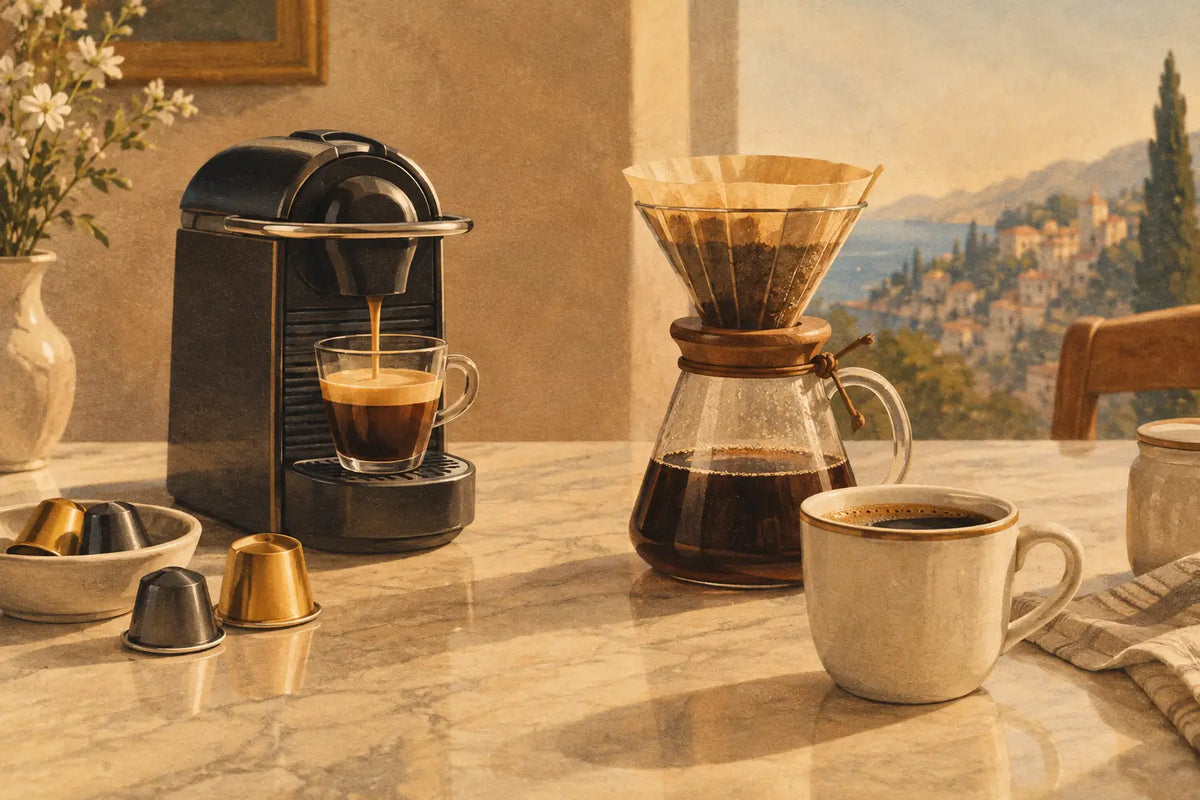

You drop in a capsule, press espresso and you're back on your way within a minute. That's exactly why sustainable choices for coffee drinkers shouldn't depend on a complicated ritual. They have to work on a Monday morning, between two calls, in a kitchen where convenience isn't optional.
The real question isn't whether you're allowed to drink coffee from a capsule. It's what happens to that capsule after the last drop lands in your cup. That's where a smarter coffee routine begins.
1. Look beyond the coffee itself
Many conversations about sustainable coffee jump straight to origins, transport or the packaging of the beans. Those matter. But for anyone using capsules every day, a visible part of the impact is literally in your hand: the capsule left over after a single espresso.
Aluminium and conventional plastic capsules rely on a waste stream that has to be collected, separated and processed properly. That doesn't always happen. A capsule still holding coffee residue often isn't separated and processed properly. And even when recycling is possible, there's a gap between what's technically feasible and what actually happens at home.
So material choice isn't a detail. A capsule made from a material that fits your everyday waste route makes a difference you don't have to remember or postpone. Not because one capsule changes the world, but because a daily habit adds up fast.
2. Choose a capsule designed for its end
Sustainable design doesn't start on the shelf, but at the end of life. For capsules that means: where does this material go once your coffee is gone?
A capsule made from coffee chaff with an organic binder is a different starting point from a capsule designed around aluminium or conventional plastic. Q Drinks makes capsules largely from coffee, with that kind of organic binder, and they're compatible with Nespresso* Original machines. So you don't have to choose between the system already on your counter and a different material.
The nuance is in the processing. These capsules are fully compostable, provided they're actually composted. Dutch waste processing isn't yet properly set up for this. So always check your local waste guide. If the capsule isn't composted, it isn't suddenly worthless, but the route is less ideal than the design promises.
Wageningen University & Research laid that difference out clearly in 2023. When compostable capsules are genuinely composted, they reach roughly 100 percent circularity in that assessment. Aluminium capsules scored around 48 percent on average. Conventional plastic capsules came in at about 23 percent. Those figures don't mean every household achieves the exact same outcome. They do make clear why material and collection belong together.
3. Don't buy more capsules than you'll drink
Sustainability is often framed as a material question. In practice, how you stock up matters just as much. A bulk pack that disappears at the back of a cupboard for months is rarely a smart buy, however good the material.
Better to pick a roast, intensity or tasting pack that matches your real rhythm. If you mostly drink espresso in the morning and lungo after lunch, stock up on that. If you like to switch it up, take smaller amounts of different flavours rather than a supply you're tired of after two weeks.
A flexible subscription can make sense here, as long as flexible really means flexible. The best frequency isn't the most ambitious one, but the one that keeps your coffee fresh and moving. Pausing when you travel or still have stock isn't a lost sale. It's simply a better habit.
4. Use your machine more wisely
A capsule machine is fast, but not automatically frugal. The difference often isn't in the machine itself, but in the small things you repeat every day.
Don't leave the machine warm for hours for no reason. Use the automatic shut-off if it's available. Don't rinse endlessly when a quick clean is enough. And pick the right volume: an espresso capsule stretched into a huge mug usually doesn't make better coffee, just more water and a thinner result.
Maintenance is part of it too. Limescale can make your machine less efficient and change the extraction. Descaling regularly extends the life of a device you already own. That's often more sustainable than constantly hunting for a newer, supposedly better machine.
5. Don't treat leftovers as an afterthought
Not every cup of coffee gets finished. Sometimes your espresso goes cold during a meeting. Sometimes there's half a lungo next to your laptop when you have to head out. It's a small loss, but over a year it adds up.
So make only what you actually want to drink. For a bigger cup, deliberately choose a lungo, or pull two short shots when that suits the flavour better. If you drink your coffee with milk or a plant-based alternative, don't pour more than you use by default. Leftovers down the drain are invisible waste, but waste all the same.
The cup counts too. A reusable mug for on the go isn't a revolutionary idea, but it's a simple choice if you often drink out. At home, a regular mug is usually the calmest option: no extra lid, no stirrer, no napkin because the cup is too hot.
6. Be critical without turning it into a project
The most sustainable coffee routine isn't always the most purist. A manual brewing method can use less packaging, but it takes time, attention and often more cleaning. Capsule coffee offers speed and consistent dosing. For a busy household that can actually mean you waste less coffee and don't pour extra energy into a complicated process every morning.
So it depends on how you use it. If you drink one quiet coffee at the weekend, beans and a grinder might suit you well. If you drink several cups during the week between meetings, school runs and workouts, a capsule machine is a realistic choice. The goal isn't to copy a coffee ritual that doesn't fit your life. The goal is to make the version you do use better.
Taste is part of that. A capsule you don't enjoy gets replaced, thrown away or corrected with extra milk and sugar sooner. So don't choose on packaging alone, but on the coffee inside the capsule too. Good sustainable choices for coffee drinkers account for material, processing, compatibility and what you genuinely enjoy drinking.
You don't have to reinvent your morning. Start with the capsule in your hand, check where it's allowed to go locally and choose a supply that fits your week. Small choices get interesting once you make them often enough. Don't just drink. Think.