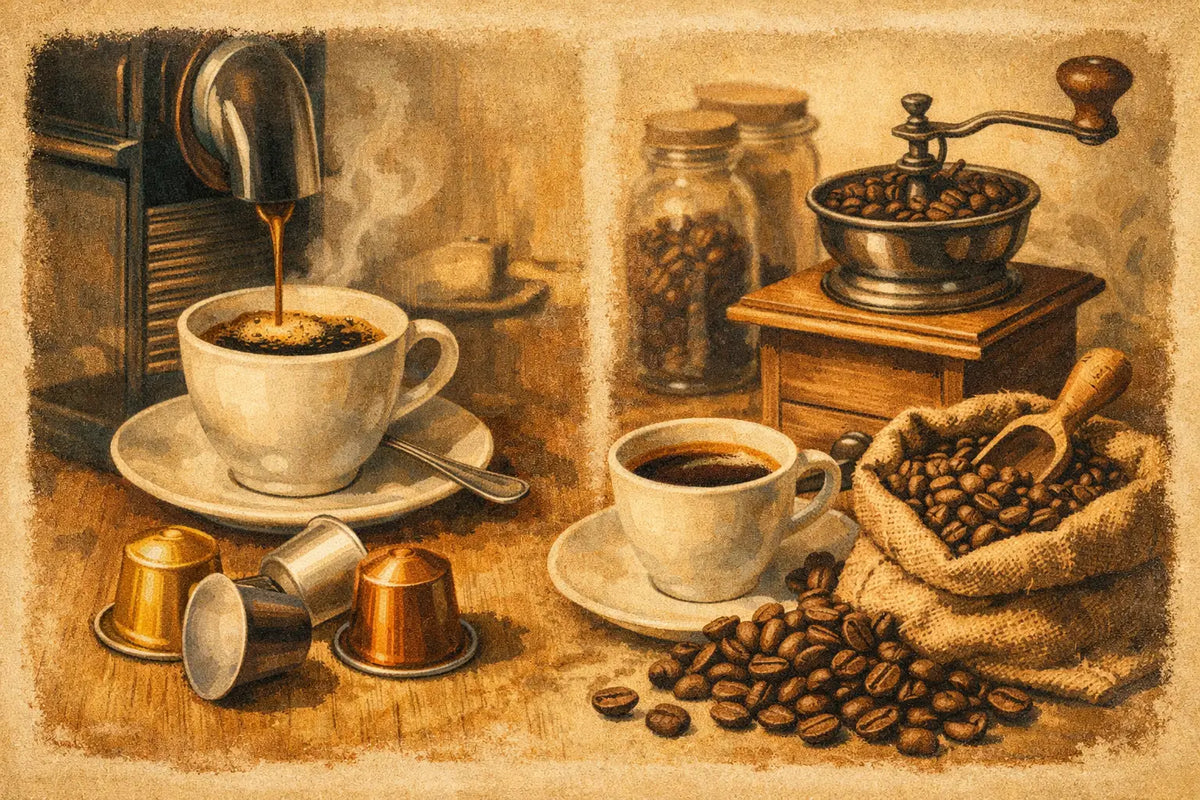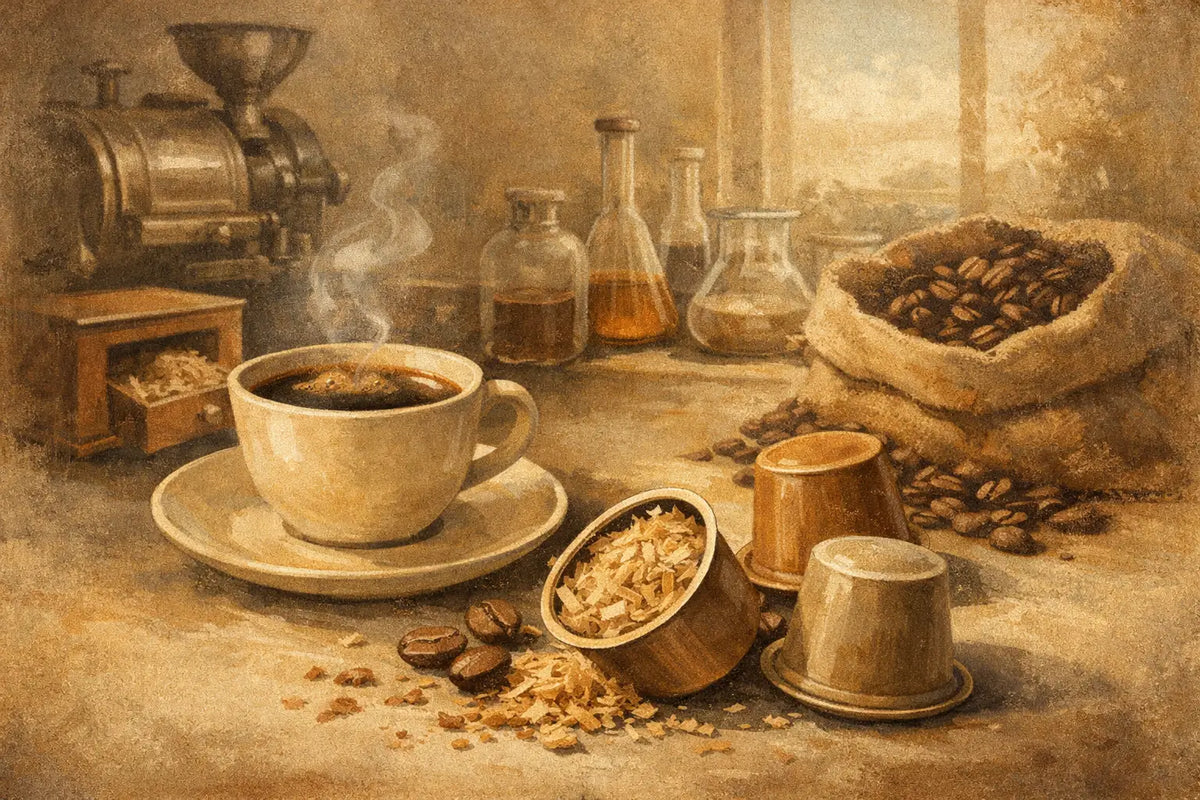

You pull an espresso between two calls, throw away the leftovers and move on. That is exactly where there is room for change. Four ways to reduce coffee waste do not start with a complicated new ritual, but with a few sharper choices around quantity, freshness, coffee grounds and capsules.
Coffee waste is bigger than the sludge at the bottom of your filter. Think of coffee going stale in the cupboard, a full pot nobody finishes, packaging and capsules that never reach the right stream. If you like making coffee quickly, that does not mean giving up convenience. It is about getting your system right.
Four ways to reduce coffee waste in your routine
1. Brew for the moment, not for the habit
Making a big pot of coffee because that is simply the morning routine often ends as a lukewarm remainder in the sink. Especially if you work from home or live with shifting schedules. So measure against the number of cups you actually expect to drink. A filter machine with a smaller setting, a mug as a measuring cup or a capsule machine makes that easy.
With capsules the portion is already set. You make one espresso or lungo, not half a pot on the off chance. That prevents waste from over-brewing, though the attention does shift to the capsule afterwards. Convenience is only truly smart when the packaging also has a logical end destination.
For visitors or busy mornings, a thermos works better than a hot plate. Coffee that you keep warm rarely improves in taste and tends to get thrown out sooner. Rather brew a smaller second round if it turns out to be needed. That costs a minute. A discarded pot costs coffee, energy and attention.
2. Store coffee as if you will still want it tomorrow
A lot of coffee waste happens before the first sip. An opened bag left next to the stove for weeks loses its character. Then you brew a cup that disappoints and the rest stays put. Not because the coffee was bad, but because storage became an afterthought.
Store coffee cool, dry and dark, in a well-sealed bag or tin. Avoid the fridge: condensation and odours do little good there. And do not automatically buy the largest pack. For a household that drinks coffee three times a week, a smaller amount that is used in time is smarter than a stock that slowly goes flat.
The same goes for capsules. Keep them out of direct sunlight and order at your own pace. A flexible subscription can be practical here, as long as you can pause it without hassle while your stock is still plentiful. Less stock stress means less coffee you only drink because it happens to be there.
3. Give coffee grounds a purpose, but do not force it
Coffee grounds do not have to be waste by default. In many Dutch municipalities, coffee grounds are allowed in the GFT (organic waste), often together with paper coffee filters. There they can be processed with other organic material. Always check your municipality's waste guide, though: the rules differ by place and sometimes change.
You can also use a small amount of coffee grounds at home, for example in a compost heap or as an addition to garden soil. Keep it modest. Coffee grounds are no miracle cure, and a thick, wet layer can start to clump. So mix it with dry material such as leaves or shredded prunings. If you have no garden or compost bin, you do not need to invent a creative project. The right GFT stream is already a good choice.
Reuse around the house has its limits too. Coffee grounds as an odour absorber or scouring agent sounds appealing, but only use it when you genuinely need it. Otherwise you simply move waste from one dish on the counter to another dish on the counter. The most elegant solution is usually the simplest: do not brew too much and dispose of the rest properly.
4. Look beyond the coffee itself: choose your capsule consciously
Single-serve coffee is fast, consistent and precisely dosed. The downside is visible the moment the capsule lands in the bin. Aluminium and conventional plastic capsules require separate collection and processing to recover material. That can work, but only if the collection, sorting and recycling actually happen.
Research by Wageningen University & Research from 2023 shows how big the difference in material streams can be. When compostable capsules are actually composted, they reach around 100% circular material use. Aluminium sits at around 48% according to the study. Conventional plastic comes out around 23%. Those figures are no reason to label every capsule blindly as green. Above all, they make clear that both the material and the route after use matter.
A capsule made mostly from coffee, with a bio-based binder, offers a different starting position here. Q Drinks capsules are Nespresso* Original-compatible and fully compostable in the Dutch GFT stream. But here too the practical check applies: not all municipalities accept coffee capsules in the GFT. If your municipality does not allow it, follow the local instruction instead of choosing on the off chance.
That detail is not a footnote. Compostability only has value when a capsule ends up in the right processing. So before you order, look at how your municipality handles capsules. If you have no GFT option for capsules, a system with as little waste per cup as possible is still better than careless disposal, but the outcome depends on your local waste stream.
Less waste starts with an honest system
The best coffee routine is not the one with the most rules. It is the routine you still carry out on a busy Tuesday. Brew what you drink. Store what you buy. Give coffee grounds a fitting place. And choose capsules not only on taste or machine compatibility, but also on what happens after that one minute of espresso.
That is not a grand gesture. It is a daily standard that fits coffee better — coffee that has to be fast, has to taste good and no longer accepts waste as a self-evident endpoint. Don't just drink. Think.