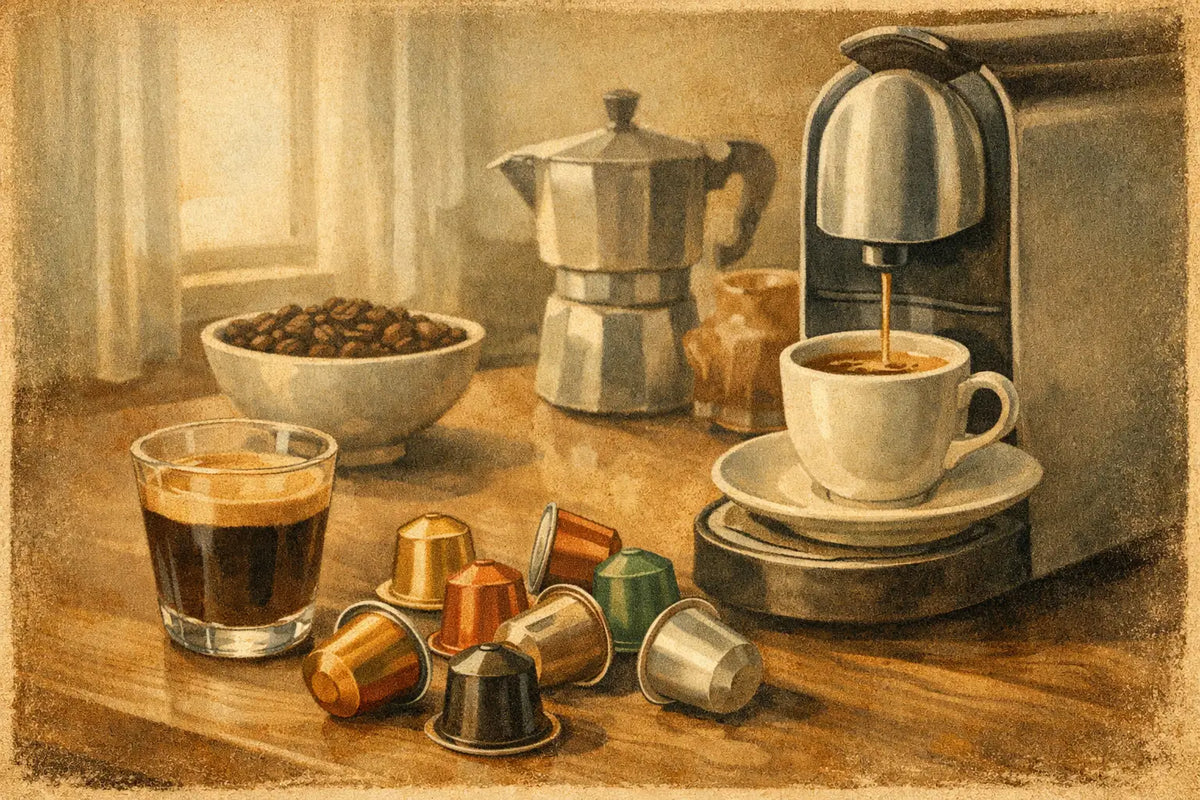
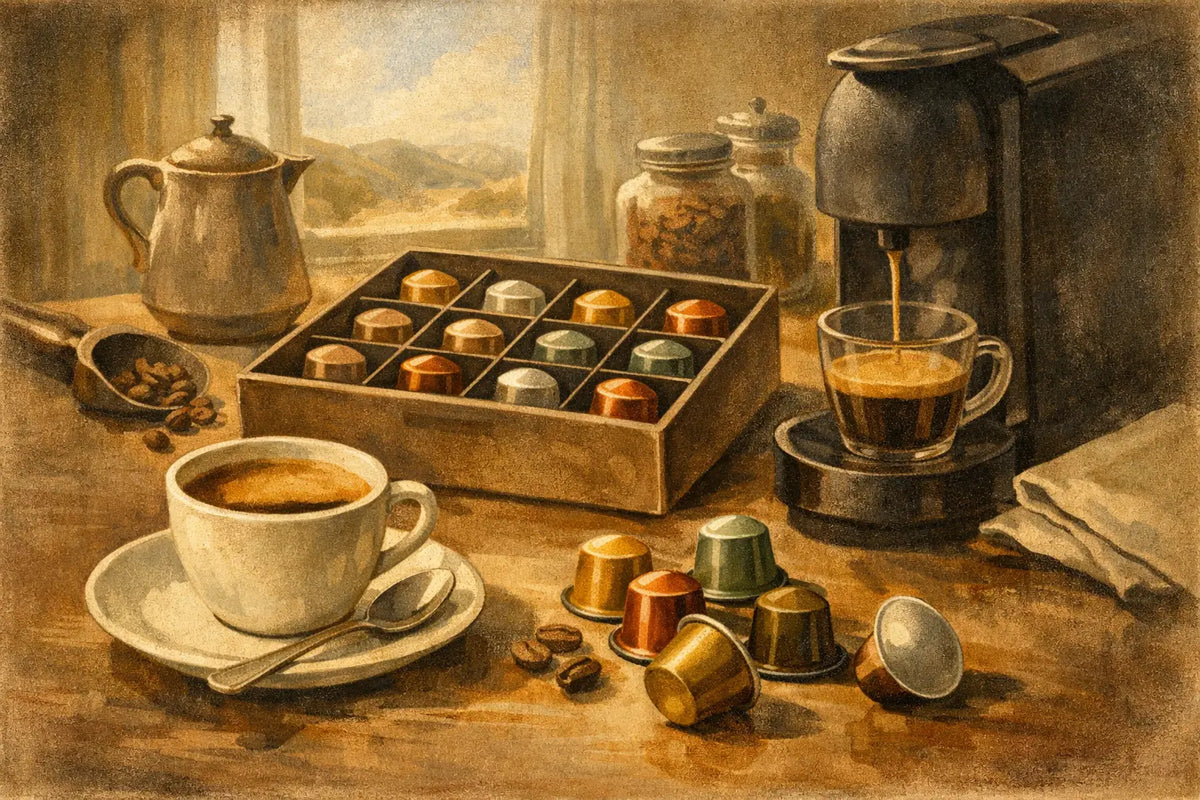
A coffee sample pack review doesn't start with the packaging, but with that first moment at 08:12: capsule in, button on, cup under the spout. Is the espresso balanced? Does the capsule work without fuss? And would you reach for the same one again tomorrow? A sample pack should answer those questions quickly - not add more decision stress.
Capsule coffee is built for rhythm. For the morning when you have five minutes, not twenty-five. That's exactly why a tasting pack should do more than line up a row of colourful flavours. It should show which Roast suits you, how the capsules behave in your machine, and whether the material behind that coffee fits how you want to consume it at home.
Why a sample pack tells you more than a product page
A product page can list Intensity, Origins and flavour notes. Useful, but coffee can't be fully read off a page. The same capsule can land very differently as an espresso than as a lungo. A dark Roast might be just right early in the day, while later you'd rather drink something lighter with more clarity.
A good coffee sample pack gives you room to compare without immediately committing to one box or a subscription. That's the practical win. You discover not only what you enjoy, but what you actually brew when the week gets busy. The capsule that sounds interesting on paper isn't always the one you grab on a Wednesday afternoon.
There's also a difference between variety and direction. Six capsules that all share roughly the same profile feel generous but teach you little. A well-composed pack lets you taste clear contrasts: a full, dark espresso next to an approachable lungo, for example. That's how preference becomes concrete.
Don't taste everything in one morning
It sounds efficient, but it flattens your judgement. After two or three brews, subtle differences fade. Better to taste spread across a few days and repeat your favourite. The first sip says something. The second time often says more.
Brew every variant the same way. Use the same cup size, the same water and, ideally, the same setting on your machine. If you normally drink a lungo, judge capsules as a lungo too. If you only drink espresso, a verdict based purely on a large cup won't help you much.
Coffee sample pack review: five points that matter
1. Taste should make a choice possible
Don't let Intensity be the whole story. A high Intensity mainly means a stronger flavour impression, not automatically a better coffee. Look at the balance between body, bitterness, freshness and finish. A capsule may be outspoken, but it shouldn't only hit hard.
Pay attention to how a coffee responds to your fixed ritual. If you drink it black, Roast and finish stand out faster. With milk, you're often looking for enough body so the coffee holds up. No verdict is universal. The best capsule is the one that works in your cup, not in a general ranking.
2. Machine behaviour is part of the experience
A capsule can taste great, but if it flows poorly or works unpredictably, you lose exactly what you buy capsules for: convenience. During your test, watch for a calm, even flow and consistent crema. Check that the capsule ejects neatly and that your machine stays clean.
Always check the compatibility label first. For households with a Nespresso* Original machine that's not a detail but a basic requirement. A sample pack is the low-threshold way to test that match in your own kitchen, with your machine and your water.
3. Look beyond the shell
With capsule coffee the material is not a footnote. You use it every day, often several times. So it deserves the same attention as Roast and flavour profile. Don't only ask what a capsule is made of, but also what you do with it after use.
Q Drinks uses capsules made largely from coffee - coffee chaff with a bio-based binder. That material isn't a decorative story around a standard capsule; it determines what's left on your worktop after your espresso. The capsule is fully compostable in the Dutch organic waste bin where your municipality accepts coffee capsules. That last condition matters: local collection differs per municipality.
4. Compare circular claims by their destination
Words like compostable and recyclable sound clear, but they describe different routes. Recycling requires collection, sorting and processing. Composting requires an organic waste stream that actually accepts this material. So in an honest review it's not only about what a capsule could become, but about what you can do with it at home and in your municipality.
Research by Wageningen University & Research from 2023 makes that difference visible. When a compostable capsule is actually composted, it reaches around 100% circularity. According to that analysis aluminium sits at around 48%. Conventional plastic comes out at around 23%. Source: Wageningen University & Research, 2023, DOI: 10.18174/641509.
That's no reason to turn your morning coffee into a moral exam. But it is a reason to read claims precisely. The material and the route after use belong together.
5. A sample pack should fit how you buy
A tasting pack is mainly valuable if it makes a next step easier. Maybe you'll order one Roast afterwards. Maybe you'll alternate two variants. Or you're looking for a fixed selection for a flexible subscription you can pause when your cupboard is still full.
So look at how the pack is built. Are the flavours individually recognisable? Can you easily find your favourite again? And is there enough difference to make a choice? A pack with only safe mid-tones is pleasant, but tells you little about your real preference.
How to test at home without turning it into a project
Keep it small. Pick three fixed moments: an espresso in the morning, a lungo around lunch and perhaps a coffee with milk in the afternoon. After each brew, note just three things: which variant you drank, how the taste lingered and whether you'd reach for it again.
That last one is the best question. Not: was this technically interesting? But: do I want this capsule again tomorrow? You don't have to write tasting notes as if you're judging a competition. Words like round, dry, strong, soft, bitter or fresh are already enough to see patterns.
Give a second chance to coffee that didn't convince you right away. Your taste changes with the time of day, your breakfast and even the amount of water you use. But be critical too: if you consistently have to rescue a capsule with extra milk or sugar, it's probably not your regular choice.
What a review alone won't tell you
Reviews from other drinkers are useful for practical signals. They can tell you whether capsules work well in a particular machine, how quickly an order arrives or whether a pack offers enough variety. On taste they're less definitive. Someone who loves a dark, intense espresso may call a lighter variant flat, while that's exactly what you're waiting for.
So read reviews for patterns, not for a single superlative. Five people mentioning the same consistent flow is relevant information. One person saying a coffee is 'too strong' mainly says something about their preference. A coffee sample pack exists precisely to bridge that gap between someone else's taste and yours.
Also look at the reviewer's context. Do they brew espresso or lungo? Black or with milk? Do they use a Nespresso Original machine? The more you know about how they drink, the more useful the verdict becomes.
The choice after the last capsule
A good sample pack doesn't end with a pile of empty shells and a vague feeling. It ends with a clear preference: this one for quick and black, that one for a long morning, maybe a third for guests. That's enough.
Then choose not the capsule with the biggest promise, but the one that consistently fits your machine, your taste and your daily pace. Don't just drink. Think.