A capsule looks indestructible. Small, sealed, ready for a quick espresso. Yet the question of how long coffee capsules stay fresh matters more than you might think. Over time coffee doesn't lose its safety, but it does lose its tension: aroma, crema, body and the bright notes you chose it for. A capsule protects ground coffee better than an opened bag, but not forever.
The short version: follow the best-before date on the packaging, keep capsules cool and dry, and don't buy more than you'll realistically drink. The longer version lies in what happens inside a capsule - and why a dark kitchen cupboard makes more difference than an impressive storage rack.
How long do coffee capsules stay fresh?
For unopened coffee capsules, the producer's best-before date is your guide. That date isn't a hard line at which coffee suddenly becomes undrinkable. It's the point up to which the maker can guarantee flavour, aroma and brewing behaviour under normal storage conditions.
Many capsules stay good for months, sometimes longer, as long as the packaging remains intact. But 'good' is not the same as 'at its best'. Coffee is at its liveliest when the aromas stay protected from oxygen, moisture, heat and light. Once those influences slowly take hold, an espresso turns flatter. The crema can come out thinner and the finish can feel less layered.
That process is gradual. A capsule a few weeks past its best-before date doesn't have to go straight in the bin. Brew one and taste it attentively. Does the coffee smell musty, taste cardboard-like, or does remarkably little come out of the machine? Then the moment has passed. Is the flavour still clear and the capsule undamaged? Then it can still be perfectly drinkable - just no longer at the level you expect from fresh stock.
What keeps capsules fresher for longer?
Ground coffee has a large surface area. That's why it reacts with oxygen faster than whole beans. A capsule slows that process down because the coffee is sealed in. How well that works depends on the packaging, the sealing and the way the capsules have been stored.
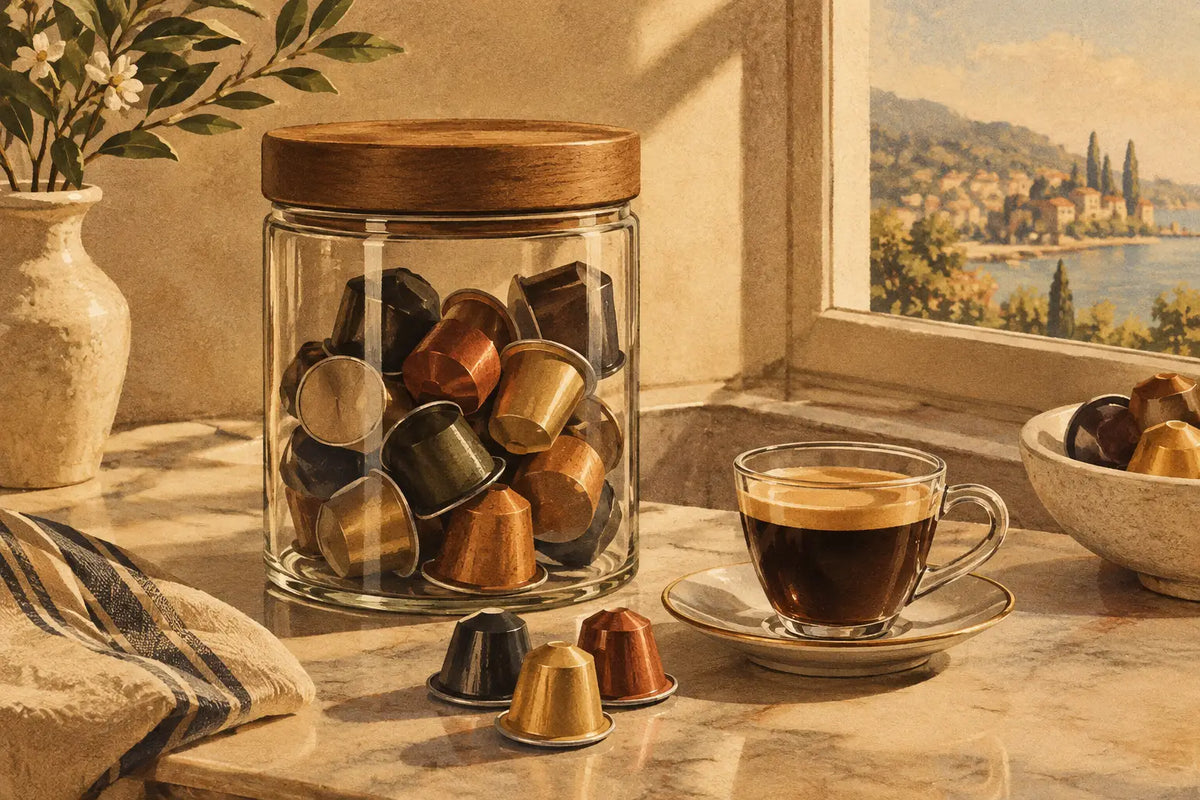
Heat speeds up flavour loss. A glass jar next to the hob might look sleek, but it's not a strong choice. A windowsill, a shelf above the radiator and the car on a sunny day are poor spots for a stock of capsules too. Better to pick a dry, dark cupboard at room temperature, away from strong smells.
Moisture is the other spoiler. Don't store capsules in the fridge or freezer. Temperature swings can cause condensation when you take them back out. That moisture does the flavour no favours and can damage the capsule or the box. A fixed, cool spot in the house beats storing them extremely cold.
Also leave capsules in their original box until you use them. That packaging isn't just for looks. It protects against light, dust and needless shuffling around. If you keep various Origins, Roasts or functional blends at home, you can simply mark the date on the front with a pen. First in, first to drink. No need to make it more complicated than that.
The best-before date is a quality moment, not a panic button
'Best before' is often treated as if it were an alarm. With coffee, that date mainly says something about quality. It's different when a capsule is visibly damaged. A dent usually isn't an immediate problem, but a crack, a leak, a lifting seal or a swollen capsule is a reason not to use it.
Also check how the capsule behaves in your machine. Does water run past it, does an unusual amount of water stay behind in the cup, or does barely any coffee come out? Then the capsule may be damaged or no longer sealing properly. That doesn't always say something about freshness, but it does mean you won't get a good espresso.
A practical nuance: taste is personal. Someone who drinks their coffee with milk notices a subtle loss of top notes less quickly than someone making a short black espresso. With a lungo, old, flat notes can actually become clearer because more water passes through the coffee. So taste your capsules in the form you normally drink them.
Signs a capsule is past its best
You don't need to be a barista to spot a less fresh capsule. Watch for a musty or flat smell, a thin crema, a watery body or a bitter, papery finish you don't recognise from that blend. One signal can be a coincidence. When several come together, the capsule is probably past its peak.
When in doubt, compare an older capsule with a fresh one from the same Roast. That's fairer than relying on memory. Coffee changes subtly, and that's exactly why a direct comparison helps. One cup can still be fine for an afternoon moment, while for your first espresso of the day you'd rather reach for the newest stock.
Storing without turning it into a project
The best approach is surprisingly simple: buy in step with your own rhythm. If you drink two capsules a day, a stock for a few weeks or a couple of months makes sense. If you order a trial pack, don't open everything at once when you know you want to get to know one flavour first.
For households with lots of different capsules, a fixed spot works better than loose baskets scattered around the kitchen. Store boxes upright, keep the oldest at the front and stop capsules from knocking into each other loose in a drawer. That's especially relevant for cups with a more delicate outer material.
Using a Nespresso* Original machine? Before brewing, always check that the capsule is clean and intact. Insert it without forcing. A capsule that jams or gets damaged as it closes rarely delivers a convincing cup. Machine maintenance counts too: limescale or coffee residue can cause a flavour problem that gets wrongly blamed on the capsule.
Does the capsule material make a difference?
For freshness, what counts first is the sealed coffee and the quality of the sealing. The capsule's material doesn't automatically determine whether coffee ages faster. Still, every design calls for packaging and a production process that protect the contents well until use.
At Q Drinks the capsules are largely made from coffee, with an organic binder. The idea is clear: a capsule doesn't have to be tied to aluminium or conventional plastic to be a practical part of your routine. Store these capsules dry, dark and in their original packaging too, and follow the best-before date on the box.
After use, the question shouldn't only be how your coffee tasted, but also what happens to the capsule. A Q cup is fully compostable. That's about the material: it's made to break down in composting, together with the coffee grounds. Whether it actually ends up there is a separate question - Dutch waste processing isn't yet equipped for compostable capsules. That sits with municipalities and their waste processors, not with the material. So check your municipality's waste guide and follow what it says. Research by Wageningen University & Research from 2023 shows that compostable capsules, when they are actually composted, score far better on circularity than aluminium or conventional plastic versions. Wageningen reports around 100% for compostable, against 48% for aluminium in the common scenario and 23% for conventional plastic. That's no reason to hoard capsules. It is a good reason to use them deliberately and dispose of them correctly.
When is it better to buy new capsules?
If your stock is well past its best-before date, your favourite blend starts tasting flat or the packaging is damaged, reordering is the simple choice. Don't wait until every capsule is gone when you can already tell your tasting experience is declining. Coffee is a small daily ritual. It's fine to set a limit on that.
Ordering through a flexible subscription also lets you match that stock to your own pace. Less piling up, fewer forgotten boxes at the back of the cupboard, more capsules drunk while they still do exactly what they were made to do.
Store your capsules calmly, dry and out of the light. Use the oldest first. And if a cup of coffee suddenly says less to you than last month, don't trust the date alone - trust your taste too. Don't just drink. Think.