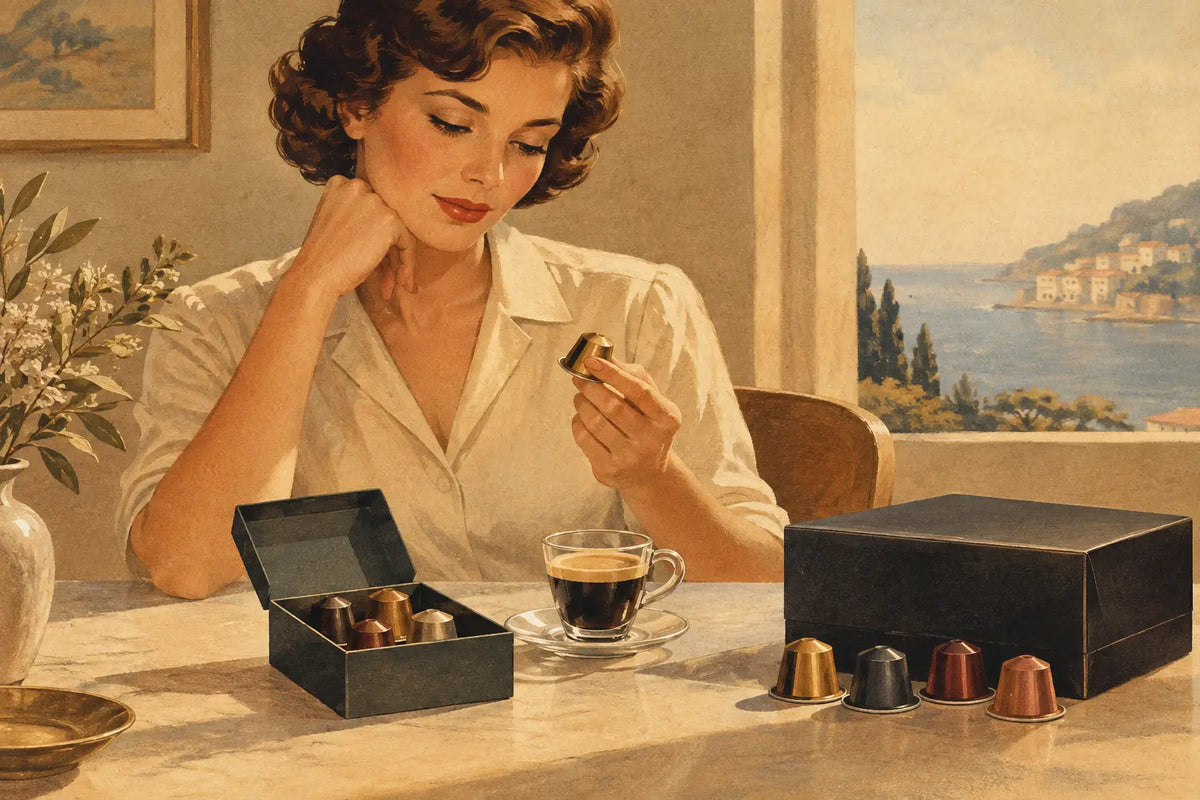
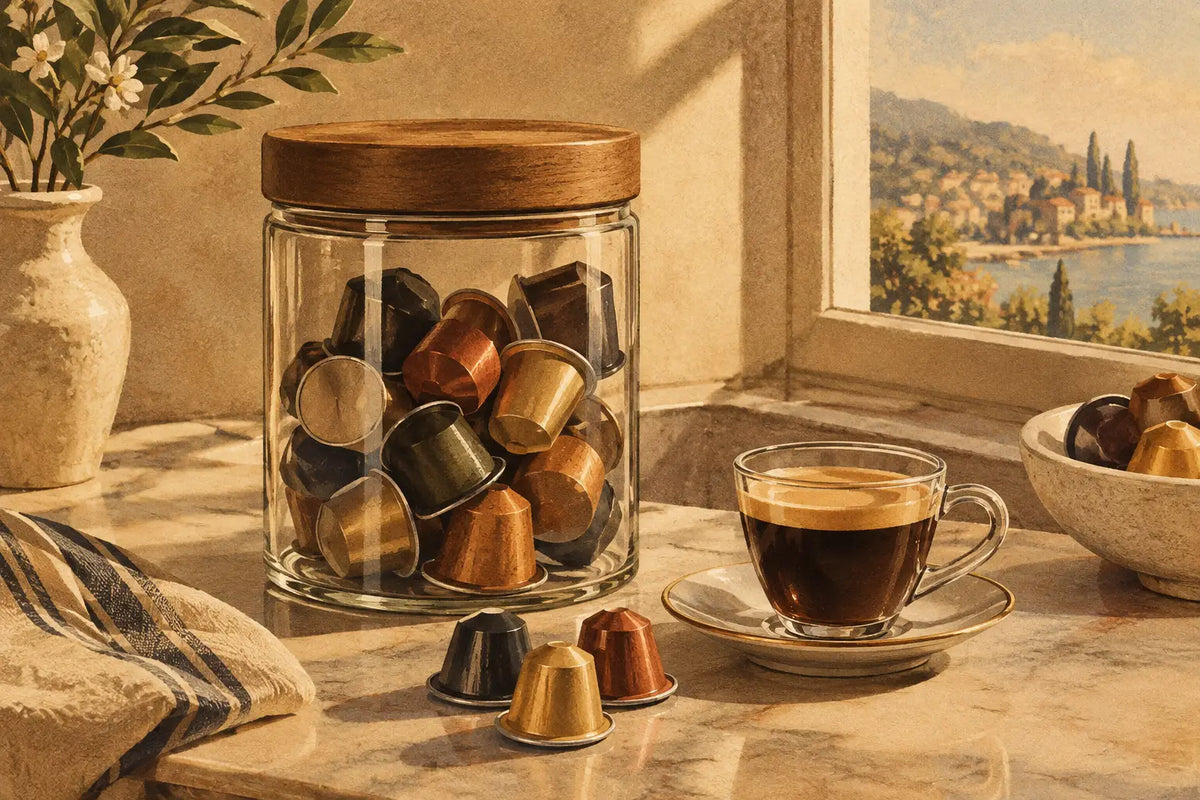
A capsule machine is fast. The coffee inside deserves a little more care. How do you store coffee capsules so the last capsule in the box tastes just as convincing as the first? Not in the fridge, not loose next to the stove, and not for weeks in an open dish on the counter. Freshness depends less on a pretty capsule holder than on three down-to-earth factors: temperature, light and moisture.
Capsules are built to protect a measured dose of coffee. Even so, packaging is no licence to leave them anywhere. Heat can flatten flavour faster, moisture is an unnecessary risk, and strong smells never belong near coffee. Store capsules smartly and your morning routine stays simple, giving every espresso, lungo or functional blend the room to do what it was made for.
Store coffee capsules cool, dry and dark
The best spot is usually the least spectacular: a closed drawer, a kitchen cupboard or a pantry, away from heat sources. Think of a place with a stable room temperature, out of direct sunlight. A capsule holder on the counter can look great, but only if it isn't right next to a window, radiator, oven or hob.
Heat is the quiet spoiler. In a sunny kitchen, or on top of a machine that is often warm, capsules get more temperature swings than they need. That doesn't make the coffee unusable from one moment to the next, but it doesn't help the flavour either. Keep a small working stock within reach and let the rest of the box sit cool and dark.
Moisture asks for the same discipline. Don't pick a cupboard right above the kettle, next to the dishwasher or under the sink. Steam and condensation belong with cooking, not with storage. Capsules made largely from coffee, with an organic binder, are best kept simply dry in their original packaging until you need them.
How do you store coffee capsules in a capsule holder?
A capsule holder is fine for capsules you'll drink soon. It isn't a storage vault. If it stands open and in the light, use it as a stylish week's supply, not as months of storage. Top it up from a closed box rather than laying out every capsule at once.
That's extra practical when you keep different flavours or lines at home. Put the capsules you use most at the front and keep spare packs sealed. The choice stays easy without your whole stock ending up in a warm, bright spot.
Mind the material and the location too. A metal rack by the window heats up quickly in the sun. A wooden or closed holder in a cupboard is calmer. The shape of the holder matters less than the surroundings around it.
Leave capsules in their original packaging
The box or sleeve isn't only there for the design. It protects capsules during transport and, at home, against light, dust and unnecessary handling. An opened pack is best closed well or stood upright in a dry, sealed container. That's especially handy in a busy household, where a box otherwise disappears between the crackers, tea and cereal.
Want to sort capsules by roast, intensity or time of day? Use a lidded container and label it with the name or best-before date. That saves you guessing later which capsule is which. It sounds small, but an overview prevents waste — and a capsule you find before its date beats a forgotten stash at the back of the cupboard.
The fridge and freezer: better not
Storing coffee capsules in the fridge sounds logical: cold equals fresh, right? With capsules, that rarely works in your favour. The fridge is humid, smells of everything inside it, and causes temperature differences whenever you take capsules out. Condensation is exactly what you want to avoid.
The freezer isn't a default solution either. Moving capsules again and again from a cold environment into a warm kitchen raises the chance of moisture forming on the outside. Besides, coffee in capsule form doesn't need to be treated as something you freeze for the long term. Buy what you'll drink within a reasonable period and store it steadily in a dry cupboard.
There is one practical exception: an exceptionally warm home during a heatwave, without a cool storage spot. Then a sealed, dry container in the coolest place in the house is still the first choice. A cellar cupboard or an interior cupboard is often enough. The fridge stays a last resort, not the ideal default.
Avoid odours, bustle and loose capsules
Coffee has a pronounced character of its own, but that doesn't make it immune to its surroundings. Don't put capsules next to strongly scented products like cleaning agents, spices or scented candles. With well-sealed capsules the risk is limited, but there's nothing to gain by parking your stock next to lemon spray or onions.
Loose capsules in a cluttered drawer aren't ideal either. They can get damaged, dusty or sit too long in an unfavourable spot. A capsule with a dent, crack or visible deformation is better left unused. Especially when the seal looks damaged, replacing it is wiser than hoping the extraction goes well.
A storage container also helps against another problem: changing temperatures. Kitchens shift quickly during cooking, baking and washing up. In a closed cupboard on the other side of the room, your stock stays out of that bustle. Simple, but effective.
Look at the best-before date, not the purchase date
Capsules are often bought several boxes at a time. Especially with a subscription that's handy: less thinking, always stock. Store new packs at the back and use first what's already open or closest to its best-before date. This principle is called first in, first out, but at home you don't need to turn it into a warehouse. One quick check as you put things away is enough.
The date isn't a dramatic deadline at which coffee suddenly changes. It's the period within which the maker can guarantee quality under normal storage conditions. If a capsule has sat for months on a hot windowsill, the date says less than when the same capsule has been kept cool and dry.
So don't automatically buy the biggest supply just because it fits in a cupboard. How much you need depends on your consumption, the space you have and how often you like to switch blend. For a household that drinks several coffees a day, a larger stock can make sense. Drink mostly at the weekend, or like trying new flavours? Then smaller and fresher is often smarter.
Storing and discarding are two different moments
Store unused capsules dry and sealed. The waste question only comes after use. A Q cup is fully compostable. That's about the material: it's made to break down in composting, together with the coffee grounds. Whether it actually ends up there is a separate question — Dutch waste processing isn't yet equipped for compostable capsules. That sits with municipalities and their waste processors, not with the material. So check your municipality's waste guide and follow what it says.
That distinction matters. Research by Wageningen University & Research from 2023 shows that compostable capsules can be roughly fully circular when they are actually composted. Aluminium scores around 48 percent in that study, 61 percent in the most favourable scenario, and conventional plastic capsules around 23 percent. The figures are about what happens to the material after use, not about how you keep a capsule in your kitchen cupboard. But they do make clear why the right waste route is part of a well-considered coffee routine.
Q Drinks capsules are compatible with Nespresso* Original machines and made mostly from coffee, with an organic binder. Store them like any quality capsule: cool, dry, dark and away from strong smells. After that, your municipality's waste guide decides where they belong.
Three signs your storage spot could be better
You don't need a thermometer beside your capsule holder. Just look at the situation. Is the stock in direct sunlight? Move it. Does the spot often feel warm after cooking? Pick another cupboard. Have open boxes sat for months among all kinds of kitchen bits? Bundle them into a sealed container.
The best capsule storage isn't complicated, and it isn't Instagram-worthy either. It's a calm, dry place where your stock stays easy to oversee. Then the choice stays simple every morning: grab a capsule, switch the machine on, get on with your day. Don't just drink. Think.