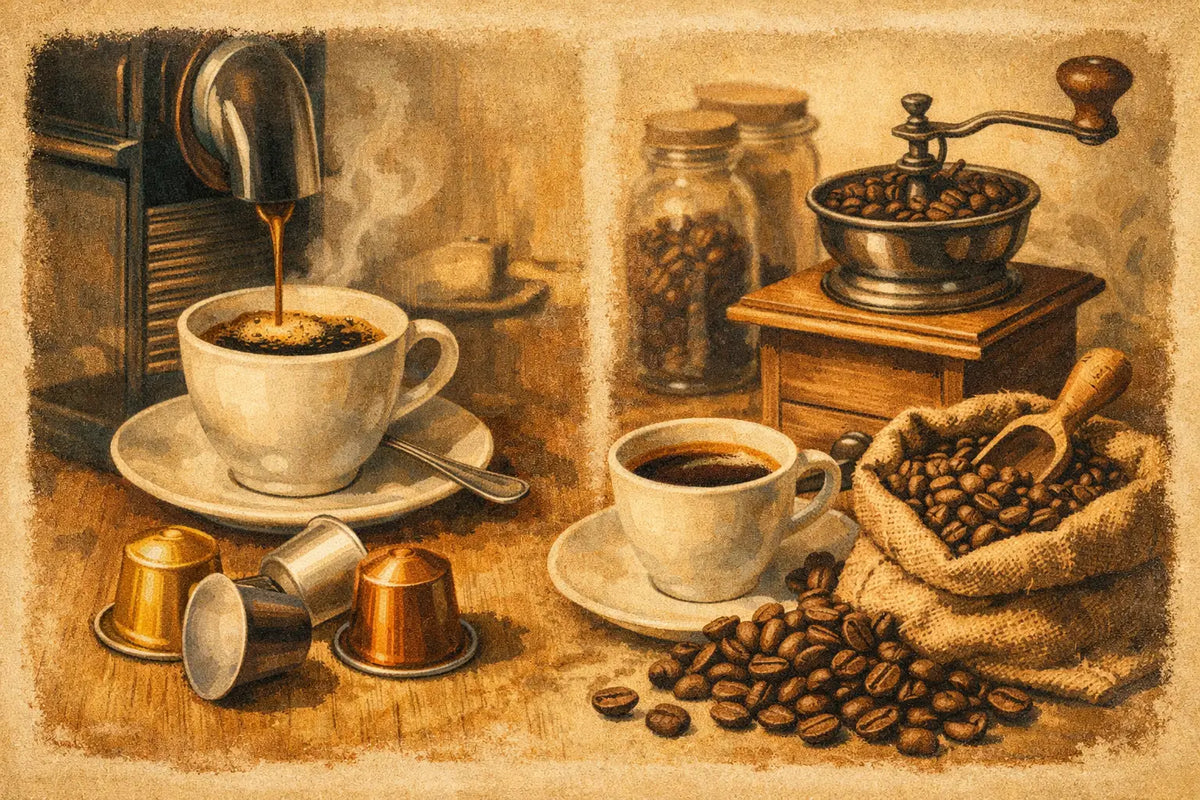

You slot in a capsule, press espresso and toss it afterwards. The difference sits precisely in that last moment. A bio-based coffee capsules review shouldn't be only about taste, then. Material, machine behaviour, the waste route and the convenience on a Monday morning count just as much.
Capsule coffee has never been complicated. The category simply changed remarkably little: coffee in a shell of aluminium or conventional plastic, a quick cup, a full bin. Bio-based capsules make a different choice possible, but that choice deserves more than a green label and a nice story. Here's what to look for before you switch.
What does bio-based mean for coffee capsules?
Bio-based says something about the origin of the material. It doesn't automatically mean a capsule is fully compostable, nor that every waste stream can handle it. That nuance is essential.
At Q Drinks, the capsule is made from coffee - coffee chaff - and a bio-based binder. The capsule is therefore made largely from coffee, but not exclusively. That isn't a detail for an ingredient list. It determines how you process the capsule after use and how honest the material claim is.
The appeal isn't in an abstract sustainability story. It's in a visible design choice: the packaging of your coffee doesn't have to be separate from what's inside it. The capsule is made to brew coffee, not to stay in circulation as material for decades.
Bio-based coffee capsules review: the four real tests
A good capsule has to convince at four moments: when you pick it up, when the machine pierces it, when you drink and when you clear up. If it falls short at one of those moments, a strong claim on paper counts for little.
1. Does it work in your machine?
For households with a Nespresso Original machine, compatibility is the first hurdle. Not as a marketing term, but practically. Does the capsule fit the holder? Does the machine close normally? Does the coffee flow evenly? And is there no mess left in the brew group after use?
A capsule can look innovative and still be awkward if it doesn't brew consistently. That's a risk no one wants to take for the first coffee of the day. So look for explicit compatibility with your system, not a vague mention like "suitable for capsule machines". Nespresso Original is a specific format, with specific expectations around dimensions, piercing and extraction.
Machine compatibility also ties in with how you drink your coffee. For a short espresso, concentration leads. For a lungo, a controlled flow matters more, because too much water can quickly thin a Roast. A capsule that performs predictably in both situations deserves attention.
2. Does taste stay central?
Material is only progress if the coffee itself holds up. Bio-based coffee capsules shouldn't be judged as if taste were a bonus. It's the foundation.
Pay less attention to broad words like "premium" and more to concrete information: the Roast, Origins, Intensity and the recommended brew volume. That tells you more about what ends up in your cup. A dark Roast can work well with milk, but isn't better by definition. A lighter or medium Roast can add more layering if you drink it black, but also calls for careful extraction.
Freshness plays a part too. Capsules protect ground coffee from air and light, but the way a brand roasts, fills and packs it remains decisive. Don't expect an identical experience between a 40 ml espresso and a 110 ml lungo. That isn't a shortcoming, simply a different preparation. The relevant question is whether the capsule does what the chosen profile promises.
For anyone who switches at home between regular coffee and functional capsule drinks, there's something extra: judge each product on its own moment. Not everyone wants the same taste, intensity or routine after lunch as at 7.30 a.m. A range with clear choices works better than one capsule trying to be everything.
3. Is compostable also practical?
Here a lot of language gets used loosely. Compostable doesn't mean: throw it anywhere and you're done. In the Netherlands, fully compostable capsules can in principle go in the organic waste (GFT) bin, but not every municipality accepts coffee capsules in that stream. So always check your local waste guide. It takes a minute and prevents a well-designed capsule from ending up in residual waste after all.
That local limitation doesn't make compostability less relevant. It only makes the choice less black and white. Aluminium capsules need collection and recycling to recover material. Conventional plastic capsules have their own waste route. A capsule that can compost offers a different end destination, provided municipal processing accepts it.
Wageningen University & Research's figures show why processing matters. In a 2023 study, a compostable capsule, when actually composted, reached roughly 100% circularity. Aluminium came out at around 48% on average, and conventional plastic at around 23%. No free pass, but a clear distinction: the material alone isn't enough. The route after use also shapes the outcome.
4. Does the capsule fit your real life?
Sustainable behaviour often fails on friction, not intention. If capsules have to be stored separately, dropped off, rinsed or collected until you finally do something with them, the good intention usually disappears between two busy workdays.
That's why convenience isn't a shallow criterion. A capsule that works in your existing Nespresso* Original machine and - where allowed - fits the organic waste (GFT) stream keeps the routine compact. No new machine. No separate ritual alongside your coffee ritual. That makes the choice more realistic for a shared household, a small office or a schedule that's already full enough.
An online subscription can fit that well, as long as it stays flexible. Coffee use isn't the same every month. Holidays, working from home, visitors and a new preference for espresso over lungo all change your pace. Pausing or adjusting should then be as easy as ordering. Convenience without lock-in feels different - and better.
Where you're allowed to stay critical
Bio-based isn't a quality stamp that removes every question. Look at the full product information. Is it clearly explained what the capsule is made of? Does it state concretely which system it's compatible with? Are the Roast and the moment of use clearly described? And is composting linked to the reality of local organic (GFT) collection?
Be alert too to the temptation to play material and taste off against each other. You don't have to accept mediocre coffee because the capsule has a better story. Conversely, a tasty capsule shouldn't get a free pass if the packaging has no convincing route after use. It's precisely the combination that sets the bar.
For some people, aluminium with a consistent collection point remains a workable choice. For others, a compostable capsule makes more sense, especially if the municipality accepts it in organic waste. It depends on your machine, your local processing and how you drink coffee day to day. An honest comparison starts with those circumstances, not with absolute slogans.
The verdict that matters
A strong bio-based coffee capsule proves itself not with big words, but with small moments that add up. It fits the machine without protest. It brews coffee you want to drink again. It tells you clearly what's inside. And it lets you know afterwards what you can responsibly do with it.
If you want to take one step, don't start with the label on the box. Look in your kitchen: which system do you use, how many capsules go through it and what's allowed in your local organic (GFT) bin? From there, choosing becomes surprisingly simple. Don't just drink. Think.